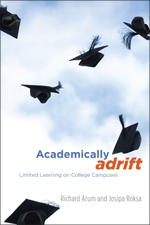
Come Sail Away

A profound sadness accompanied my reading of Academically Adrift: Limited Learning on College Campuses, by Richard Arum and Josipa Roksa. I mentioned this study when it was highlighted in the Chronicle of Higher Education a couple months back, and have just finished reading it. My sadness stems from having been told from my earliest years that I was a natural teacher, but having fallen victim to statistics. Higher education, Arum and Roksa assert, no longer considers undergraduate education to be its highest priority. This is statistically borne out. Often it is because colleges and universities no longer have the will or incentive to retain committed educators. Concerned parents sometimes ask me what’s wrong with the system. Truth is, I worked hard on my teaching only to be forced out—I simply don’t know. A large part of it, I believe, is that in the 1970’s the US government instituted changes in higher education policy to advantage freer market forces (i.e., capitalism). Our educational institutions have been on the decline ever since.

Not being a sociologist, I can’t assess all the data presented in Academically Adrift, but the portrait painted is a disheartening one. Middle class and working class people pay enormous amounts to send their kids to college. The majority of students do not learn much in the way of critical thinking when they are there. It became clear, however, that one thing higher education does not erase is class distinctions. The findings seem to indicate that, if anything, college deepens the rift. Those colonists who long ago fled the tyranny of the crown replicated their own version of a caste system in their new nation. I have not been the only one to notice that those of us who grew up in very humble circumstances just don’t stand a chance of earning credibility in academia’s elitist eyes. Our only hope is education—precisely what many college students are not getting for their parents’ money.

My critique of higher education is accompanied by just a small morsel of hope. I cherish every school I’ve had the privilege to teach in, save one. In each classroom I found some students who were eager to learn, some of whom would become friends. Education is pointless if it doesn’t make life better for people. We could be starving dogs growling for the same bone (just like capitalists) living in a junk yard or a desert. Education alone holds the promise of lifting us out from our bestial predilections. With its Midas touch, however, the free market has transformed higher education into a money-making venture eviscerated of its very soul. Unless our society can learn once again to support education for its own sake—the sake of improving our lives instead of improving the bottom line for the top one percent—we will find ourselves back in our caves scratching the fleas from our unwashed bodies. Of course, at least the one-percenters will have plenty of cronies standing in line to scratch their noble backs even then.

Rule Britannia

Being back in Britain serves as a constant reminder of how conspicuous consumption has come to be a hallmark of American culture. When my wife and I moved to Britain back in the 1980s we soon became acclimated to the shift in scales to a size that seemed much more within our grasp. Yes, civilized people could live without undue excess and still be quite happy. Living in the States swiftly eroded the confidence that less is enough. Those who do not climb die. Back in Britain, there is evidence that the unabashed capitalism is spreading like a poison through this nation as well. Too readily the draw of gain and personal comfort outstrip our concern for other people. On a whole, however, the ideals of a society where all have health care and the elderly are not simply forgotten still remains intact.

Perhaps it is the benefit of having once been an empire that spanned the globe, or perhaps it is a hangover from having borne the burden of monarchy and a stratified society where noblesse oblige ensures that those below are not left behind. Not that such a system is without its faults. A century ago Titanic was setting forth from these ports and sank with the humble classes going first. Such tragedies show that even where noble ideas hold sway, the inexorable draw of evolutionary development will favor those who assert themselves. The monkey on top when the ship sinks gets to draw the last breath.

Back in my Nashotah House days I used to have recurring nightmares of sinking ships. In our attempts to extend mastery over the largest environment on our planet, the one in which we cannot survive, we face an uncomfortable reality. Even if those whose names still register a nod of recognition are those who had amassed the most wealth, they are equally as deceased when the hull strikes the Atlantic floor. Is it such a difficult matter to make sure that everyone has enough before allowing those enamored of wealth to accumulate superfluous amounts of it? When the ship sinks, those with the wealth to buy themselves extra minutes may have time to think. And if those thoughts are honest, they will realize that the cost has been too great all long.


Religious Capital

Eric Weiner’s book, Man Seeks God, surely received a boost with an article in Sunday papers (originally written for the Los Angeles Times). In this piece, Weiner comments on the American fluidity of religion, how people pick and choose the spirituality that works for them. His observations are based on the results of a Pew Trust study that indicates about a third of Americans change their religion during their lifetimes. This is a departure from the age-old tradition of being born into a religion, something that still seems to apply to two-thirds of the American population. In his article Weiner suggests this is not entirely a bad thing, since people are consciously deciding on that to which they will commit themselves. I haven’t yet read Weiner’s book, but the situation described here has a potent underlying implication.

Religions tend to make claims based on certitudes and assertions of absolute truth. When religion becomes merely a matter of choice, has it not lost its very foundation? This may not be a bad thing, but it does change completely the essence of religion. No longer can religion be considered an inviolable truth handed down from on high if the truth is a matter of choice. Or, more troubling, perhaps we no longer seek truth. In a population based on personal satisfaction, religion becomes an extension of personal comfort. In a society where non-faith is suspect (most atheists still complain of being considered “evil” for their non-belief), people need to believe something—anything. We can’t test the truth in any empirical way, so we all have to admit to some guessing. When born into a religion, questioning is a sign of doubt. When shopping for a religion, questioning is a smart economics. Does this religion work for me? Is there one that suits me better? Is it worth the extra costs?

The center of focus has shifted from seeking the one, unwavering truth that is beyond us to seeking a belief that we can stomach. Religion is a commodity. Perhaps this development is inevitable in any society so dedicated to the free market that even common decency is labeled socialism. Is it possible for people who constantly think in terms of supply and demand to understand an absolute in one tiny sector of their lives? Choice becomes an all-or-nothing proposition. Its pragmatism indicates its origins. When people can choose a religion without consequences, it should be obvious that this is a human construct. Instead, we want to believe that our religion is the right one because that’s the way we like it. Perhaps the question we should be asking is whether our lifestyle is authentic or simply a fabrication made to suit our wishes. Our treatment of religion as a product to purchase and use reveals more about what we believe than does any creed.


Retrograde Hollow-days

Surrounded by the intoxicatingly ebullient aroma of balsam, it is difficult to believe that it is not yet Christmas. As 4-Hers decorate their wreathes, in November, I recall that the first signs of Christmas appeared in the stores before its unexpected cousin Halloween this year. In fact, stores hawking Christmas remain open year round. This retrograde motion of the holidays in time belies the very concept of the “holy day.” Ancients, and not-so-ancients, believed that there actually was something different about particular days. The trimmings and the trappings were secondary to the point of the day; something momentous had transpired on this very day, making it unlike any other. With the advent of industrialization and its unrelenting work ethic, holidays came to represent a kind of mini-exodus, a release from labor that falls outside the insufficient weekend. Leisure time encourages shopping. A modern holiday is born.

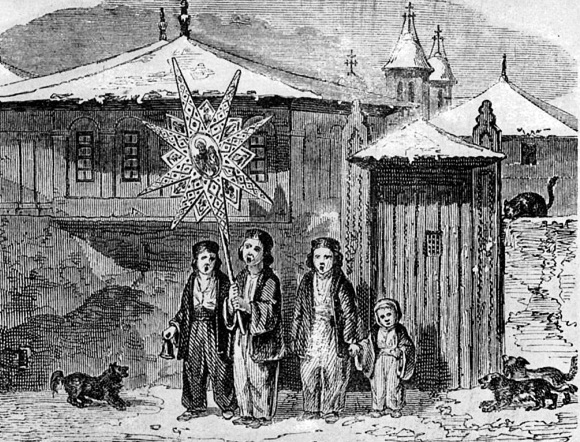
A child's Christmas in Bucharest

The increase in labor-saving devices has placed us in a twilight of leisure. Holidays can be anticipated many months in advance—gifts purchased earlier and earlier, until the holiday itself seems to pale by comparison. Moving retrograde into other seasons. The joys of the consumer holiday are hollow. It is too easily forgotten that money is a symbol, a mere medium of exchange. It has become an end in itself. Just two centuries ago nobody would have dreamed of collecting the symbolic patina of a capitalist system for a profession. Now accounting may lead to great wealth. The wealth, however, is transparent. Millionaires, like emperors, are disinclined to have the fact that their clothes are immaterial pointed out. They are, after all, where we want to be. Let the one with no dreams pop the first seam.

Holidays have the capacity to give symbolic meaning to life. They emphasize the cycles of nature and of life itself: birth, procreation, death. Removed from context, however, they lose their meaning and become just another excuse to spend too much, eat too much, drink too much. We call it celebrating. Those on the receiving end of the cash flow have the most to gain by promoting such hollow-days. Nothing is so easily exploited as child-like anticipation. The scent of balsam takes me back to a far-distant childhood this November night. The memories, no matter how dysfunctional the setting, are serene and full of anticipation. The symbolism suggests this may not be vanity after all. Until the bank statement comes, and the hollow-days begin all over again.


Mere Typography

Juxtapositions are important. The way that words are laid out on a page can say as much as the words themselves, as any poet knows. In the light of the ongoing media frenzy over Rev. Terry Jones’ misguided attempt to set everything right with the world – through fire – and a natural attempt to keep related stories together, the New Jersey Star-Ledger ran two stories on page three yesterday that display the deep ambivalence many Americans feel about Islamic culture. At the top of the page the headline reads, “In Florida pastor’s eyes, burning of Quran is an act of war against evil.” At the bottom of the same page runs an article headlined, “Iran: Stoning sentence for adultery under review.” Two or more faces of Islamophobia on the same page.

As remarks made on my previous post on the subject attest, many westerners simply do not understand Islam. This is perhaps to be blamed on the all-too-prevalent attitude that “history is boring.” Have people been asleep for the past thirteen centuries? Islam is much closer in time to the origin of Christianity than it is to us. With concerns of supersessionism and the covert desire to capitalize on one’s religion, Christianity has been content to ignore Islam as long as those in charge have been able to maintain capitalist quo. When forced to face the fact that two major monotheistic religions have designs on the same world, some members of each camp are only too ready to declare those in the other “evil.” An attempt to understand other religions would go a long way toward ending the carnage.

Perhaps the phobia should more properly be labeled religious xenophobia. We dislike those different from us. Rare is the person who, when confronted with a contrarian, will attempt to understand rather than destroy. Students may readily qualify for higher education degrees without ever having to face the question of how to handle different religious outlooks. We would rather pretend that they are not there. The ambivalence shown towards the issues of Islam in the Star-Ledger could just as easily be turned on Christianity, or even Judaism, Hinduism, Buddhism, or Sikhism. Religions are conflicted because people are conflicted. Instead of recriminating, we should all take a long, serious pause in front of a mirror before we start accusing other religions of being evil.

Who said what now?