
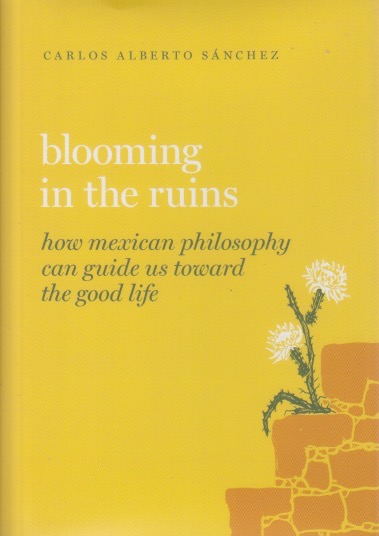
Once upon a time, I applied for a teaching post at Syracuse University. (Actually, twice upon a time, but that’s a longer story.) I was able to gather that one reason I failed to merit an interview was that the religion department prided itself on its dedication to continental philosophy. Lacking imagination, I couldn’t see how that might apply to teaching Hebrew Bible but then again, I don’t know much. I’m starting off with than anecdote because it is in keeping with the spirit of Carlos Alberto Sánchez’s excellent Blooming in the Ruins: How Mexican Philosophy Can Guide Us toward the Good Life. I recently wrote about how reading philosophy is something I enjoy when I can find the time, but what really struck me about this book is that Mexican philosophy is a counter to continental (i.e., European) philosophy and it is much closer to my own outlook. I’m not in any danger of being offered a new job so it’s safe to say so.
I actually picked up a copy of Sánchez’s book because of a chapter that I’d read. Much of the work begins with anecdotal accounts, followed on by something original, amplified, and solid (you’ll need to read the book to flesh that out). Mexican philosophy rejects the idea of universals because each of us is socially located. What may have seemed universal to European philosophers of the seventeenth through the nineteenth centuries, many of them quite privileged, simply doesn’t apply to a person raised poor in Mexico. (Or Pennsylvania, for that matter.) I read the continental philosophers in school, but they had not had my experiences. My traumas. And yes, Sánchez emphasizes that trauma is part of the picture.
While I can’t summarize this wonderful little book here, I can recommend it. If you have an interest in the larger questions, and if you want some philosophy that doesn’t try to impress you with big words and complex grammatical formulations, this may be for you. Sánchez writes as if he’d be willing to sit down with you and discuss the matters that make life worth talking about. The chapter that sold me on his book was the one on the Mexican view of death. It is only one of several that deserve a bit of your time to chew over. So I was not welcome among those who specialize in continental philosophy. Maybe I was looking in the wrong place. Maybe those who are open to homegrown thinkers of sometimes deep thoughts live south of the border.
 Steve A. Wiggins