Finally, Therapy

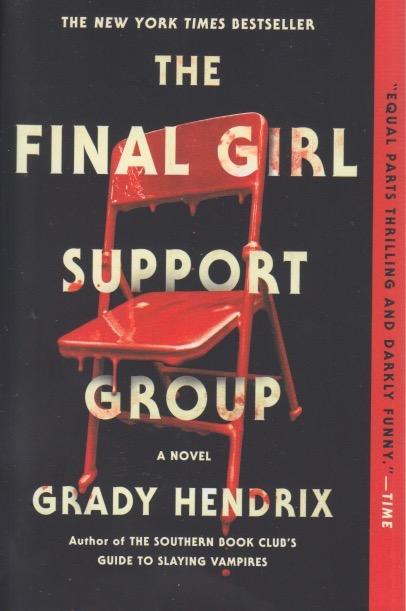
Like religion and horror, humor and horror can also get along well.  As an aesthetic, it’s not for everyone, but Grady Hendrix does it well.  It took some convincing for me to read The Final Girl Support Group.  I’d read one of Hendrix’s nonfiction books and was impressed, and that led me to his fiction.  It also demonstrates how an academic might actually be able to make a difference.  As you might guess, the novel features “final girls” from several fictional events, made into fictional movies, who get together for therapy.  It’s a funny idea and yet it’s not.  Hendrix clearly wants women to be treated fairly, but he’s also clearly a horror fan.  It’s sometimes a tricky balance to hold.  He does it pretty well in this novel.

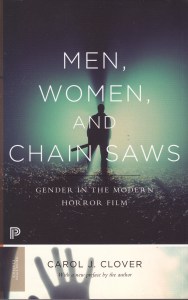
The idea of a “final girl” comes from Carol Clover’s crossover academic book, Men, Women and Chain Saws.  This is the book that introduced the concept to the world.  As with most analytic concepts it’s only an approximation.  Clover noted the way that, in slasher films, the only survivor tends to be the virginal girl who doesn’t join in substance abuse.  Since the slasher genre is usually first credited to John Carpenter’s Halloween (Hendrix suggests in his acknowledgments that it’s Psycho), I’ve always wondered because Laurie Strode does take a toke in the car and we’re not really told much about her dating life.  I’m not a big fan of sequels, so maybe I’m missing something.  In any case, slashers have never been my favorites, and as sexist as it might sound, Poe’s observation about threats to beautiful women is something the “final girl” relies heavily upon.

The novel itself is pretty gripping.  I’m not going to put any spoilers here.  I was reluctant to read it but I’m glad that I did.  It’s classed as “horror” because of the theme but there’s definitely a lot of literary finesse as well.  It’s the kind of thing that doesn’t really seem to be deep, but upon reflection, it has more to say than you think it does.  The resolution of the novel is messy.  I suppose that’s one thing that makes it literary.  The characterization is amazing well done.  I had trouble keeping track of the back stories of all the final girls but that’s part of the fun.  While there are definitely horror moments, Hendrix never lets you forget that you are supposed to be laughing too.  It’s a fine balance and he manages to hold it together throughout while giving agency to final girls.

Updates

So, I’m getting ready to update this website. I’ll give you a warning before things change. Another update, however, is in order. I’ve been promising that I’d let you know when my forthcoming book with McFarland received its final title. Well, drum roll please! The final title is actually the first title I proposed—Holy Horror: The Bible and Fear in Movies. And it has an ISBN: 978-1-4766-7466-7. And a cover design too, but I can’t share that just yet. It is appropriately lurid, matching the subject. But in all seriousness, the book makes a case for the fact that many people understand their religion via popular media. Being a bad boy, I look at it through horror movies.

The title Holy Horror was a play on Douglas Cowan’s excellent book, Sacred Terror. I recall reading that book, starting the night I bought it as SBL, curled up in the swank conference hotel bed, turning pages until I couldn’t hold my eyes open any longer. It had honestly never occurred to me that religion scholars could get away with writing about horror movies. Cowan had the natural advantage of being a Canadian, something I’ve always longed to be. He also has a secure university post. I was, at the time, just a guy trying to feel secure in what seemed like (and turned out in reality to be) a threatening seminary position that was shortly to end.

It may be difficult to understand how horror can be consoling. It can. I’m a squeamish guy. I don’t like blood and gore. I hate being startled. Nevertheless, I took comfort in this genre as my career was falling apart. Holy Horror was a cathartic book for me to write. There’s more than a little metaphor in it. One thing that will become clear to readers is that the Bible is no stranger to horror movies. Ironically, many of them are strangely conservative—Carol J. Clover’s classic Men, Women, and Chainsaws (which I’ve reviewed on this blog) made that point clearly. Horror often has the same message as your typical Disney film, although it’s presently slightly differently. How so? Well, I can’t say very much here or you’ll have no reason to read my book. McFarland does a great job with publishing this kind of title. You won’t find it in Barnes and Noble, and not likely in your local indie either, but it’ll be available on Amazon and these days that’s enough. And before long these pages will change to reflect its coming.


Engendering Fear

menwomenchainsawWe live in fear. At this point in history, it seems, with good reason. Horror films, apart from being considered low art, teach us to deal with some of these fears. I hadn’t been reading about the genre for very long before I began to notice the repeated references to Men, Women, and Chainsaws: Gender in the Modern Horror Film. This is Carol J. Clover’s seminal study of gender theory and horror. Probably best known for first identifying the trope of “the final girl,” Clover gives much more than that to the conscientious reader. Her chapter on possession movies is among the most insightful that I’ve read. And yes, she does make a very good case for the final girl.

Using theories of gender, she explores why both boys and girls (the former numerically more obvious) flock to such disturbing movies. Although she suggests masochism has something to do with it, is isn’t simply that boys enjoy seeing girls suffer. Quite the opposite. Boys often see themselves in the place of female victims. As with most things associated with gender, it’s far more complicated than it seems. In that sense, this is a book for our time. We live in what George Banks calls “the age of men,” and while Mary Poppins can hardly be called horror, the underlying narrative bears some warning tones. Men, left to their own devices, will seize what power they can grasp. We’ve spent the last five decades teaching men that this is no longer appropriate, only to have that message wiped away with the final trump. Horror can be remarkably pro-feminine. Business, as we’ve seen over and over, is less so.

Not having ever formally studied gender theory, some of the intricacies of Clover’s argumentation were no doubt lost on me. I was, however, able to gather a remarkable amount of appreciation for the subtexts in many of the movies I’ve watched. Gender, you see, touches everything we do. It behooves us to be aware that careless, or thoughtless support of misogyny does not lead to the results that many men suppose. Some horror movies are truly difficult to watch. Not all conform to the standard expectations. What Clover has shown, however, is that often the women are able to draw from a depth of strength to which the male characters lack access. They don’t do so willingly. In fact, they are often reluctant. When the horror is at its end, however, the final girl emerges triumphant.