Cat Curse

In researching Sleepy Hollow as American Myth, I watched every feature-length movie of “The Legend of Sleepy Hollow” that still exists.  I also watched many other productions, based, however loosely, on the Legend.  I was unaware that The Curse of the Cat People should’ve been included.  There is no database of all cultural references to Sleepy Hollow, and although Curse of the Cat People has many fans, nobody advertises it as related to the Legend.  But it is.  I happened to watch this 1944 film because I’d been thinking about Cat People.  My jaw dropped when the film opened with a teacher taking her children on a walk and explaining that this was Sleepy Hollow.  My book had been published just last month and I was discovering new material!  The movie is a bit disjointed, apparently because studio executives wanted new material added and some of the edited pieces explaining the story were lost.  Still, it is well worth seeing.
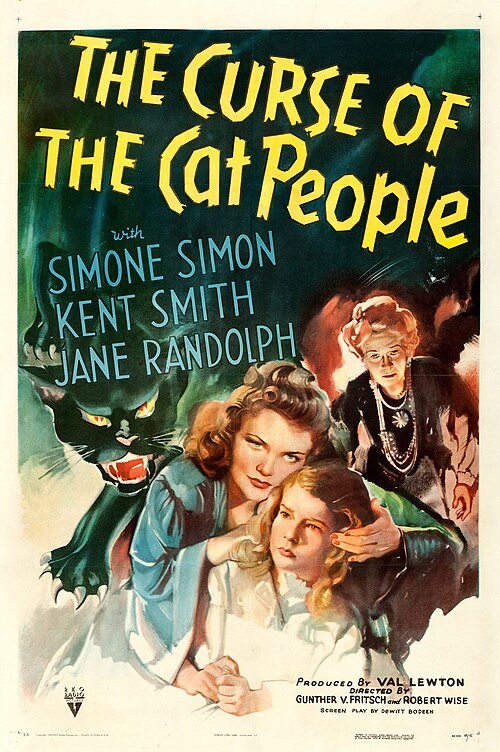
Six-year-old Amy Reed has no friends.  A daydreamer who has a rich fantasy life, she frightens her father, Oliver, who had been married to Irena—one of the cat people.  Oliver never believed Irena was really a cat person and is afraid his daughter is suffering under similar delusions.  This is because Amy is given a ring that grants wishes by an old widow who tells her a version of the Legend of Sleepy Hollow.  The wish Amy makes is for a friend and Irena, the ghost of her father’s first wife, shows up.  There are no cat transformations here, but there is a great deal of psychological subtlety.  Is Amy really seeing Irena or is her loneliness filling in the voids in her life—her father is distant and refuses to accept what his daughter tells him. Instead he punishes her for it.

When Amy gets lost on Christmas Eve, Irena saves her from the murderous daughter of the widow who gave her the ring.  It’s clear that some of the connective tissue is missing, but the story is sincere and smart, even if only very loosely a sequel.  The story of the headless horseman, pre-Disney for those of you who’ve read my book, presents the horseman as collecting unwary wanders on the bridge and compelling them to ride with him.  He’s not after anybody’s head.  Indeed, this is the way he’s described in Irving’s story.  Just as I’ve begun collecting films for Holy Sequel, it looks like I should begin keeping a list for Sleepy Hollow as American SequelCurse of the Cat People will be first on the list.

Leopard Spots

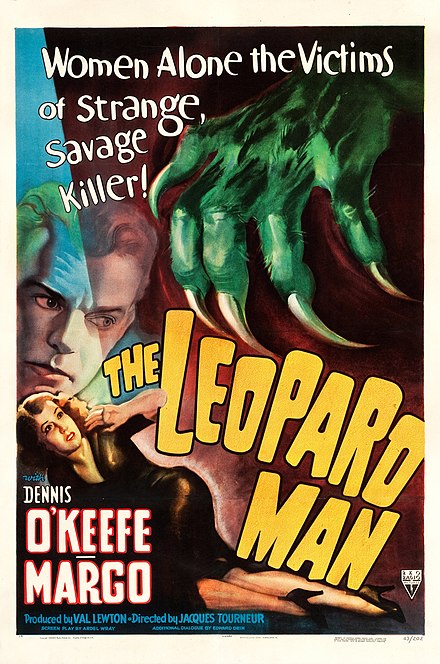
There’s always a dilemma involved.  Rent or buy?  Libraries face this when deciding on a subscription or perpetual access deal—is this something you’ll need for a long time?  More than once?  So also with movies.  Do you rent, watch, and forget or buy, supposing you’ll need to go back?  This plays out in my head when there’s a movie I want to see in these days of streaming.  The Leopard Man wasn’t a big hit when it came out in 1943.  There wasn’t really much of a taste for horror during the Second World War anyway.  In retrospect, however, it’s one of those films that has appreciated with age.  Apart from its effective use of the Lewton bus, the movie was well written.  It retains ambiguity and suspense throughout.  And if there is a leopard man who shapeshifts, we never see him doing it.  Spoilers follow!

Following on from his better known Cat People the previous year, Jacques Tourneur kept with the large cat theme in this film.  A publicist who (apparently) has no scruples, encourages his client/girlfriend to upstage a fellow performer by taking a leopard into her act.  The stunt backfires, however, when the frightened cat escapes.  Then mauled women are found and a hunt is on for the leopard.  If you’re adept at this kind of set-up you’ll figure out who the killer is—it’s not the leopard, except in the first case.  It’s implied that, rather like Cat People, the religion of the ancients, as Dr. Galbraith points out, might have some effect on modern people.  His dispassionate remarks about serial killers provides a clue, however, to who’s really behind it.

Religion runs like a thread throughout the movie.  The processions intended to alleviate the guilt for the treatment of the Indians, the ancient religion of those who made the museum pieces, and the Catholicism of the locals all play a part in this.  The question of whether Galbraith really becomes a leopard or not remains unanswered, but I sense it’s strongly implied that he does.  He had no intention of murdering the young woman in the cemetery and certainly had no time to premeditate the carrying of leopard hairs and claws to cover his tracks.  This is a man of science caught up in the spell of a forgotten religion.  Or so it seems to me.  In any case, it’s time to dust off this old gem and bring it back to the light.  It’s probably worth buying just to see it again.


Cat Nipped

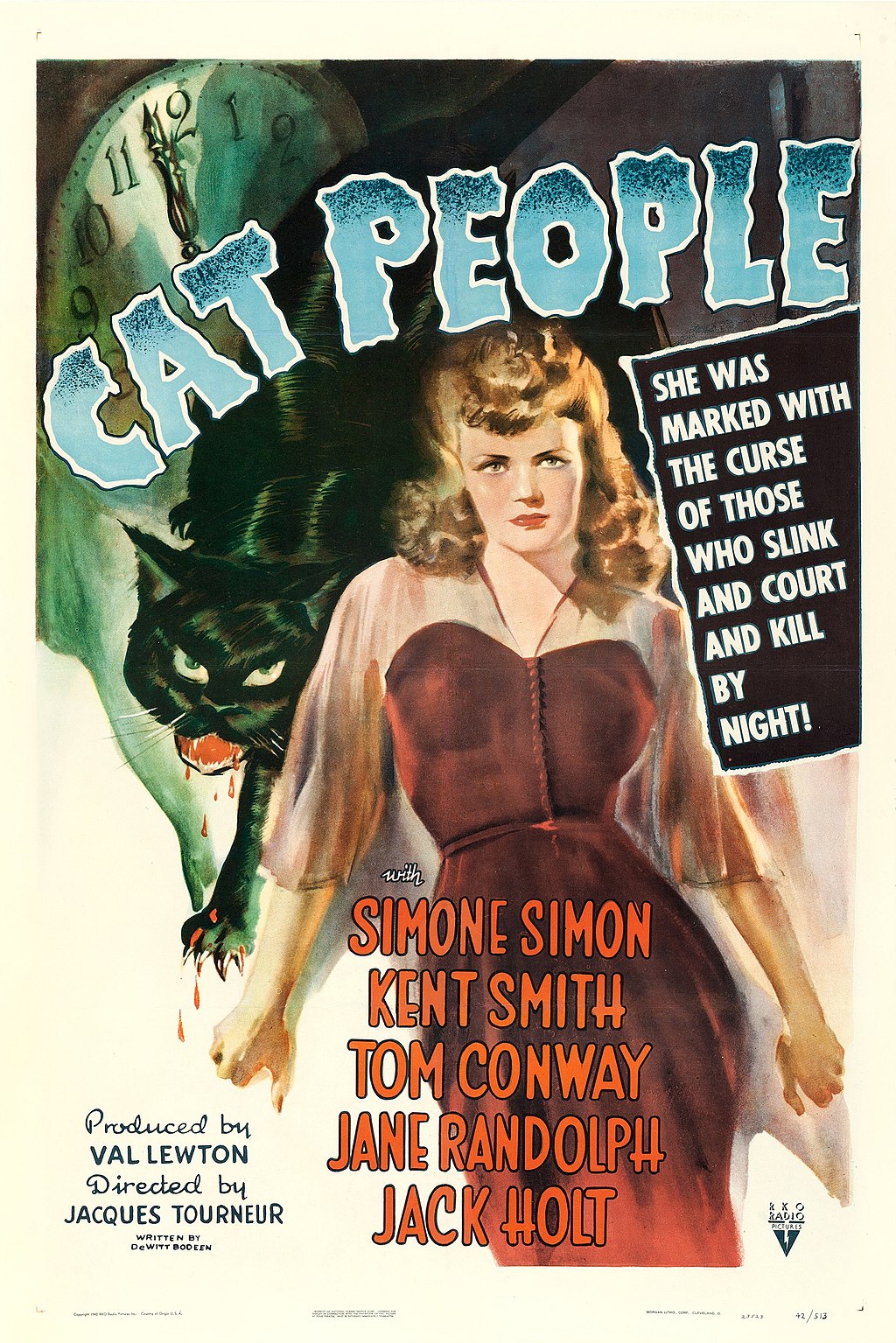
Holy Horror began with movies from 1960 on.  You see, I had watched the 1982 remake of Cat People without ever watching the original from 1942.  The remake has Paul Gallier, the brother of Irena, as a religious leader.  He doesn’t cite the Bible, so the movie fell outside the limits I set for that particular book.  I recently watched the 40-year older original version and was surprised to find not only the religion intact, but also the Bible as part of the story.  Both versions integrate religion and horror and some of the scenes are very close between the two.  The original centers around Irena Dubrovna, a Serbian immigrant.  In addition to originating the The Lewton Bus technique, the film also introduced a religious origin for the horror.  When Irena meets Oliver Reed, she explains to him that in Serbia, in her home village, some witches were driven out into the woods of the surrounding mountains by the Christians.  There they formulated a curse leading to becoming cat people when aroused.

Irena, fearing sexual arousal, spends time apart from Oliver after they marry, mainly watching the black leopard at the zoo.  One of the custodians warns her it’s an evil animal, a monster as described in the book of Revelation, which he quotes.  Of course, this leopard is an ordinary big cat, and the woman to whom he quotes Scripture is a cat woman.  Irena knows inside that she’s one of the cat people, but nobody will believe her.  The film also makes use of a quote from John Donne regarding sin.  Indeed, the film makes it clear, even after Irena dies, that she had never lied.  While she’s stalking Oliver and Alice in their office one night, Oliver pulls down a T-square, the shadow of which forms a cross on the wall, and he abjures her, in the name of God, to leave them alone.  Religion, the clash of religions, makes the monster.

Cat People, despite having had a mixed reception, was an influential movie.  Like much of early horror, it’s tame by today’s standards.  And yet it’s aged well.  I didn’t expect to be drawn in as much as I ended up being.  After all, I’d seen the remake first.  America at the time had a fear of the Balkan region, where mysterious eastern Europeans still had tales of vampires, werewolves, and cat people.  Of course, the last of these was invented for the film.  The director, writer, and producer wanted to create an intelligent horror film, which they did.  Moody, atmospheric, and based on religious tension, it is worthy of a Holy Horror sequel.