Shaping Halloween

Halloween is the favorite holiday of many.  I suspect the reasons differ widely.  Although the church played a role in the development of this celebration, it didn’t dictate what it was to be about.  It was the day before All Saints Day, which had been moved to November 1 to counter Celtic celebrations of Samhain.  Samhain, as far as we can tell, wasn’t a day to be scared.  It commemorated and placated the dead, but it wasn’t, as it is today, a time for horror movies and the joy of being someone else for a day or a few hours.  There isn’t a preachiness to it.  Halloween is a shapeshifter, and people love it for what it can become.  If December is the month for spending money you haven’t got, October is the month for spooky things.  Halloween is the unofficial kick-off of the holiday season.

For me, it’s a day associated with dress-up and pumpkins.  Both of these bring back powerful childhood memories.  The wonderful aroma of cutting into a ripe pumpkin can take me back to happier times.  I remember dressing up for Halloween as far back as kindergarten.  I could be someone else.  Someone better.  It was a day when transformation was possible.  I’m probably not alone in feeling this, although I’m fairly sure that wasn’t what was behind the early use of disguises this time of year.  I’ve read many histories of Halloween and they have in common the fact that nobody has much certainty about the early days of its inception, so it can be different things for different people.  Even within my lifetime is has moved the needle from spooky to scary, the season of horror movies and very real fear.

There’s a strange comfort in all of this.  A knowledge that if we can make it through tonight tomorrow will be somehow less of an occasion to be afraid.  It is a cathartic buildup of terror, followed by the release of being the final girl, scarred, but surviving.  And people, from childhood on, enjoy controlled scares.  Childhood games from peek-a-boo to hide-and-seek involve small doses of fear followed by relief.  The future of the holiday will be open to further interpretation as well.  As a widespread celebration it is still pretty young.  And like the young it tests its limits and tries new things.  At this point in history it’s settled into the season of frights and fears in the knowledge that it’s all a game.  I wonder, however, if there isn’t some deeper truth if we could just see behind its mask.

Fighting over Chocolate

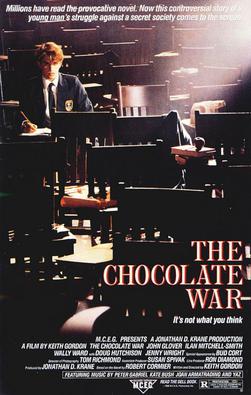
It’s really a teen movie, The Chocolate War is.  That may be the sweet spot for dark academia.  I’m maybe a bit old for such things, but being old tends to mean remembering how it was.  Not exactly how it was, though.  Chocolate War takes place in a Catholic boys school, Trinity by name.  Perpetually underfunded, the students have to sell chocolate (now we’re in territory I recall—remember me, Gertrude?) to help keep it running.  Meanwhile, the Vigils, a secret society, have a considerable amount of pull on campus.  Led by a prescient and overly mature boy for his age, Archie, the Vigils assign select students difficult tasks in a kind of high school hazing.  Jerry, a freshman whose mother recently died, is assigned to refuse to sell chocolates for ten days.  He then decides (for reasons never explained) not to sell them at all.

The refusal leads to a financial crisis for the school.  The Vigils try to force Jerry to sell, engaging in harassment tactics.  Nothing works.  Then Archie coerces him into a “boxing” assembly where students pay to have their specific punches thrown by one of the boys (a bully or Jerry) at the other, who simply has to take it.  Before the match begins, Archie, the Vigils’ leader, is tricked into taking the bully’s place.  Jerry, who’s on the football team, knocks him out, sending some teeth flying (probably why the film got an R rating).  In the end, Archie is demoted, but Jerry realizes that with his refusal to comply, he led to the result he was protesting against (the harassment and boxing match led to selling all the chocolate despite his refusal to participate).

Dated, yes (1988), Dead Poets Society, no.  Still, there’s much to ponder here.  Bullying—used by very high offices in this land—seems to be a growing problem.  And yes, when you get a bunch of adolescent boys together, trouble can arise.  It’s believable.  Although considered a flop, critics were kinder than the box office.  There are dark messages to decode here.  The price of nonconformity—an issue that doesn’t disappear with adulthood—and, perhaps looming larger, its effectiveness.  The teacher temporarily running the school, Brother Leon, is part of the problem, as is often the case in dark academia.  He’s not evil, however.  The film places the abuse of power on Archie, although he doesn’t condone violence.  Ultimately violence is used to unseat him.  With the result that the system (Trinity) prevails nonetheless.  Worth considering.


Uisce Beatha

The idea of a state church, I have to admit, sometimes seems not so bad. Before you click off this page in disgust, please let me explain. Once in a great while, I think about what state churches really are. From the most ancient of times, religious institutions supported governments and governments gave money to state religions. It isn’t a perfect system, but the reason it sometimes appeals is that it might prevent the kind of religious quarreling that we see in the run-up to every election: whose religious vision will govern us? I get theological whiplash. Wouldn’t it be easier to have a state church and be done with it? After all, those who live under state churches really aren’t obligated to believe in the teachings, but just to pay for them.

I’m only being facetious here, of course. We all know that in reality where religions and governments get too intertwined human misery results. The Reformation should have taught us that, if nothing else. The crimes of ISIS continue to show that religious belief makes a poor basis for government. Another case that my wife recently pointed out to me is in the quiet and civil nation of Ireland. Ireland has the stereotype of being Catholic, but according to an article in The Guardian, more than 90 percent of state-run schools there are under the control of the church. For some residents, like the family featured in the article, this becomes a conflict when schools won’t admit the unbaptized. Admissions committees with holy water may be a concept that many people find strange, but the fact is churches can set rules just as strict as secular bodies. No baptism, no confirmation, no matriculation.

I would, I think, be concerned as such a parent. Once my child was admitted and enrolled, would not the teaching go against what was being taught at home? Do governments have the right to decide a child’s religious outlook? Here is the dark underbelly of the apparently benevolent state church. Belief, of all things, is an intensely private matter. Many church goers do not understand the deep beliefs of their religious body, and since we seldom stop to think about religion we just do as we’re told. Education, it seems to me, should be very much aware of religion. Instead we see the opposite happening, at least in this country. If we pretend religion doesn’t exist, it will just go away, right? There is a reason that the church teaches that baptism is symbolic drowning. Only for those, however, who pay attention.

Angel's view of Ireland?

Angel’s view of Ireland?


Catholic Nones

In a recent issue of the Chronicle of Higher Education, an article pondered the future of Catholic universites in an age of nones—those who don’t affiliate with any religious tradition. As with so much in life, the evidence countermands expectations. Enrollment is stable and even non-Catholics are attending. Part of this, no doubt, is because a greater number of high school students are being channeled into college, but there seems to be more to it than that. Those interviewed suggest that it is often that students, nones included, favor an education with a moral grounding. Materialism doesn’t give one much to go on besides human convention. Even if students don’t accept Catholicism, there’s no doubt that the Catholic Church presents itself in a way that admits little doubt over what’s right or wrong. Even if you choose not to observe the strictures, there’s a comfort in know they’re there.

One of the schools foregrounded in the article is Marquette University in Milwaukee. While at Nashotah House I came to know some members of the Theology Department there, and I visited the campus numerous times. One of the interlocutors in the article is a physics professor who, admitting concerns at first, has found Marquette—a Jesuit university—remarkably open to science. The days of Galileo are over. Even Catholics know science is science. Indeed, the Vatican itself employs scientists and a Catholic priest was the first person to formally postulate the Big Bang. As someone who has applied to many Catholic universities over the years, and who has had a fair number of interviews, my sense is that the close-mindedness comes with theology, not science.

IMG_0990

Especially in the days of retrenchment under John Paul II, control over hiring for religion (“theology”) faculty at Catholic schools underwent renewed scrutiny. I was informed that I was not selected for positions because I was not Catholic. You could, however, be a none physicist and land a job. This discrepancy of knowledge has led me to fine tune the Chronicle’s question a bit. The Catholic Church is well funded. Its universities would only be in danger from radical drops in student numbers. This favors the hiring of mainstream professors in every discipline. Except religion. It is as if this small presence on a large campus, such as Notre Dame, could hold out against the humanist knowledge emanating from every other department. A candle, as it were, in the hurricane. And that candle, amid all the nones, must accept official doctrine. At least on paper. And all will be well.


Huge or Not?

The word “refugee,” I recently learned, was originally coined to refer to the Huguenots. As the Reformation began to take hold in Europe, although mostly associated with Germany and Switzerland, many French believers left Catholicism and became known as Huguenots. Early modernity was a time when religious persecution was rather openly practiced (as it still is in parts of the world) and many Huguenots were forced out of their homeland where Catholicism was the state religion. The word used to describe these unfortunates was “refugee.” For whatever reason, the plight of the Huguenots has never really captured the public imagination the way that many groups of displaced individuals has. We seldom hear of Huguenots any more, but generic refugees are daily in our news.

800px-Print_entitled_Horribles_cruautes_des_Huguenot_en_France_16th_century

While it is hardly a mark of pride or accomplishment to have Christians persecuting Christians as the origin of the term “refugee,” the fact that refugees are becoming more common rather than less so should be worrying. Borders, all of which are artificial, no matter how high we build our walls, lead to closed opportunities. Every once in a while, I ponder the phenomenon that none of us has any control over where we’re born. We might be fortunate enough to find ourselves in an affluent democracy (so I’m told) or equally beyond our control in a repressive totalitarian military state. The ability to see things from another’s point of view is essential to the concept of the refugee. Can we imagine what it is like to be persecuted for religious belief? For being born female in a chauvinistic society? For being poor when money seems to be everywhere for those who know how to extort it? Have we no sympathy for those who find themselves conceived under trying circumstances? If it were me, I’m sure I would think differently about it.

Historically, and by the numbers, the Catholic Church has been by far the most successful form of Christianity that the world has known. Claims to the title of “Christianity” are hotly contested, but the continuity, in some form or other, has hung together for a couple of millennia. In times past, those who differed, such as the Puritans in England and Huguenots in France, were encouraged to leave. The world was plenty big enough. Were the borders of today erected in early modernity, the plight of the Huguenots, like that of many untolerated religious groups, might have been far more dramatic. Largely assimilated today, the Huguenots are not much on most people’s minds and yet refugees still regularly approach the borders beyond which a more humane life awaits. Religious persecution gave the world the word; could its opposite provide the solution?


Movie by Faith

Yesterday’s New Jersey Star-Ledger carried an article by film critic Stephen Whitty entitled, “Where script meets scripture: Recent films take a leap of faith.” The phenomenon he observes is that mainstream, big studio-backed film-makers are more and more turning to plots and scripts that emphasize faith. It is not always standard, revealed religion-type faith, but a belief that there is something else. Something beyond that with which our daily lives presents us. People are seeking, but traditional religions are having a hard time convincing them that they have the answers.

In a striking contrast, films that present a spiritual danger frequently revert to the stock image of a Catholic priest as the means of deliverance. When is the last time a Protestant exorcist took on a demon on the big screen? Torn though it is with its long and checkered history of imperialism, exploitation, and scandal, the Catholic Church with its obscure rituals is effective where the machinations of the Protestants are not. This too is a leap of faith, one that believes in the efficacy of ritual despite its origin or lack of scientific theory. Science provides a way of understanding the world that many people experience as cold and comfortless. Even many scientists choose simply to trust in what their spiritual guides teach them.

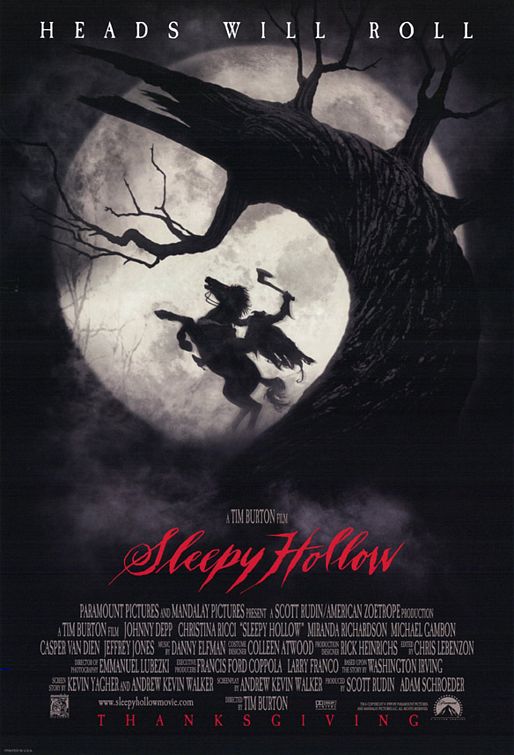
Over the weekend my wife and I watched Sleepy Hollow. It is an annual tradition; it is our October movie. In this film Tim Burton plays off the superstition of Sleepy Hollow – in fact real, in the movie – against the science of Ichabod Crane. In the end, Ichabod has to face the supernatural on its own terms in order to bring the world back to science. Having sent the headless horseman back to perdition, Crane once again returns to a New York City at the start of a new millennium, full of the optimism of science. It is the dilemma of the modern western world. People are tugged, torn even, in two diametrically opposed directions. Our experience leads us to believe in a “demon haunted world” while science placidly informs us that all can be explained. Movies do reflect the human outlook in many respects, and the end sequence has yet to be shot.


Let’s Do the Time-Warp Again!

Yesterday MSNBC reported that the Vatican has again called for a conference involving serious scientists to discuss the implications of astrobiology — life in space. Despite the mocking sneers of the media, growing numbers of serious thinkers are doing the calculations and scratching their heads. When I was a child, I was assured that earth-like planets elsewhere in the universe were virtually impossible, statically. Now we know of several rocky orbs circling distant suns. Our own sudden advances in technology have started some to think that if we raced from heavier-than-air flight to the moon in only 66 years, and from landline to audio implant in about a century, maybe other intelligent life could do the same? What would the implications be for the geocentric world of Genesis and the Gospels?

The Catholic Church and Science are hardly best buddies; frequently they are not even on speaking terms. No, the tide did not change to a warm embrace with the (centuries late) apology to Galileo or the sudden realization under John Paul II that evolution is “more than just a theory.” All one has to do is think of the issue of stem-cell research and the eagerly offered hand is suddenly withdrawn. But on the issue of aliens, perhaps the church can race ahead of the projected God-of-the-gaps, do an end-run, and be ready to embrace E.T. when he finally makes himself known.

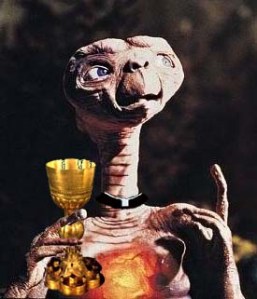
Don’t get me wrong, I am grateful that the Vatican has embraced evolution and thumbed its Roman nose to the creationists. (They deserve even more than that!) I am glad they are considering the possibilities of extra-terrestrial life. There is, however, a nagging doubt in my mind that they may be coming to the conclusion that the late Larry Norman once did that “if there’s life on other planets, then I’m sure that he must know, and he’s been there once already and has died to save their souls.” What good is advancement in science if mythology refuses to budge? What would an extra-terrestrial priest look like? What if they don’t have blood to fill their chalices? Do they have trumpet-horns on their saucers to announce the second coming? Yes, let’s explore our universe, but let’s not forget to update our credibility meters as well.

ETpriest

Our father which art in heaven?


Currying Divine Favor

The name Kerala leapt out at me from a stunning newspaper article that reeked of indulgences and simony just this week. Kerala, a southern region of India, is home to a large number of Syriac Orthodox Christians. In my time at Gorgias Press I often heard their industry praised and was informed how cheaply fellow “Christians” would work. I even saw the position of a great fellow worker at Gorgias evaporate as his duties were “outsourced” to India. Ah, Outsourcing, thy name is Greed.

I recall the days when Greed was considered one of the seven deadly sins. Apparently now it is an acceptable means of replenishing ecclesiastical coffers. An article on Thursday’s New Jersey Star-Ledger front page bore the headline “Recession hits Indian churches offering outsourced prayer”(!). The article explains that Catholic churches in the United States, hard-pressed for priests, have been outsourcing Mass intentions (dedicatory prayers) to their colleagues in India. The mind spins — American families, wanting a Mass intention dedicated to dear departed Aunt Bertha, sells the option to India where prayer is cheaper. As the headline declares, the Recession has cut into the profit margin of the Indian Catholic Church. I’m no mathematician, but it seems that a degree in accounting might help to sort all this out: Americans sell prayer intentions to priests in Kerala, who (when they aren’t working for Gorgias Press in their spare time) send them along to a God who is supposed to be omniscient anyway? And money changes hands for this? In Kali we trust!

Organized religion requires financial upkeep; only a blind naked mole rat can’t see that. Nevertheless, when religions gain enough financial leverage to become power brokers, it seems that they have slipped their moorings. I have watched hypocritical “prosperity gospel” believers benefit from the hard work of the poor, and I have seen the coffee-table books touting the immeasurable wealth of the Vatican, and I have witnessed the homeless curled up on urban church doorsteps on a cold Sunday winter morning. And I remember what Amos wrote, “For I know how many are your transgressions, and how great are your sins — you who afflict the righteous, who take a bribe, and push aside the needy in the gate…” (5.12). And I wonder who might be the safer bet, Yahweh or Kali?

WWAD?

WWAD?