Who Owns It?

Who owns the Bible?  No, you can put your hands down.  I mean who owns the concept of the Bible?  This question occurred to me while thinking about the Apocrypha.  Does the Apocrypha belong or does it not?  This became a polarizing issue with the Reformation and subsequent Protestant ownership of the concept of the Bible.  The Apocrypha was mostly written by Jews, but has never been part of the Hebrew Bible.  The process of narrowing down the books to include wasn’t straightforward and since God hasn’t spoken on the topic, has never really been settled.  The books of the Apocrypha circulated with the Bible, as did a few other books.  Sometimes they were even bound together inside one cover with the standard Protestant 66 books.  Obviously I’m discussing the Christian canon here.

I’m sure you’ve known someone this has happened to, if it hasn’t happened to you personally.  This person is an actual expert on a topic.  S/he goes to a place where an unexpected discussion on their specialization breaks out but nobody asks them to speak to it.  This person then becomes offended, sometimes even speaking out, loudly, that this is their area, they have expert knowledge of it and should be consulted, at the very least.  More likely than not, their opinion should be considered definitive.  This is the image I have in my head with Protestants and the Bible.  Sure, the Catholics had it long before, but they didn’t encourage individual study.  In fact, they discouraged laity from reading it.  Only when they, the Protestants, came along did anyone really pay attention to the Bible, and, it must be admitted, they do have a point.  All the Bible study that goes on today, no matter what faith tradition (if any) would not have happened without the extreme Protestant reverence for the Good Book.

But still, there are other branches of Christianity that disagree.  There are more Catholics than any single sect of Protestants.  And a great many Orthodox Christians as well.  Some of the latter include the books of 1 Enoch and Jubilees in their Bibles.  Even so, any publisher that wishes to make inroads on selling the Bible must defer to the Protestant canon.  This is the case even though the King James Bible included the Apocrypha.  So as I ponder who it is that owns the image of the Bible, my mind keeps coming back to the same place.  Those who make the loudest, and most prolonged claim are the Protestants.  They own the Bible, in the public eye.

Teaching Horror

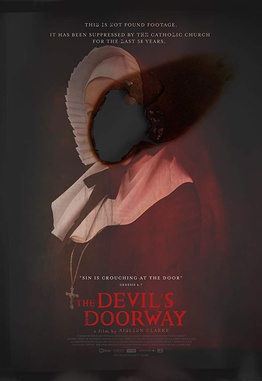
Critics who complain that Aislinn Clarke’s The Devil’s Doorway has nothing new really have no appreciation for parables.  An Irish found-footage film, The Devil’s Doorway is, as it clearly states, a lament over the Magdalene Laundries in Ireland.  I’d never heard of these institutions that existed until less than 30 years ago.  Founded by the Catholic Church, these “asylums” were places where women in trouble were essentially treated as slave labor.  Women, who often have difficulty hiding the results of sexual promiscuity (something men more easily get away with), were put to work in these reformatories.  I don’t know if the conditions were as bad as presented in the movie, but they provide a springboard into a perfectly serviceable horror film.  The horror tropes may be familiar, but that’s true of most horror of these days.

Two priests are sent to a Magdalene Laundry to investigate a reported miracle of a bleeding statue of Mary.  Please pardon my invocation of Alice Cooper here, but “Only Women Bleed” would be appropriate to consider.  Fr. Thomas, older and skeptical, doesn’t believe in miracles while Fr. John, the “techie” (it’s set in 1960) films the proceedings.  The priests uncover layer after layer of hypocrisy and deceit.  The Mother Superior, who shows no deference to the priests, insists that many of the pregnant women that have passed through the asylum were impregnated by clergy.  But there’s more.  As the statues bleed, a young woman, a pregnant virgin, is found kept in a dungeon.  Ghosts of murdered children cavort through the night.  A satanic niche for a black mass is discovered.  And the pregnant virgin is also possessed by a demon.  There’s a lot going on here.

To mistake all of this as “just a horror movie” is to miss the point.  Such is the way with parables.  Clarke, the director, was an unwed mother at 17 who realized that, had this happened a few years earlier, she could well have found herself confined to a Magdalene Laundry.  The movie doesn’t, it seems to me, condemn Catholicism per se.  For example, the two priests documenting the activities seem to be good people.  Fr. Thomas, as it turns out, had been born in this selfsame institution.  Raised as an orphan, he became a priest who, not surprisingly, doesn’t believe in miracles.  He too, was a victim.  Religious horror serves many purposes.  Often the very unfamiliarity of religion itself can drive the fear.  Another purpose, however, is to educate.  The Devil’s Doorway educated me, and I appreciate the parable.


Godic

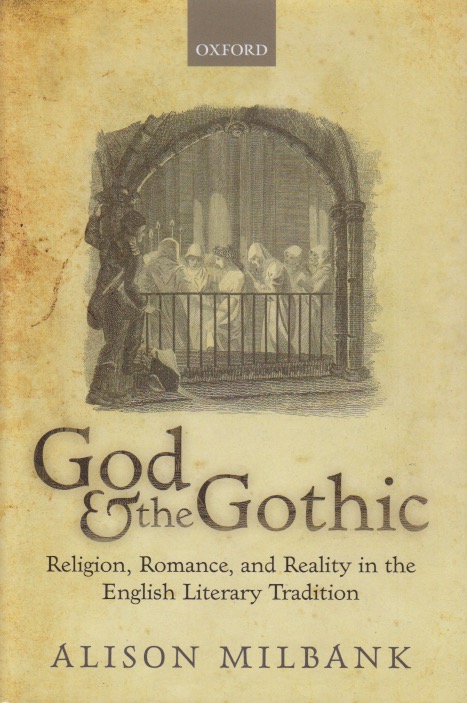
I have tried, in my halting way, to articulate what religion has to do with horror.  Alison Milbank is more experienced than I and it shows in her book God and the Gothic: Religion, Romance, and Reality in the English Literary Tradition.  There can be little doubt that the gothic is the direct ancestor to what became horror in the twentieth century.  In this intriguing study, Milbank explores just how the gothic made extensive use of religion, a sensibility that has carried over into modern horror.  Having taken a good long look at this myself—the fascination was there before Holy Horror and reaches back to my childhood—it is nevertheless affirming to find another student of human fears and fascination regarding the darkness has come to similar conclusions.  I always walk away from books like this with a renewed reading list.

Milbank points out, in the context of the literary world of England, how horror and religion not only cover the same theological ground, but come into direct contact time and again.  She does so by suggesting that Protestantism constantly seeks the lost Catholicism.  In England this came to be embodied in the Church of England, the middle way between Catholic and Protestant.  She covers various aspects of this such as melancholy, the doubling of characters, supernatural creatures, and death.  And more.  This isn’t a quick or light read, but I found myself making many connections I had missed.  Much of this, admittedly, came in books I’ve not read.  One of the problems with interest in the classic gothic is that bookstores don’t cater to selling older books and some of them weren’t successful in their own day, let alone ours.

There is a vindication in finding you’re not alone in a field.  Many of us who work on religion and horror know one another.  We’re a somewhat small, hidden group.  Milbank approaches all of this from the point of view of theology.  Theology is a somewhat distinct practice from religious studies and even from biblical studies.  There is overlap, of course, but theology is generally distinctly Christian in a context like this.  And that fits the living context of the many authors explored in this study.  Many familiar, and a few unfamiliar names appear.  What they have in common, apart from making up the cadre of gothic writers, is that religion influenced their writing and they weren’t shy about noting it.  This book explores the shadows very well and I’ll be revisiting its insights again and again.


Label Maker

Did you ever have one of those label makers?  The kind with a rotating wheel that embossed a plastic ribbon with letters that you could stick to things?  Labeling is so easy!  I often feel constrained, however, by the chosen labels of extremist groups.  Not all evangelicals are power-hungry or enemies of human welfare.  This is perhaps one of the keys to the success of extremists.  Camouflage has long been recognized by evolution as a most effective tactic.  I have many evangelical friends who do not protest cartoons, or ride around in Trump-laden vehicles, polluting the environment like there’s no tomorrow.  The problem is what to call them since the more radical wing has usurped their nomenclature.  I often think of this because I eschew labels in general, but people in a collective can do quite a bit more damage than a single disgruntled individual.  Perhaps “disgruntled” should be part of their name?

Religions generally begin as efforts to help make the world a better place.  The historian of religions sees, however, that over time many believers begin seeing the peripherals as the central tenets of the faith.  Since I’m familiar with evangelicalism, let me use that as an example.  As a form of Christianity, evangelicalism began with the Reformation.  Pietist groups, freed from Catholicism’s idea of communal salvation, began to worry about their individual souls and how  they might be saved.  Their belief structure eventually came to include the necessity of converting others because, if you read the Bible a certain way, that’s a requirement.  Over time this outlook  evolved into the idea that only one group (one’s own) has truly understood the Christian message.  Once numbers grow numerous, it becomes like the medieval Catholic Church—large enough to take political power.  Somewhere along the line the central message of helping make the world a better place morphs into making the world evangelical only.  Or whatever label we feel constrained to use.

labels are problematic

I’m not picking on the evangelicals here—this could apply to any extremists.  And it certainly doesn’t apply to all evangelicals.  Religion has been part of human culture from the very beginning.  A good case can be made that it is one of the basic components of consciousness itself.  A person has to learn how to become unreligious.  We are also political animals.  Who doesn’t want things their own way?  We can’t all win, however, and some religions have difficulty separating, say, a savior willing to die for others and the insistence on one’s own way no matter what others want.  Like most aspects of life this is a balancing act.  I grew up evangelical.  I have friends who are evangelical.  I don’t want to insult anybody, but what can you do when you feel disgruntled by the degradation of religion into an excuse for hate?  I lost my label maker long ago and I no longer know what to call things anyway.


Weaponized Scripture

One of the many questions that haunt evangelical Christians is whether it is okay to watch horror films or not.  The same applies to whether it’s okay to listen to rock-n-roll (even as it’s reaching its senior years).  Cultural accommodation is often seen as evil and evangelicalism, as a movement, is frequently offered as a culture all its own.  I recently rewatched Brian Dannelly’s Saved!, a coming-of-age comedy about a group of teenagers at American Eagle Christian High School.  Gently satirical, it portrays well how evangelicals try to redefine “cool” in a Christian mode.  Taking tropes from pop culture and “baptizing” them, Pastor Skip—the principal—assures the young people that they’re every bit as cool as secular culture icons, only the Christians are going to heaven.

The film came out when I was teaching at Nashotah House.  That seminary also had problems with secular culture, but in a completely different way.  Its method was basically to ignore that culture.  Isolated, Anglo-Catholic, one might even say “Medieval” but for the sanitation, it was likely not a safe place for a professor to be watching such films.  Evangelicalism and right-wing Catholicism were beginning to find each other.  Once the cats and dogs of the theological world, they were becoming more like goldfish in their bowl, watching a strange and unnerving world just outside the glass.  A world in which they couldn’t survive.  Now, Saved! is only a cinematic version of this, but it has a few profound moments.  Mary, the protagonist, comes to see the hypocrisy of both the school and her former friends when she supports a boyfriend who is gay.

At one point her friends attempt an intervention.  They try to exorcize Mary, and when that fails one of them throws a Bible at her.  Picking it up, Mary says “This is not a weapon.”  Since this movie isn’t by any stretch of the imagination horror, I didn’t address it in Holy Horror.  As I rewatched it in the light of that book, however, I recognized a motif I did discuss in it.  The use of the Bible in movies is extremely common.  That applies to films that don’t have an overt Christian setting such as this one does.  The iconic Bible is a protean book.  Despite what Mary says it can indeed be a weapon.  It often is.  Many of us have been harmed by it.  Christian separatist culture has its own dark side, even if it’s carefully hidden, its adherents think, from the secular world outside the fishbowl.


Southern Turn

In America’s ever roving commercial eye, Día de Muertos has become an extension of Halloween.  Retailers have realized that people will spend a lot on their fear, and the autumnal holidays delve into that primal territory.  Since the Day of the Dead, being a mix of indigenous Mexican religions and the Catholic celebration of All Souls’ Day, comes two days after Halloween why not blur them together with greenbacks?  So capitalist thinking goes.  While certainly not free of monied interests, the Disney/Pixar movie Coco has the virtue of addressing Día de Muertos as the separate holiday that it is.  A form of ancestor worship—a religion extremely common around the world—the thought-world of the film shares in common with Tim Burton’s Corpse Bride this idea that the afterlife is colorful, if not joyous.

I realize I’m jumping the gun here, but I just saw Coco for the first time over the weekend.  Not just a culturally sensitive treatment of an indigenous holiday, it is also a celebration of music.  In a very real sense, music is life in the film, and even the dead continue to thrive in its presence.  Again, the connection with Corpse Bride suggests itself.  The key difference, from a religionist’s point of view, is that Coco is based on, to an extent, actual religious traditions.  An irony of this is that, together with the worship of Santa Muerte, the focus on death sometimes makes the Catholic Church nervous.  Focus should be on resurrection, not death.  But what if death isn’t seen as evil?  Where is thy sting?  This can be a real challenge when your organization is offering escape from death.

The fear of death is natural enough.  It’s the ultimate unknown.  It fuels both religion and horror.  In that sense films like Coco that show a joyful aspect of the hereafter do an end-run around traditions that base their wares on ways to avoid the consequences of death.  Hell becomes a threat to be avoided—the forgotten dead in Coco face annihilation, a fate that Héctor notes comes to everyone eventually.  Eternal torment isn’t in the picture.  I have to wonder if this view doesn’t present a form of salvation that is unwelcome among rival religions.  Although Catholics don’t have the hostility toward Halloween that many Evangelicals display, there is a challenge of rival faiths here.  Stores have already begun offering this year’s Halloween wares, and increasingly among them are Day of the Dead decorations.  The holidays are quite distinct, although related, and movies like Coco suggest what we fear may be more a matter of perspective than of the decree of an angry deity.


Reformation Blues

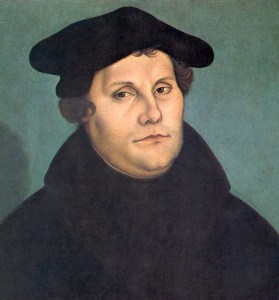
Welcome to Reformation Year! Well, not actually. It’s more like an anniversary. Five centuries ago this Halloween, Martin Luther grabbed his silver hammer and history forever changed. In 1517 nobody could guess that that obscure strip of land across the Atlantic (nobody knew how far west it went except maybe those who already had lived here for millennia) would one day identify itself so strongly as Protestant that other religions would be merely tolerated. Even when it established itself as a land of religious freedom, it mainly would have Protestants in mind. Indeed, Martin Luther unlikely ever met a Hindu or Buddhist. His concern was the Catholic Church which, in all fairness, had already split into two major branches a few centuries before he was born.

lossy-page1-558px-Martin_Luther_by_Cranach-restoration

Thinking about the Reformation makes me uncomfortable. As my regular readers know, I’m concerned about ultimates. In a universe where “you only live once,” and eternity is so very long, you need to make the right choices when selecting a means of salvation. Really, an eternity in constant torment makes a Trump administration look like a day in the kiddie zoo. This is a very important choice. Heaven and Hell are a non-zero-sum game. You pick the wrong one and you suffer for ever and ever and ever. And ever. With one united church at least you could know that everyone else believed the same. Now you have to shop around for salvation. Which brand really does whiten best? Which is the most flame retardant? Things got pretty complicated as soon as that nail entered that Wittenberg wood.

The truly sad thing is that all this splintering represents those of the same “religion.” It’s bad enough that Christian versus “infidel” was already a thing, but from 1517 onward it was Christ versus Christie, as it were. You may have been lucky enough to have been born into the right family, but if you descended from the wrong scion you were still going to end up in Hell. Catholicism may have been corrupt—selling indulgences is pretty shady business when you can get them for free—but once that break is made we can’t all be right. Somebody’s going to end up eternally in torment and it’s not even going to be the heathens. Reformation suggests something’s wrong in Rome. You can’t hide behind being born Baptist, Methodist, Presbyterian, or Lutheran. No, you’ve got to do your homework and learn which is actually correct. Where is Pascal when you need to make a bet?


Saint Charles

Honestly, I’m not sure where the idea of votive candles started. An educated guess—which will have to do in my state of limited research time—is that candles, like oil lamps, began as a practical necessity in places of worship. Temples, churches, synagogues, mosques—these tended to be large rooms and sometimes featured stained glass in their windows. Even if they didn’t, sometimes people want to pray after dark. Especially after dark. In the days before electricity, a lamp or candle was an obvious choice. Over time the practice of lighting votive candles developed. Lighting a candle for someone, living or dead, symbolized saying a prayer for them. The idea is much more common in liturgical branches of Christianity than it is in strongly reformed ones. Still, it’s a comforting idea. The few times that I’ve lit a candle for someone I’ve always felt better for having done so.

img_3125

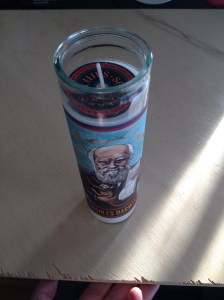
Whenever a practice becomes sacred, parody is shortly to follow. As human beings we seem to be inherently aware that we take ourselves far too seriously far too much of the time. When I go to the grocery store—usually in the aisle with the more “Catholic” ethnic foods—I glance at the large, painted votives for sale. Secretly I’m hoping I might spot one for Santa Muerte, but this far north and east of the border that’s unlikely. Our own version of Saint Death is about to take office anyway. I was pleasantly surprised, therefore, to find a Charles Darwin votive candle in my stocking this past month. Intended, of course, as a novelty, there’s nevertheless something a bit profound here. What we’re praying for is the continuity of life. Evolution itself is under threat of post-truth science which is soon to receive official sponsorship. Time to light a candle and hope for the best.

I plan to keep my Darwin candle for emergencies. The idea isn’t that the figure on the candle is a deity. Those painted on the candle are the saints who have some influence in the divine hierarchy of this cold universe. When you light a candle you ask that saint to witness your prayer. I sense that many among my own political party have recently rediscovered how to pray. The beauty of a Darwin votive is that it’s non-denominational. We all evolve, whether we admit it or not. So if you can’t get yourself to a church, synagogue, or mosque on the traditional day of worship, Darwin can shed light at any time. And maybe even support a prayer for light in the coming darkness.


Plainly Ghosts

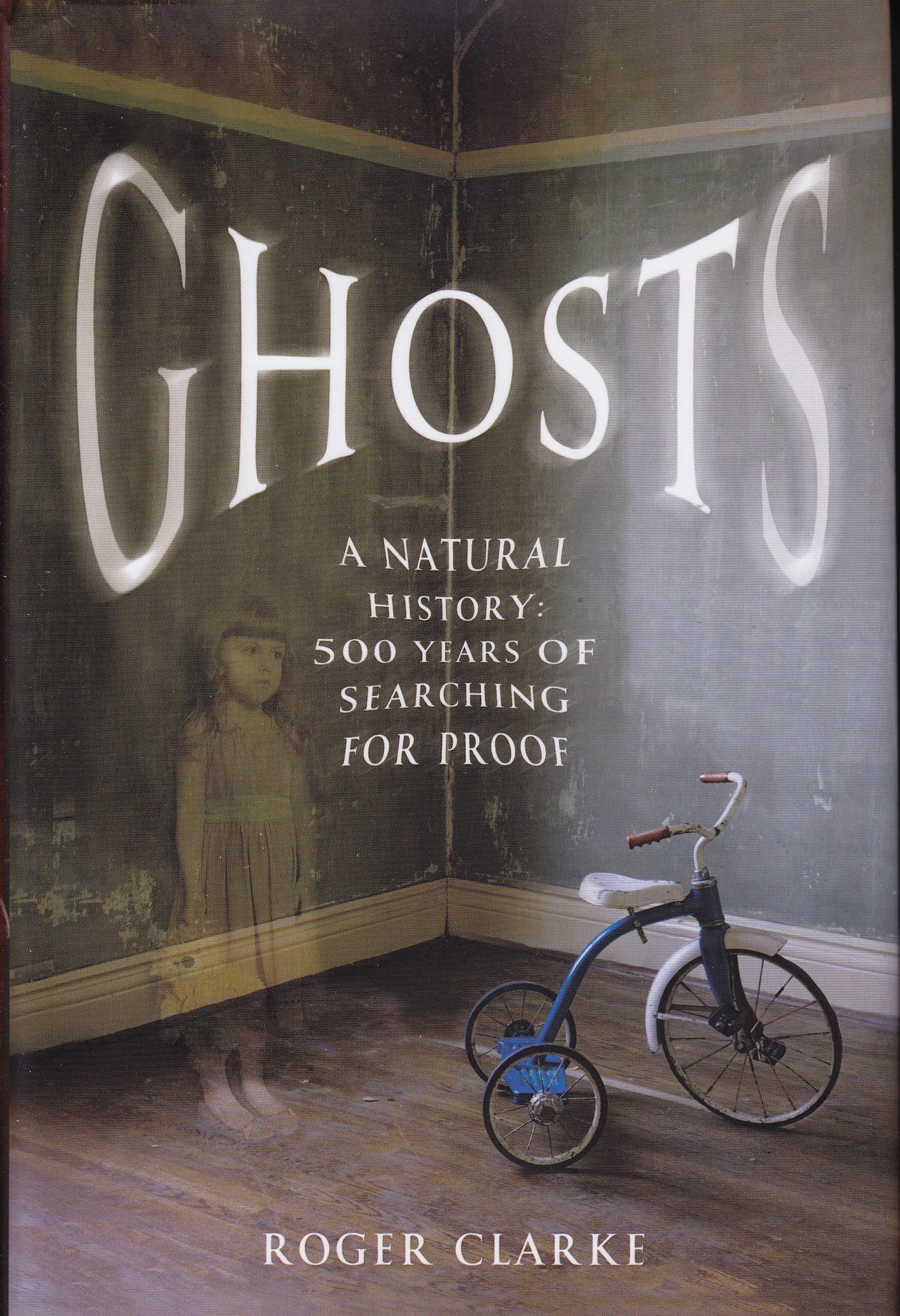
GhostsSometimes I’ll buy a book and secret it aside to read later as a kind of reward for making it through some heavier material. Research monographs don’t always do the job for which they are required in the commuter’s life—keeping me awake on a long and tiresome bus ride. I look forward to the book that has more appeal, and I don’t want to rush through it right away. I picked up Roger Clarke’s Ghosts, A Natural History: 500 Years of Searching for the Truth in Princeton’s wonderful Labyrinth just after Christmas (the traditional time, I learned, for telling ghost stories). Now that spring is more or less firmly in place, and I’ve gotten through some erudite studies that I might use for an academic paper or two, I picked it up to pass the time on my weary ride. As regular readers will know, ghosts have long been a preoccupation of mine, but one on which I’ve always been ambivalent. Clarke doesn’t set out to prove anything here. His book is more experiential than agenda-driven. He begins with the simple observation that people do see ghosts.

Lamenting that he himself has never seen one, Clarke sets out upon a partially autobiographical explanation of where this fascination began. Being from the United Kingdom—often cited as the most haunted country in the world—he goes through some of the more famous accounts with a sharp eye. Crying shenanigans when they’re obviously there, he questions how one can claim that any one country is more haunted than another. More importantly, he notes how seeing ghosts is a marker of class. Historically, the rise of the middle class led to the death of the ghosts. The rich and the poor see ghosts more often. Those in the middle associate such sightings with poor education, while those who are most educated and refined take ghosts for granted. It is only with the rise of reality television, the true opiate of the middle class, that ghost belief has become acceptable in the broad center.

Clarke also frames his work against the religious background that Catholics, with their belief in purgatory, had room for ghosts in their theology. Protestants tended to see anything reported as a ghost as a demon, since the soul either went to heaven or hell after death, meaning that there’s no ghost left to wander around. While doubtlessly skeptics exist, I have always been intrigued that even hard-nosed scientific views of the paranormal world tend to go a bit softer on ghosts than they do on cryptids and aliens. I suspect that’s because ghost reports have been around as long as written records and, presumably, long before. People have always seen ghosts, and in such large numbers that it is difficult to simply call them names and say they’re foolish. Yes, we may be a credulous lot, but we can still find books like Ghosts at a reputable bookstore. And we can tuck them away as guilty pleasures to take the chill off an otherwise very dull ride.


Saint Diego

Didacus of Alcalá fortunately, I think we might all agree, was more commonly known as Diego. The city of San Diego is named for him, as his nickname was a diminutive of Santiago, or Saint James, patron saint of Spain. Ironically, the more recent Saint Diego is best known for his visions of St. Mary, or Our Lady of Guadalupe. To keep your saints straight you need a score card sometimes. To go by the names, California must be a most sacred place. 120 miles north is the City of Angels. Then the city on the bay named after Saint Francis. Then Saint Barbara. One of my favorites, however, is San Louis Obispo. Everywhere saints. What of Didacus? Born in Spain, he was a missionary to the Canary Islands. I don’t think he ever visited southern California. The Franciscan mission dedicated to him, however, is what grew into the presently eighth largest city in the United States.

Wandering the streets of the old part of San Diego, you might find evidence that a mission led to this sprawling city. Or perhaps not. Now it is famous for fun in the sun—beaches and clubs and the US Navy. I have to wonder what Didacus would have thought of his namesake. I wouldn’t presume to speak for a saint, but I can’t see him surfing or enjoying perpetual summer. Did he have any idea what he might have been starting by denying himself and helping others? He was known for his curing of the sick, although he himself died of an abscess some five-and-a-half centuries ago this month. Like most ascetics, it seems one thing he highly valued was being left alone to contemplate. Would he have even survived in modern San Diego?

IMG_1818

One of the observations I make quietly, from the sidelines, is how frantic religion scholars seem to be. Frantic to write that book, get that tenure, find that recognition. It is sometimes easy to forget that educating students is a reward in itself. Having attended large conferences like this for nearly a quarter century, I have watched carefully. Saints and sinners both wander these carpeted halls with motivations as widely diverse as those of Didacus and Daedalus. Although there are 10,000 people here, including, briefly, Jimmy Carter, the world will go on tomorrow as if none of this ever happened. The homeless will still sleep in the park across the tracks from this world-class convention center. We’ll send our sick to hospitals instead of to churches. And if it weren’t for this conference in this city, I would never even heard of Didacus of Alcalá.


Lost Supper

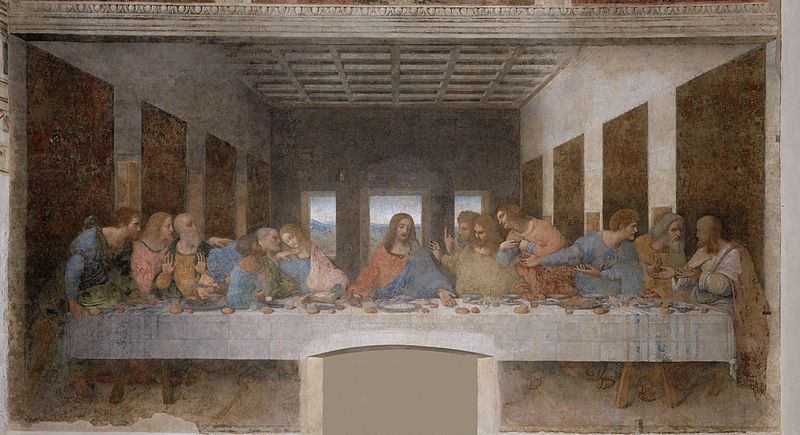
Culture, for better or worse, involves a deep connection to religion. No matter how secular we suppose the world to be, profound connections to belief surface in the most unlikely places. Time magazine’s culture section this past week has a brief blurb on “Burger Blunders.” Having been a vegetarian for a decade-and-a-half, this short story might not have caught my interest had my wife not pointed out “the Ghost,” a burger offered by Kuma’s Corner, a heavy-metal band-themed bar in Chicago. “The Ghost” comes with an unconsecrated communion wafer on top, and this has raised some spirits, according to Time’s culture team. Even Protestants recognize the power of the symbol of the wafer, even if they can’t accept transubstantiation. In Catholic belief, however, prior to consecration the sliver of bread is just that—a bit of pressed wheat product. The wafer came to be preferred because it was more easily contained than the crumbs of a regular piece of consecrated bread.

Communion, or the Eucharist, is a ritual meal based on the Jewish Passover. According to the Gospels, it was during the “last supper,” a Passover seder, that Jesus instituted the ritual. Early Christians ate together, and, recalling the symbolism, gave special prominence to the bread and wine. Bread, however, produces crumbs. When theology got ahold of bread it became a sacred object, after it was properly consecrated. It was believed (is still believed by some) to be very powerful in that state since it had become the actual body of Christ during the ritual. Wafers, technically unleavened bread, had many advantages to the emerging theological sensitivities. Portion control, symmetry, and virtually no crumbs. I’ve attended many masses, and the extreme care for particle control is everywhere from ciborium to patten to sacred linens that cover the altar like a liturgical table cloth. They are all accessories to the containment of broken bread.

Última_Cena_-_Da_Vinci_5

Communion wafers, however, when unconsecrated are just bread (if even that). They are not made palatable as snacks, but are more easily available online than basic gears or recordings of your favorite musical. Heavy metal has always enjoyed its blasphemous image as one of the most in-your-face counter-cultures possible. It is also profoundly religious. (Note, I am not saying that heavy metal is Christian or even Judeo-Christian, but it does participate deeply in religious symbolism.) If robbed of its shock-value, it is just loud noise. By association, however, many people mistake the wafer itself for what it represents. Without the added ingredient of consecrations, however, the liturgical churches tend to say it’s just bread. If you’ve ever eaten it, you’ll know that that assertion requires faith sufficient to move a Big Mac.


Making Saints

Some places are inaccessible in the academic world. Or perhaps invisible. I couldn’t help but have Santa Muerte on my mind as I visited the Phoenix/Tempe area of Arizona. I knew from reading Andrew Chestnut’s Devoted to Death that the skeleton saint has a large following in that area. Having been raised in a working class religion in a blue-collar household, I also knew that such trappings might not be entirely visible around a university setting. Arizona State is a huge school and my minimal free time on the trip only permitted a wander-radius of a couple blocks from around the campus. Many universities are, because of their property-value-lowering non-profit status, on the edge of sketchy neighborhoods where work-a-day people live. It didn’t seem that way in Tempe. The areas I reached all seemed to have that adobe-solid middle-class feel to them. Not that I go looking for seedy neighborhoods when I’m traveling by myself, but I do like to see stores that aren’t part of a chain, and to get a sense of local culture. For most academics, the pedestrian devotion to Santa Muerte is below the radar.

The concept has haunted me ever since reading Chestnut’s study—why would people find appealing to death attractive? Santa Muerte has the trappings of a Catholic saint, but she is, plainly put, death personified. She is a favorite among drug lords and criminals, and that is somewhat understandable. Her Hispanic devotees, I realize, often live lives of desperate poverty. The well-heeled saints of conventional religion might not be able to see things from their perspective. Although the Catholic Church continues to make saints, many of the traditional saints predate capitalism. Capitalism creates its own insidious disenfranchisement. I realized this already as a child growing up in a setting where just about everybody I knew had it better than my family did. For some to prosper, others must suffer in such a system. I knew which end I belonged on.

As in my visits to Santa Barbara (a much more conventional saint, by the way), Austin and Houston, in Tempe the Hispanic population was evident mostly in the menial labor sector. The person who makes your hotel bed or brings the hot plate of food to you in the restaurant. The person who mops up your spills or picks up your trash. And they are the ones who’ve made it into the earning bracket of the minimum wage. Why not worship personified death? Does not Santa Muerte remind them that we all face the same rictus grin at the end of our days? Isn’t it best to be on good terms before we reach that inevitable place? It was clear that on my visit I wasn’t going to be able to get far enough from prosperity to see the skeleton saint myself. At Phoenix Sky Harbor airport, waiting for my 11:30 p.m. flight back to cloudy skies, all the shops were closed. I passed by a boutique with local art, and there I possibly glimpsed her. A small statuette, possibly just the grim reaper, among other Day of the Dead motifs. Was it inspired by Santa Muerte? I would never know, I pondered, as the Hispanic airport attendants, still at work around me, were busy emptying the garbage.

IMG_1080


Dying for Religion

devotedtodeathReligions never lose their ability to surprise. This entire concept of belief is one with which I am intimately familiar but about which I’m completely puzzled. If we’re honest, we don’t know from whence belief comes or why it is so effective in keeping people balanced. (There are fanatics for rationalism just as surely as there are for religious faith.) When I saw R. Andrew Chestnut’s Devoted to Death: Santa Muerte, The Skeleton Saint, I figured it would be a good read for October, when Halloween comes so readily to mind. Although I’ve studied religions all my life, I’d never heard of Santa Muerte, “Saint Death.” Probably this is because, as a representative of folk religion, Santa Muerte is not an “official” religious figure. Folk religions are what the faithful actually believe, rather than what the religious officials declare that they will believe. Many a deluded bishop would learn to his chagrin, if he deigned to speak with mere laity, that his platitudes count only in the high court of theological heaven. Saint Death is more like the experience of the rest of us.

Chestnut, a scholar of Mexican religions, discovered Santa Meurte while living in Houston. His book is a narrative introduction to the background and history of the religion, its beliefs and practices, and a consideration of what the skeleton saint offers so many Latinos. Although the news in the northern reaches of America often does not bear it, Santa Meurte has regularly made the headlines in southern climes. As a symbol of death, and therefore potential protection from death, Santa Meurte has gained notoriety by her worship being taken up by drug runners and convicts. Mexico’s regrettably long struggle with poverty and sometimes corrupt governments has led to a society in which death is very familiar. As Chestnut demonstrates, Santa Meurte likely has her roots in the Grim Reaperess of plague-ridden medieval Spain, and she has been a somewhat hidden figure in Mexican Catholicism for at least a century or two. Her first public exposure came in 2001, and since then her association with the criminal element has been repeatedly highlighted in the media.

Santa Meurte, however, is a source of consolation for those who have little in life to anticipate but death. Often, in societies driven by the acquisition of wealth, plutocrats forget that justice comes in the guise of the Reaper. To the believer, Santa Meurte is not evil. She is a natural offshoot of the Catholic veneration of saints in a culture where human aspiration is quickly and unfeelingly snuffed out. Those in positions of power claim the Santa is Satan, but they may be looking in the wrong place for evil. Pointing to the Gospel statements that death will be overcome, they overlook the passages that insist on giving away all that you have will make you ready for the kingdom of heaven. Death, even if trumped at the final trump, will greet us all by and by. Santa Meurte is a very practical saint. Chestnut’s book is a good choice to read when the chilly wind shakes the trees for their particular October rattle of dry, lifeless leaves.


Who’s Got the Keys?

Having grown up Protestant, I assumed that was normal. Adults, who have the benefit of years of negotiating with other adults in ways that may seem unsavory to children, have the definite advantage here. Children believe what their parents tell them, and should the matter come down to eternal life or everlasting damnation, you sure want them to have your back. Sunday’s New Jersey Star-Ledger has a perspective piece by Tom Moran, whose parents raised him Catholic. Catholics and Protestants are Christians divided by a common religion. As I have studied the teachings of each over the years, it has sometimes felt impossible to fit the two together in any meaningful way. They both think Jesus is cool, but beyond that, the disagreements almost immediately begin. Moran notes that in the US fewer than one in four adults identifies as Catholic although one in three was raised in that tradition. His article goes on to outline how Catholicism has frequently aligned itself with law at the sacrifice of compassion. Sounds like religion to me.

Religionists place great, perhaps even eternal, stock in being right. The Catholic Church has traditionally considered itself expert in issues of reproduction, a conceit that is only more bold when it is regulated by celibate men. And the source can’t really be the Bible since there are plenty of places where the good book is a little naughty. The biblical understanding of reproduction was a conclusively unscientific postulate. When microscopes, not telescopes, revealed what was going on at the microscopic level, theology should’ve blushed and excused itself from the room. Instead, the church proclaimed that it knew better than any bespectacled intellectual; after all, unwavering tradition must count for something. This bears the imprint of a system with little left but theological bluster. And it’s losing its thinking members.

Moran interviewed Newark Archbishop John Myers, a man concerned with the sanctity of marriage and who has a questionable record of reporting abuses, for his story. As Moran pointed out, Myers has not been the outspoken advocate of the poor, but he does back the candidate with sacred underwear. I’m not sure when the last time was that the good Archbishop took a drive around Newark. It is hardly a little piece of heaven on earth. Even waiting for a train in the station can fill a customer with a sense of despair. God’s will, apparently, is somewhat more narrowly focused on what consenting adults do behind closed doors. The level of disjunction is enough to throw the Popemobile out of alignment. Of course, I write all this from the sidelines. I was raised Protestant, and no matter what the Mormons or the Catholics say, I was taught from my youngest years that they’re just plain wrong.

Those are some big keys…


Watch, and Pray

Religion is a lucrative business. There is likely a deep, evolutionary urge for fair play nestled somewhere in primate DNA. Monkeys and apes seem concerned about it, and certainly nothing gets people more upset than a cheater who does prosper (unless he, less often she, is the protagonist of some gangster movie). Most of us work pretty hard to make a living, often doing tasks that push us beyond our comfort range in order to ensure some kind of success. The same is true of clergy. Yes, stories of lazy or lackadaisical ministers abound, but many work long hours under often stressful conditions. Most are not paid very well. Their eyes, according to unwritten writ, are turned toward a larger prize. In an economy that has become a nearly universal capitalism, everything has a price. People want to feel that they are pleasing God but there are oh so many rules and regulations! The Hebrew Bible alone has 613, and then add the Christian Scriptures and two millennia of ecclesiological dogmatism and you’ve got one hefty bill. We don’t mind paying a bit of that for a religious specialist to take care of the details while we get on with the real business of life.

Now add a little math. How many people does it take to add up to a small fortune? Already by the Middle Ages the Catholic Church, really the only show in town across Europe, had amassed a real treasury. Although individually the clergy could claim to own nothing, collectively they were flush. Even today the wealth (and therefore power) of the Vatican is nearly beyond comprehension. A colleague recently pointed me to a story I had missed back in April. This involved the computer age and lucre in an unexpected place. Russian Orthodox Patriarch Kirill I was photographed sitting at a high-gloss table, wearing a Breguet watch valued at $30,000. There was an outcry. The Russian Church, long under the pressure of a communist state, could hardly be described as opulent. Well, liturgical vestments and accouterments are expected to be costly, but personal items such as watches, are expected to be modest. Thirty-thousand dollars is a lot of money to be reminded of when to show up for mass.

In response, some church leaders turned to technology for a solution. The watch was Photoshopped out of the picture and, as if a miracle, the scandal disappeared! Except they forgot the glossy tabletop—the reflection of the watch, like Dorian Gray’s portrait, remained as evidence. (The story may be found here, along with the damning photos, if you can stand the snarky writing.) Owning such a watch may be considered bad form among the humble clergy, hiding it, however, is even worse. I don’t mean to single out Patriarch Kirill—the Russians have had a pretty rough go of it, what with Stalin and Reagan and all—but religions seldom like to have their coffers examined. The laity will pay handsomely to avoid the extra work salvation demands. Herein lies the rub: salvation has become less tangible as material wealth has expanded. Many people have mistaken one for the other. It’s just that they don’t want to get caught enjoying a little too much of the one at the expense of the other.

Now watch this, for time is fleeting