Ephrata Cloister

Conrad Beissel isn’t exactly a household name.  I never heard of him until a visit to Ephrata Cloister during a Lancaster staycation.  My wife knew about the Ephrata Cloister due to a music course she took at the University of Michigan; he was influential in developing a distinctive musical style.  Since we were in the area we stopped in for the tour.  Beissel was banished from what would become Germany in the early eighteenth century.  He made his way to America where he established a kind of monastery in south central Pennsylvania in the early 1700s.  Not Catholic, he was inspired by German Pietists, the Anabaptists, and Christian Mysticism.  Not ordained, he established what became a Seventh-Day Baptist association because whenever he tried to settle as a hermit others came to him.

Celibacy has always been a hard sell for religions.  Once his Camp for the Solitary was established, it grew to about 300 members, with only some 80 celibates, or solitaries.  This 80 was half men and half women.  They built around 40 buildings in what was then the frontier and they couldn’t have survived without the 120 or so married people who joined the church but continued to live at home with their families.  Like many separatist groups, the Seventh-Day Baptists were expecting Jesus’ return at any day and lived their lives accordingly.  Not strict about others joining him in this, Beissel was an early vegetarian, eventually becoming primarily a vegan (although that name wouldn’t develop for a couple centuries).  They had midnight worship services since they believed Jesus would return in the middle of the night.  They were, with the supportive families, self-sufficient.  The group established a printing press, and at one time it was possibly the largest printing operation in the colonies.

After Beissel died, the community continued.  They realized that, like all celibate communities, it would be difficult to survive and the celibacy rule was dropped.  The last celibate member died in 1813.  The community by then had taken on the form of an independent church and it survived until the 1930s.  The remaining land—some of it had been sold off over the years as the community shrank—was bought in the early forties to be preserved by the state.  Theirs was never a very large group, but it was significant enough that their memory was felt to be important enough to preserve.  Beissel wasn’t alone in establishing such sects here in Pennsylvania.  The tradition is, interestingly, part of the American heritage and demonstrates how the religious, ordained or not, live in their own worlds.

A Glimpse at the Future

Last month one of the three remaining Shakers died. In this era of religion unawareness, not many Americans, I expect, could identify this dying religion. The Shakers aren’t the Quakers—we like to give religions we don’t understand pejorative monikers—they are a group that grew out of the Friends but that had important differences. Shakers believe, especially, in celibacy. It had to grow through conversion since Shakers could not reproduce biologically. At their height there were about 6000 of them—the number of Twitter followers of a fairly successful humanities professor, I suspect. They were hard-working and their brand of furniture endures beyond the life of the sect. The official count of Shakers worldwide now stands at two.

This little bit of news saddened me. Not that I’ve ever been tempted to join the Shakers—it would be a bit of a stretch for a family man—but I’ve always admired countercultural groups. Like many religious sects of the late eighteenth century, the Shakers were millenarians. That is, they believed in the imminent second coming of Christ. Given this belief, biological reproduction wasn’t really necessary. In fact, it was counter-productive. Like so many of the slumberers of the Great Awakening, the Shakers eventually settled in upstate New York. Since their lifestyle was different, they had to form their own communities. The last community is in Maine. When the last two Shakers go to their reward, barring a miracle, the denomination will be extinct.

life_of_the_diligent_shaker

The Shakers were distinctive for yet another reason as well. They were open to, and often defined by, female leadership. This might be expected in a world where men have difficulty controlling themselves in mixed company. Catholic monasteries locked men in without women. To agree to live in a mixed gendered community but without mixed gendered relations took a dose of will power that borders on the saintly. The Shakers won’t be the only religion to have gone extinct, when that happens. Religions, like organisms, grow, thrive, and die. This little group had a disproportionate impact on society. Those who watched Michael Flatley throwing his body across the stage to the haunting joyfulness of the Shaker Hymn “Simple Gifts” likely had no idea that the world owed one of its most beautiful melodies to a group of people living celibate lives in the woods of Maine. The Shakers’ unique contributions to the weird and wonderful world of religion will be missed by at least one.


Dearly Beloved

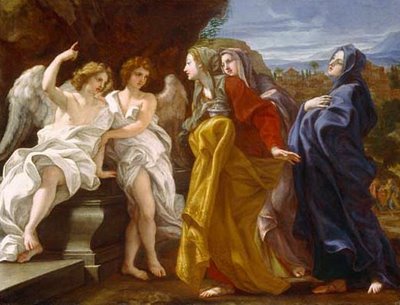
Coptic Christians have been in the news recently. In a late push to be known as the radical orthodox, it seems, the Copts have arrested the headlines. Tensions in the Middle East appear to have shifted to this ancient group and the media finds itself fascinated by them. In an unrelated development, a Coptic papyrus fragment appears to mention Jesus’ wife, according to CNN’s Belief Blog. Naturally, people are curious (read “upset”) at this revelation, although it is not history, just tradition. For decades, perhaps centuries, scholars of Christianity have noted that Jewish guys Jesus’ age would have been, by all social expectations, married. Celibacy was not really an option in the first century of the common era, and yet, no one explicitly mentions Jesus’ wife. This causes a larger crisis for divinity, because once Jesus was recognized as divine what would you do with a wife? She would complicate things (or at least theology).

The female divine is certainly as ancient as the male divine, culturally speaking, if not older. Despite cartoons of Cro-Magnon man dragging Cro-Magnon woman by the hair, all indications are that early people revered the feminine mystique as life-givers. Naturally, this equates to a kind of divinity. Only when society grew to be dominated by politics, no matter how primitive, did the male usurp the role of life-giving image-of-god-bearer. The male part in procreation was upgraded to being the creator, and the female relegated to a mere receptacle. Male gods alone could create universes, and women were downgraded to incomplete men. Still, in the myths around Israel (and perhaps within Israel as well) gods were married. The divine principle included both genders, although in an unequal distribution of power.

Fast forward twenty centuries and we have movements that encourage young women to consider Jesus as a kind of chaste lover. That’s a little hard to do if he was married—issues of adultery, at least in fantasy land, cause a real complication. The fact of history is that we possess very little of Jesus’ biography. Depending on how we parcel out the Gospels, we know only about one year’s worth (or three very scant years) of his life. Many personal details are left out. The Bible is clear that he had brothers and sisters, and even some of their names are preserved. We know his parents and find out that he was a cousin of John the Baptist. The relationships likely continued from there into other connections, but they weren’t central to the story the Gospel-writers wanted to tell. Adding women always complicates a male religion. Only non-gendered religions can be truly universal.

So this newly translated Coptic fragment comes from centuries later when it would seem natural that any Jewish man of the time would have been married. What was his wife’s name? Here’s the beauty of the revelation: for that, we can still offer the consolation, “fill in the blank.”

Rounding up the usual suspects?


In God We Lust

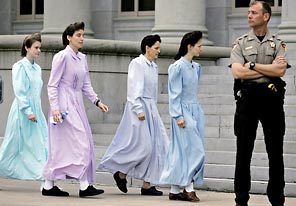
One of the entrenched ironies of human mentality is that reason will not suffice to change religious views. Many studies have repeated demonstrated that faith is impervious to logic, and this has appeared with Ektachrome clarity in the case of Warren Jeffs. Rev. Jeffs, the leader of the Fundamentalist Church of Jesus Christ of Latter-Day Saints, has painted himself into a mental corner that makes the logic of legal proceedings appear as slapping the idiot. Logic and faith do not connect. Any Christian who has read the letter to the Hebrews should know that. Nevertheless, Rev. Jeffs, having illogically dismissed his team of lawyers, has been attempting a divine defense to justify his alleged sexual abuse of minors. He remained silent during his opening statement, despite judicial advice that such a tactic might harm his case. Breaking silence yesterday with a nearly hour-long sermon, faith responded to logic and was found wanting.

Society at large fails to consider that studies of religion have been carried out from multiple angles over many decades. We have erudite studies of the philosophy of religion, the psychology of religion, the anthropology of religion, and the sociology of religion. They all point to the human origins of this phenomenon, often demonstrating that a basic disconnect remains when religious belief is brought into the harsh light of logic. Neurologists and biologists have explored the utility of religion as a survival tactic, and evolution seems to have blessed it. Yet trial lawyers, judges, law enforcement officials, and politicians—often themselves religious individuals—are charged with apprehending and convicting others who simply take their religion to extremes. Religions make untenable demands on adherents. God has a poor record of turning up in the courtroom. His divine statements are absent from the stenographer’s tape.

Not knowing the details, it is difficult to find much sympathy for Rev. Jeffs, should he be found guilty. Yet at the same time, his interpretation of religion differs only in a matter of degree from other religious sexual ordinances. Is it normal for a clergyman to live a lifetime of enforced celibacy? Although signing on the dotted line may indicate a tacit agreement with church policy, what young man can clearly anticipate the pressures of decades fighting biology and psychology? Yet the practice is perfectly legal. Until the nearly inevitable inappropriate results squirm out. Public rancor runs high, as it should, against child molesters. The children are innocent victims. The perpetrators, however, believe themselves to be following divine dictates. It would seem that much suffering would be ended if God would go on the record here, so that we might have solid evidence with which to judge the case. If it please the court.

Photo credit: Tony Gutierrez, AP, from The Seattle Times