
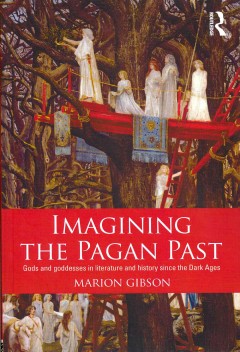
 The old gods still live. In literature. The modern world with its open spirituality has continued the process of rediscovering ancient deities. Marion Gibson’s Imagining the Pagan Past: Gods and goddesses in literature and history since the Dark Ages offers a glimpse into how British writers since the earliest days have wondered about the gods. Of course, many of those early writers were already Christianized, and treated the old gods as curios that might be placed on an intellectual shelf of bygone days. Some, however, came up with an idea that can still be found, on occasion, among dwellers in the British Isles—the idea that the original British religion was monotheistic. Indeed, some believed that the religion of Noah made its way to Britain, establishing a debased, but yet roughly correct worldview that was only contaminated by Roman polytheism. There are books suggesting, a la Latter-Day Saints, that the lost tribes of Israel found their way to Britain. Joseph of Arimathea planted his staff at Glastonbury, after all. Nothing satisfies like being the chosen people.
Gibson explores both the Celtic gods and the Norse gods. British literature has drawn upon both deity pools to populate a literature with colorful, if sometimes dark, deities. Beyond the literary, many of these gods survived in popular culture throughout the ages. Some of my fondest memories of the UK are driving to prehistoric sites with friends and finding the gods alive and well. As the sun, feeble at best in a British December, sank one afternoon we pulled into Wayland’s Smithy, a neolithic long barrow. I’d never heard of Wayland before. Gibson reveals the story of Wayland, as well as Woden and Thor, as the gods jumble in a Gaimanesque celebration of cultural diversity. Even on hikes to obscure sites the locals often knew the stories of the gods that had once passed this way.
There’s a virtual Sutton Hoo’s trove of information in Gibson’s brief study. At many points I found myself pausing to think, “that’s where that idea came from” as I followed the trajectory of her explorations. Even some of the deities she does not explore found their place in my three short years in the enchanted countryside where pagan Celt met pagan Saxon met pagan Roman, leading to a heady brew from the well-known Diana to Julian the obscure (there is some witchery afoot here). Even that Anglicanism that once circled the globe did not rid itself of this great cloud of witnesses. We keep our deities alive by preserving them in scripture, whether sacred or secular, and we have done so for hundreds of years. And the old gods, in this monochromatic world of science and industry, remind us where the rainbow really originates. Imagining the pagan past is sometimes the most human thing to do.
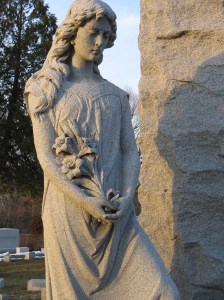 The specific form of penny offerings seems to go back to Benjamin Franklin’s burial, at least in America. A few years back while in Philadelphia, I saw for myself that people still leave pennies on Franklin’s grave in Christ Church Cemetery.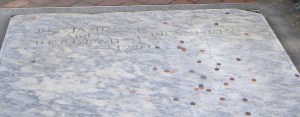
 I recalled having seen stones on tombs outside Jerusalem some years back, and I even had a student bring me a stone from Israel to keep as long as I promised to put it on her grave after she died. This practice in its recent form is associated with Judaism, but again, it has ancient roots. The building of cairns, or piles of stones, is often associated with the Celts or the pre-Celtic inhabitants of the British Isles. On our many wandering through the highlands and islands we saw several Neolithic examples in Scotland, particularly in the Orkney Islands. The practice of putting stones atop the dead also goes back to ancient times. One plausible suggestion is that it was intended to keep the dead in their graves. A more prosaic conclusion is that digging deep holes takes more work than hauling over a pile of rocks.
 Steve A. Wiggins