My Heavens

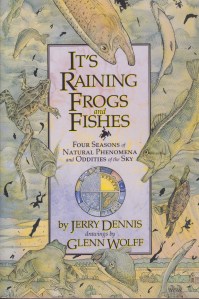
The details escape me. I was a student at Grove City College, working on a paper. In the library I ran across an article about a rain of fish. Always interested in the unusual, I was surprised to see such a piece in a reputable journal, and up until that time I’d never heard of Charles Fort or his gathering of such accounts from around the world. That paper was in my mind when I picked up It’s Raining Frogs and Fishes by Jerry Dennis and Glenn Wolff at a used bookstore. Subtitled Four Seasons of Natural Phenomena and Oddities of the Sky, it was published by the mainstream Harper, so I figured it wasn’t too far afield from reality. It turned out to be more the subtitle than the title, but an engaging read nevertheless.

There is a small section on rains of fish and other strange objects, but the book is really a tribute to the sky. Although I’m not an anthropologist, I have long been intrigued by the fact that people everywhere associate the sky with the divine. From the human perspective, it’s massive and all-encompassing. No matter where you stand on this planet, the sky extended over you, engulfing the horizon and implying even more beyond. It is responsible for our weather, and without the buffering of our atmosphere no life would’ve evolved on the earth at all (and that would be a pity because I enjoy writing this blog). Perhaps even before there were humans proper, our ancestors thought there was something divine about the sky.

While the firmament can’t be contained in a book, this one tries to consider just about everything you might find in the celestial realm. From extremes of weather to meteors to strange things falling from the sky, it tells of rain and snow and sunshine, insects, bats, and birds. The four seasons don’t really function as the best conceit for the book, since the sky is eternal and many of the aspects discussed are present all year long—the moon is with us always and the sun rises and sets even in winter. Nevertheless, this strange and alluring book demonstrates how the sky makes us what we are. Even though it was written in the last century it warns of global warming—then merely an idea—and shows how humans are capable of destroying that which gives them life. That article back in college suggested that the impossible happens, and that, given how the world is going, causes me to look upward with wonder.
Fishy Business

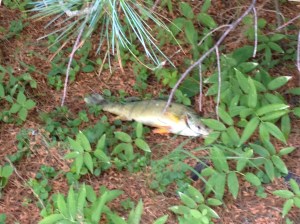
There’s bound to be a logical explanation for how it got there. After all, this is private property and people have been here all day long. Somebody would have noticed if fishermen had stomped up this boardwalk, dropping their catch along the way. There’s no place to dock a boat. And yet here it is in all its Fortean glory. A fish out of water. Literally. It’s a perch, I think. About eight inches long. Forty yards from the nearest water. Other than the flies all over it, it looks in good shape. As if it were out for a swim in the dry air and lost its way back to the nearby lake. I’m sure there’s a logical explanation, but I can’t help but think of Charles Fort and his witty takedown of conventional reasoning.

In addition to fish, this lake also hosts ospreys and bald eagles. Just yesterday morning I saw one flapping above the water looking for breakfast. And one of my relatives saw an eagle struggling with a fish the other day—an issue of maintaining air-speed velocity when fully laden, I think—only to have to catch and release. Could that have happened twice? Raptor drops the slippery, heavy fish and can’t fit under the pine trees with that wingspan to pick the thing up. Possibly. It’s not the most fun explanation, but it will do when logic’s non-negotiable.

Charles Fort, the great anomalist, is perhaps most famous for his irrepressible insistence that rains of fish had a more exotic explanation than a tornado sucking them up only to drop them far from water. In his puckish way, he wrote how such “damned facts” were explained away by convention. Fort liked to hold the door open for the wider possibilities. Meanwhile we’re stuck here with the unarguable reality that there’s a dead fish by the boardwalk, far from water and a logic that makes me ask, if it fell from a bird’s talons why does it look so perfect? No twigs or pine needles picked up from its heavenly plummet. No obvious injuries to its piscine flesh. Even had some disgruntled fisherman rowed up unobserved and flung a perch as far as he could, the thing would’ve had to’ve had quite a spiral on it to’ve made it this far from the lakeshore. Science works by sweeping the facts outside the norm off the table. I’m not saying there’s anything paranormal about this fish, I’m just wondering what Fort would’ve made of it, beyond a free lunch.


Paranormal Activity

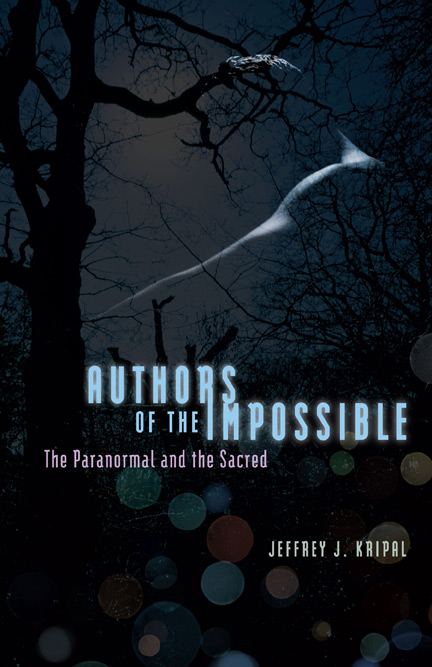
Once in a great while books with the potential to shift paradigms come along. These rare books often deal with taboo subjects, those areas of inquiry forbidden even to the most educated sectors of society. One of those books is Jeffrey Kripal’s Authors of the Impossible. I bought this book because of its subtitle: The Paranormal and the Sacred. I have argued before that paranormal subjects are very closely related to religion, but it is so unusual to find another scholar who openly takes on this question that I was shocked at finding Authors of the Impossible. Kripal is an academic who is willing to consider what is, as he admits, impossible. Those who’ve read deeply in the record of human experience, however, know that weirdness has accompanied us from the time we could write it down. It stands to reason that the uncanny stretches back before even that singular hallmark of human development. I have suggested elsewhere that it might even be the origin of religion itself.

Universities are establishment institutions. Free inquiry is not free, as I’m sure advocates of the National Security Act are glad to know. Most university professors who’ve seen a ghost or some unidentified object in the sky or an anomalous creature will never admit it. The easy equation of such things with mental instability keeps establishment people in line. It also cuts off honest inquiry into things people have experienced for centuries. Kripal is unafraid. In this book he considers the works of explorers most academics refuse to take seriously, despite their obvious intellectual ability: Frederic Meyrs, Charles Fort, Jacques Vallee, and Bertrand Méheust. Let’s have a show of hands: who has heard of any of them, except maybe Charles Fort? Each of these explorers was/is very educated. Each takes an aspect of the paranormal seriously. As Kripal points out, we will accept a physicist from CERN telling us that the impossible happens at the quantum level, but if you see a UFO you belong in an asylum. Is it because the paranormal violates not only the laws of physics, but also the laws of religion?

Life is too large to take it all in. We don’t even know what consciousness is. This is a question to which Kripal returns to conclude his book. His suggestion is that the paranormal is a literary hermeneutic—we are written by forces and powers outside our knowledge. Without denying science, indeed, while advocating it, Kripal suggests that it is not the whole picture. We are animals with two brains fused into one, and even scientists and materialists feel the sting and caress of emotion. Kripal is brave enough to assert that the emotive, imaginary side is just as real as the rational, materialist side. Noone can seriously doubt science and step onto a jet, Kripal shows that one need not doubt science to step onto a UFO either. If we are willing to participate in the reality our minds generate, the potential for human evolution really explodes. The only problem with Authors of the Impossible is that it is too short. An extremely deft writer, Kripal makes you laugh and think at the same time. And when you’re done, you’ll realize just how weird the world really is.