Cheesy History

It has been a few years since I’ve taken any courses on ancient history, but I took quite a number of them while preparing for my doctorate. Staring at my Dominos pizza box, I wonder if I must have missed class they day we covered ancient pizza. Actually, Dominos has been emphasizing cheese of late. Perhaps the least healthy ingredient in your typical pie, when you order you can “cheese it up,” and if you want breadsticks on the side, you can add cheese to those too. The box is whimsically decorated to sing the praises of cheese. Don’t get me wrong; I spent nearly a decade and a half in Wisconsin and I do like cheese. But perhaps this is just a little, well, too cheesy?

Dominos

The side panel suggests (to an increasingly gullible population) that “Ancient Egyptians might have been the original cheese experts.” The iconography depicts a man milking a cow, a man churning butter, and a man holding aloft a piece of what seems to be Swiss cheese. Maybe it’s Emmental. There are no women involved in this scene of making holy cheese. The man milking the cow has a distinctly European look. The man churning or stirring the cheese looks to my eye like a native American—are those feathers on his head? A Wisconsin Egyptian? The Egyptian holding the cheese aloft looks to be a priest or perhaps the Pharaoh. His uraeus is clearly visible. Rays emanate from the cheese like the life-giving solar disc of Egyptian myth.

I’m probably a fool for looking for footnotes on a pizza box, but I wonder whence this information comes. The mind of some ill-informed marketer? An opiate, or cheese-induced, dream of historic proportions? Perhaps those of us with training in these areas have not done due diligence in our teaching of the facts. Or perhaps I’m making a mound of cheese out of a mere crumb. It’s all in good fun, but I know that eventually it will make its way into term papers and other fast-food inspired versions of reality. We all know what to expect from the owners of the leaning tower of pizza.

Faith of a Lusty Monk

Wisconsin is so much more than its iconic cheese. I was reminded of this fact when my wife sent me an advertisement from the latest edition of the National Mustard Museum catalogue. I have to confess that while living in Wisconsin we became fans of the earlier incarnation of the institution when it was a roadside attraction called the Mount Horeb Mustard Museum. In addition to the perk of the biblical namesake of the town, the museum itself was the kind of place you instantly fall in love with. Quirky, pungent, and informative. The museum was nevertheless dominated by the shop that spoke for most of the actual floor-space. You could sample most mustards either by pretzel or by little sample spoons – no double-dipping please! There were only a few hard-core patrons there at our first visit, but as we continued to stop in over the years, the clientele seemed to be growing.

The ad my wife brought to my attention is for “Lusty Monk Altar Boy Honey Mustard.” The title begs for exegesis: Lusty Monk is the brand. The concept on many of the mustards we saw at the museum was to emphasize humor and shock value. Apparently the venial sin of enjoying mustard is enhanced with a decorous dollop of naughtiness. I suspect many people buy the products for the cleverness of the labels alone. Altar Boy is the title of the specific mustard blend. One must be careful to separate the word “Honey” from “Altar Boy,” otherwise an inappropriate picture might emerge. Of course, no one need admit they were thinking that anyway. “Honey Mustard” is familiar to condiment connoisseurs as a slightly sweet version of the dressing made with a generous infusion of industrious bees’ work (and there are many honey bees in Wisconsin as well). Thus read, there is nothing suggestive of mendicant malfeasance in this mustard.

On Wisconsin!

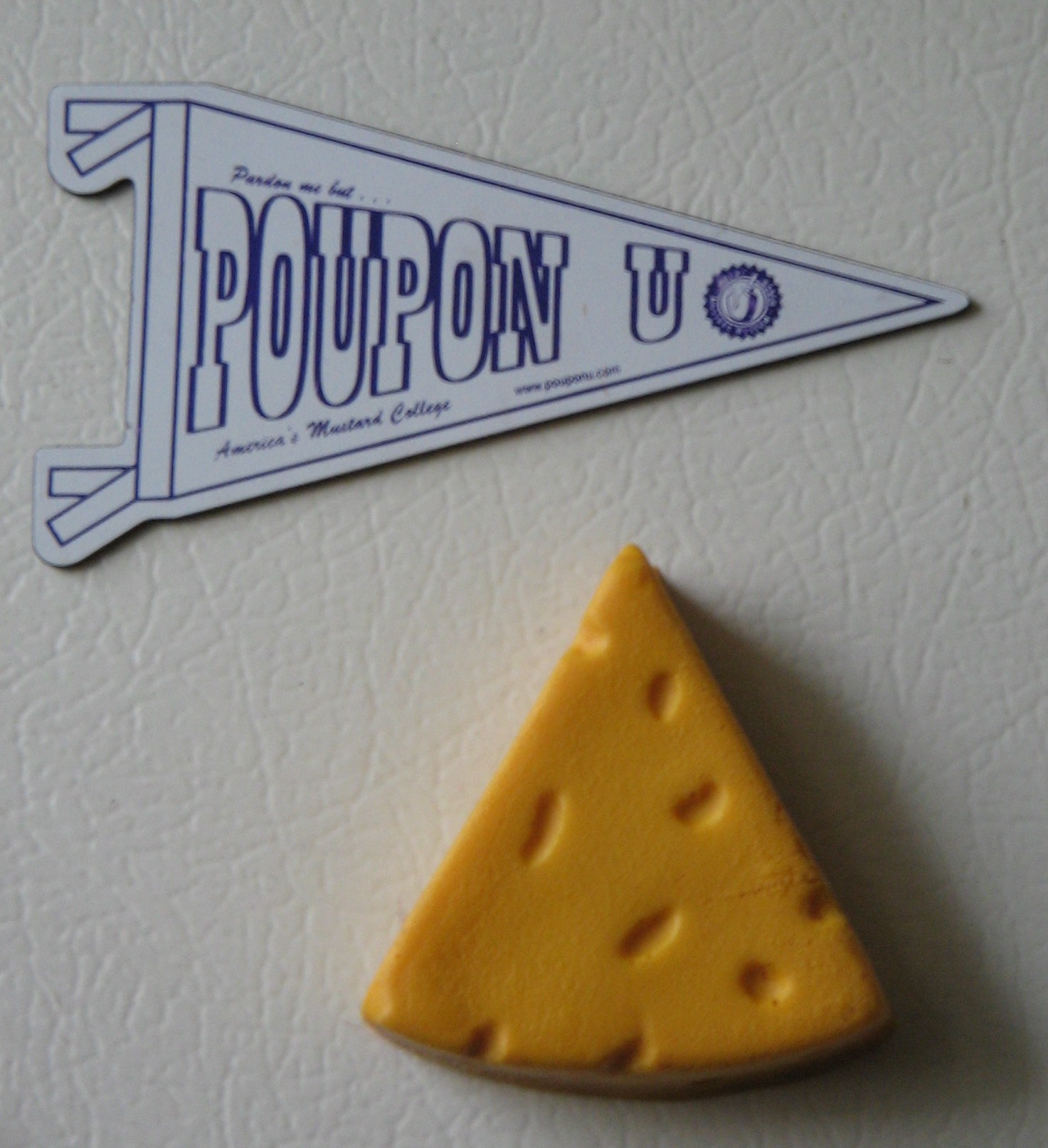
An entire blog could be devoted (and there may be one for all I know) to the slightly unsavory names of various mustards. A good place to do research would be at Wisconsin’s own National Mustard Museum. We still receive their catalogues, but since moving to New Jersey easy access to one of our favorite free museums has sadly become an empty jar of dreams and memories. We still proudly display a Poupon U. banner in refrigerator-magnet format to remind us of the tasty hours we spent sampling the very plant whose seed Jesus compared to faith itself. And the many off-color titles temper this faith with fun.