
Even before the Chelyabinsk meteor, Time magazine had committed to the printers with a story on asteroid 2012 DA14. From our terribly parochial viewpoint, such cosmic invaders are in our airspace (or at least in our satellite zone), as if we owned the very heavens above us. They are somehow an affront to our religious sensibilities. Many religions revolve around a celestial orientation. We all know that God is “up there” and the Devil is “down there.” What we’re discovering “up there,” however, is scarier than the Devil for many people. Space rocks are just part of the debris from the messy business of universe creating. Although space may be mostly empty (but dark matter has us reevaluating even that), it is far from tidy. Rocks rain down on us every day, and our user-friendly atmosphere that we’ve polluted so badly still begrudgingly incinerates those that enter at the wrong angle, brightening many a night with spectacular meteors. I’ve even seen some bright ones while driving in traffic in New Jersey. Wondrous indeed.
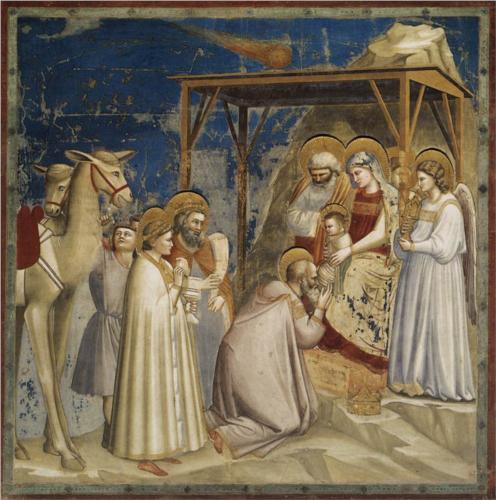
Back in seventh grade I did a science report on comets. This was a fascination that led me to take astronomy in my Sputnik-era high school—complete with planetarium—and in my older, more conservative college—sans planetarium. Comets were, until fairly recent times, religious harbingers. The Time story even has a detail of Giotto’s Adoration of the Magi from the early fourteenth century, complete with Halley’s Comet hovering overhead as the ersatz Star of Bethlehem. In a pre-Copernican universe signs in the sky had to be divine. There was no other logical way to explain them. Of course, in science class I stuck to the facts. As a religious kid, however, I knew there was something more to it.
Our skies are not our own. The universe isn’t here for us. These scientific revelations are frightening on a religious scale. We haven’t quite gotten to the point where we’re ready to let go of the Heaven above that no telescope can see. We don’t even have any way to spot hunks of rock the size of Chelyabinsk’s unbidden visitor with any kind of accuracy. We don’t even know how many there are. Before the second Russian explosion, Time prophetically noted that about a million stones of a hundred feet or more are near our planet and that one 150-footer could be 180 times more powerful than the bomb dropped on Hiroshima. Our recent brush with God’s dropped stone was only about 30 times the size of the terrors unleashed on Japan. According to ABC a Father Dimitri of Chelyabinsk said, “This event happened the day of the big Orthodox holiday that means meeting with God and this has to make people think.” I know I’m thinking. I sure hope his aim is good.

 Steve A. Wiggins