Wag the Book

I was pulling together a bibliography, you know, like one does, when I realized just how outdated the usual formats are.  Particularly the trinity invoked at the end of Chicago/Turabian—city: publisher, date.  Now, to their credit a number of more recent formats have dispensed with the “city” part.  Most presses have multiple offices and even those of us in the biz can’t always tell which one produced the book, which was, in all probability, printed elsewhere anyway.  Why list the city?  In this internet age, no physical copy of the book may have even been in the office.  The real problem, however, is the date.  Scholars want to know when something was published.  Publishers want to prolong the copyright (seventy years after an author’s death apparently isn’t long enough).  They can do this by using the next year as the copyright, as long as a book’s published in the latter half of the year.

Maybe you’ve had this happen too.  You put a book in your bibliography which, at the time, has a date a year later than it is in real-time.  You’re writing the future, apparently.  Or maybe publishers are just optimistic.  The fact is it’s a fiction.  Citations were invented so that you could find where an idea originated.  Dates can be important for a book that’s gone into multiple editions and you want to be sure to look in the correct one.  I had any illusions about permanency shattered when I realized that publishers routinely fix errors in books with no indication that they’ve done so.  It used to be that, if you knew how to read the printer’s key on the copyright page you could even figure out which printing of a book you held.  All of this fun disappears when we go electronic.

This sense of temporariness is problematic.  People ask me “Why don’t you get a Kindle?”  Books are an investment.  Consider iTunes.  How many times have you had to “rebuy” a song because you changed devices?  Or has your battery died right in the middle of something?  Have you tried to sell an MP3 you no longer listen to in a yard sale?  Books are physical objects—more than the words they contain.  They may be dated before they’re published, but they do have staying power.  Besides, citing an electronic source, what with broken links and all, is a tenuous business.  Those who write books want some indication that what they labor over for so long has a real presence in the world.  Even if you can’t say, precisely, when or where it was published.
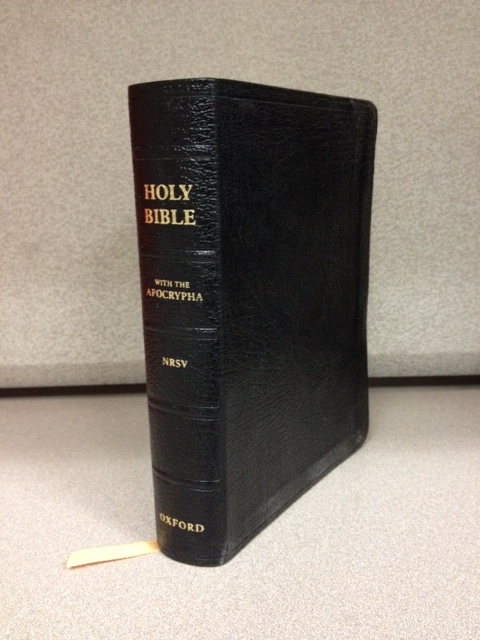

Which Bible?

No doubt the Bible holds a privileged place in western civilization. Arguably, it is the most influential book that exists in terms of its cultural influence in this hemisphere. Not that the Bible has had an easy ride of late. Many are vocal about its shortcomings, notably its violence and steadfast consistency with its own social mores of patriarchalism and election. Unfortunately these critiques sometimes (often) discourage people from reading it. (It is a very big book.) Having spent a good deal of my career dealing with the Bible, however, it is like a friend. Most friends have a habit or two that drive you to the brink of madness, but still, you know and trust them and tend to see the good rather than the flaws. The Bible is a holy book with warts. I cringe when I read parts of it. I’m not quite ready to let it go yet, however.

One reflection of this ambivalence I see often is that scholars (among others) have now taken to spelling the Bible without a capital letter: the bible. Perhaps it is the latent editor in me, or perhaps it is the Chicago Manual of Style that hangs like Damocles’ dictionary above my head, but like it or not, the Bible is a proper noun. In English we capitalize proper nouns. On Twitter, Facebook, or YouTube (all of which my computer auto-corrects to capitalized proper nouns), I understand. Most hands don’t get sufficient pinkie exercise to make that stretch to the shift key. But in academic writing? I’m pretty certain that e. e. cummings had nothing to do with the title, and other than loss of prestige, I’m unsure how to explain it. I have read book proposals from biblical scholars (biblical, by the way, is an adjective and does not require capitalization unless it is part of a title) who leave Bible all in lowercase letters. Have we come to this?

Leaving the “Holy” out of the title is academically sound. After all, Holy is a confessional modifier, and scholars strive for neutrality. With the proliferation of bibles—everything from Beer Bibles to Gun Bibles are out there, all capitalized, I note—we should take care to treat the Bible with grammatical care. It shows nothing of one’s faith commitment to capitalize it properly. God, on the other hand, may be used as either a proper noun or a common noun. Usage dictates capitalization. In the Bible Elohim is more often a title than a name. I knew civilization was in trouble the day I saw the phrase “butt crack” in an article in the Chronicle of Higher Education. The least we can do to combat the decline is to stretch that pinkie once in a while as an offering to the god of good grammar.

Bible


The Bells

No matter how naïve I find myself, reading student papers always rings bells. They may be alarm bells of my own obsolescence or the tintinnabulation of a new era dawning. Either way, they scare me. Having spent many, many days concentrating on reading papers to the detriment of daily life, I have been submerged into a world that is foreign to me. Yes, I am used to students texting in class, and I know when their laptops are open for “taking notes” that university wi-fi networks are freely available for surfing the net. I know they are only paying half-attention. I may be old, but I’m not completely stupid. Well, not all students do this, but the practice is ubiquitous enough to be considered normative. Their world is a realm of electronic information. The old ways are passing.

I recently learned that footnoting is dead. Already-in-the-tomb-four-days dead. An art that my mediocre high school drilled into every student in English class is no longer even remembered. I even had good students report to me that the campus writing center housed no one who even ever used the Chicago Manual of Style, although some of them had heard of it. In mythology class, any book is referred to as a “novel” or “story” with no regard paid to its actual genre. For those weaned on electronic reading, the old distinctions no longer apply. The Internet is full of information, and many young people can’t discern the wheat from the chaff. Raise your hand if you know what “chaff” is. I didn’t think so.

Seeing all of this in the context of a mythology course is fascinating. Many students refer to the days when gods and monsters actually existed. It is as if the Creationists have won without a struggle. The concept of religion, as reflected in the fiction of mythology, no longer fits the paradigm. Reality is electronic, and paper is fiction. Bells, bells, bells, bells, bells, bells, bells! At least as I get shelved with dusty books, I will be in a familiar environment with gods, monsters, and dinosaurs. This is the world I was born into and which will not long survive the passing of my generation.