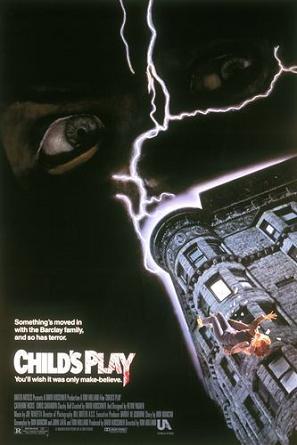
Play Time

Of course I’ve seen Child’s Play before—what kind of poser do you think I am?  But that was back before I started blogging.  After writing a post about Puppet Master, I thought I should watch it again because it didn’t really strike me as memorable the first time around.  Probably the reason for that is I knew the basics of the story before I saw the movie and, like zombies, possessed dolls are a little hard to buy into.  Still, on this second viewing I was a bit more impressed.  The idea of the monster that won’t stop coming is a scary one, and I’d forgotten just how much Chucky had to be dismembered before being stopped.  And there are some legitimately scary scenes, despite unanswered questions.  In case you’re not familiar: criminal Charles Lee Ray is shot to death in a toy store, but not before transferring his soul, through voodoo, into a Good Guy doll.  This doll is bought on the black market by a widow who can’t afford one, for her son’s birthday.
Chucky befriends the boy but starts taking revenge on those who’ve wronged him, including the police officer called to investigate his first murder.  The officer happens to be the one that shot Ray at the beginning of the film.  Nobody believes that the doll is alive until it attacks them personally.  Nobody, that is, except Andy, the six-year-old owner of Chucky.  (Although it isn’t cited as such, I have to wonder if Toy Story’s Andy wasn’t actually based on this one; that’s not the official story, but still…)  Child’s Play wasn’t the first horror film to portray an animated doll, but it was perhaps the most influential.  Chucky went on to become a repeat slasher villain with wide recognition.

I’d completely forgotten the appropriation of voodoo as the animating force behind Chucky.  Of course, that leads to the very obvious weirdness of a doll using a voodoo doll to kill someone.  To modern sensitivities, the use of Vodou feels inappropriate, but this was in the eighties, and other religions were fair game for horror.  In fact, religion was fair game.  Without it, no animated Chucky, and no threat to Andy and his mother.  Religion and horror have played together from the very beginning.  The possession aspect also ties into religion and there have been no end of possessed dolls since Chucky first lunged out the screen with his knife.  It was a good play date, it turns out.
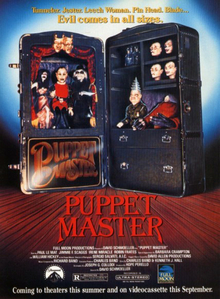

Fear of Puppets

David Schmoeller is a horror director I discovered only in the last several months.  I watched his first film, Tourist Trap, after having found Netherworld streaming for free.  Perhaps his most famous film is Puppet Master.  Although intended for a theatrical release, it was ultimately shifted to direct to video.  That didn’t stop it from becoming a cult film and from spawning sequels and spin offs.  Like other Schmoeller films, it’s a bit disjointed.  But it’s also fun to watch.  Since this is a film from the eighties, I won’t be too worried about spoilers—fair warning.  So, the puppet master lives in a hotel and brings puppets to life, literally.  He does this using ancient Egyptian magic.  About half a century after his death, four colleagues of Neil Gallagher receive a psychic message from him.  They travel to the hotel only to find he’s dead.

The puppets, released from their hiding place, begin killing the guests.  This is one of the many things never explained.  The puppets don’t appear to be evil, but they are murderous.  Three of the four colleagues become their victims in typical horror fashion.  The last surviving friend, an anthropology professor from Yale, and Gallagher’s widow, discover Neil has brought himself back to life, using the puppet master’s Egyptian magic.  He plans to live forever, but apparently he has to kill his former friends to do so.  As he explains this, and beats the professor and his wife, the puppets realize that he’s a bad man.  They attack and kill Neil when he’s trapped in an old elevator.  The ending reveals that his widow can also reanimate the dead.

Child’s Play had been released the previous year, but the trope of haunted or cursed puppets had been in the horror tradition already for decades.  Dolls and puppets are often residents of the uncanny valley and yet people can’t stop making them.  We often learn to draw by representing our families with crayons.  The fascination of replicating ourselves artistically provides low hanging fruit for horror films.  Fabricated things that look human—and we can add mannikins here—starting to move, or coming to life, scares us.  So much so that even less-than-great movies such as Puppet Master can become their own franchise.  As a horror movie, it isn’t terrible.  It’s also not likely to keep you up at night.  At least one other David Schmoeller film is on my to see list, and I have a fair idea of what to expect.  I watch them duly warned.


No Play-Thing

Childs_PlayPossession. It’s one of the scariest concepts in the religious arsenal. The idea that a person could be taken over by a different entity and surrender his or her selfhood to a malevolent saboteur is frightening indeed. Horror films have been deft at exploiting this. As a college student I was slow to watch the latest horror flicks. Some I’m only now beginning to find. Over the weekend I watched Child’s Play for the first time. Like most people who have some sense of popular culture I knew that Chucky was an evil doll, but I never really knew the backstory. Despite the utterly untenable hypothesis of the movie, it still manages to be scary in our CGI world, despite the bogus lightning. The frightening part comes from what is an admittedly creepy doll in the first place becoming possessed by a religious serial killer. Charles Lee Ray, named after three infamous assassins, displays facility with a religion that some identify as voodou, although that association comes primarily from the voodoo doll that Chucky uses to dispatch his mentor.

At least Child’s Play makes the effort to explain what forces exist that might bring plastic and stuffing to life. In true horror fashion, it is not the Christian god, but forces that are somehow more powerful, more malevolent. It would hardly behoove the maker of all the universe to inhabit a Cabbage Patch knockoff. The Lakeshore Strangler has been in training to cheat death and remain alive forever. He takes lessons from a mystical character whose religion is referred to only obliquely, yet whose efficacy is obvious in the malevolent toy. Willful suspension of belief is necessary to make this resurrection story plausible, but that disbelief must include belief in religious powers. The horns of this self-same dilemma hoist all religious believers in a scientific world.

Chucky is participating in one of the oldest of all religious traditions—death avoidance. Some of the earliest evidence that we have showing that hominids were developing religious sensibilities is the burial of the dead. There is really no reason to bury if we are only carrion like every other meat-based product. Whether it is out of fear or reverence, we turn to religion to assure us that there’s something more. It may not be scientific, but that’s largely the point. For many even today, a concluding scientific postscript leaves a body cold. Time for a leap of faith. Horror films are often decried as lowbrow and unsophisticated. Chucky, however, like many mythic monsters, is rapping his inhuman fingers on the door of religion. Specifically resurrection. Although in this case, it might be best to keep that door firmly closed.