Camping Out

Garsh-darn-it, I’ve missed the end of the world again! I’ve been so busy lately that I hadn’t bothered to pay attention to that which really matters. So here I find myself in the post-apocalyptic world and still waiting for a bus. Was that all there really was to life? I mean, I just found out that the world was ending on the day of. Couldn’t I get at least 24 hours’ notice? (I wish we’d all been ready?) A group called eBible Fellowship, followers of the late Harold Camping, figured out that his prediction of the end for May 21, 2011 was only the shutting of Heaven’s doors. I’d been wondering where that draft was coming from. According to the Radnor Patch, the actual end of the world, according to eBible’s calculations based on Camping’s spiritual algebra, was yesterday. That could explain a lot.

Apocalyptic groups have often had a problem getting the exact day right. No surprise there, however, since the Bible says even Jesus doesn’t know. Historically, there have been a number of options available to the budding apocalyptist. You can simply go very quiet and hope nobody notices. You can commit mass suicide (not recommended). And others would seem to suggest that you can claim it did happen, but that we just haven’t noticed yet. That was the response of some of Charles Taze Russell’s followers when 1914 saw the continuation of the world, despite a war that has scarred it ever since. Maybe the world has ended many times before. Still, the rest of us still find ourselves too busy to notice.

Here it comes.

Hyakutake, 1996. My first comet.

Apocalypticism is most prominent among those groups that hold to a biblical dating of the world. If it has only been here about 6000 years, then its imminent end seems entirely plausible. Those who take a longer view, more on the order of billions of years, seem a little less worried. That’s not to say that the world couldn’t end. A reasonably sized asteroid could finish it for our species. We wouldn’t need a supernova to do us in. Still, we can learn something from the chiliasts. We can learn that introspection is not a bad thing. We don’t need to hoard weapons, canned goods, and water, but we can stop once in a while and ask if all this insane running around we all do is really worth the effort. Since the world has ended, I’m thinking I might slow down a bit. I’ve got a lot that I still want to accomplish, but given that it’s all over, what’s the rush? I just wonder if they’ll buy this kind of reasoning at work.

Contacting Faith

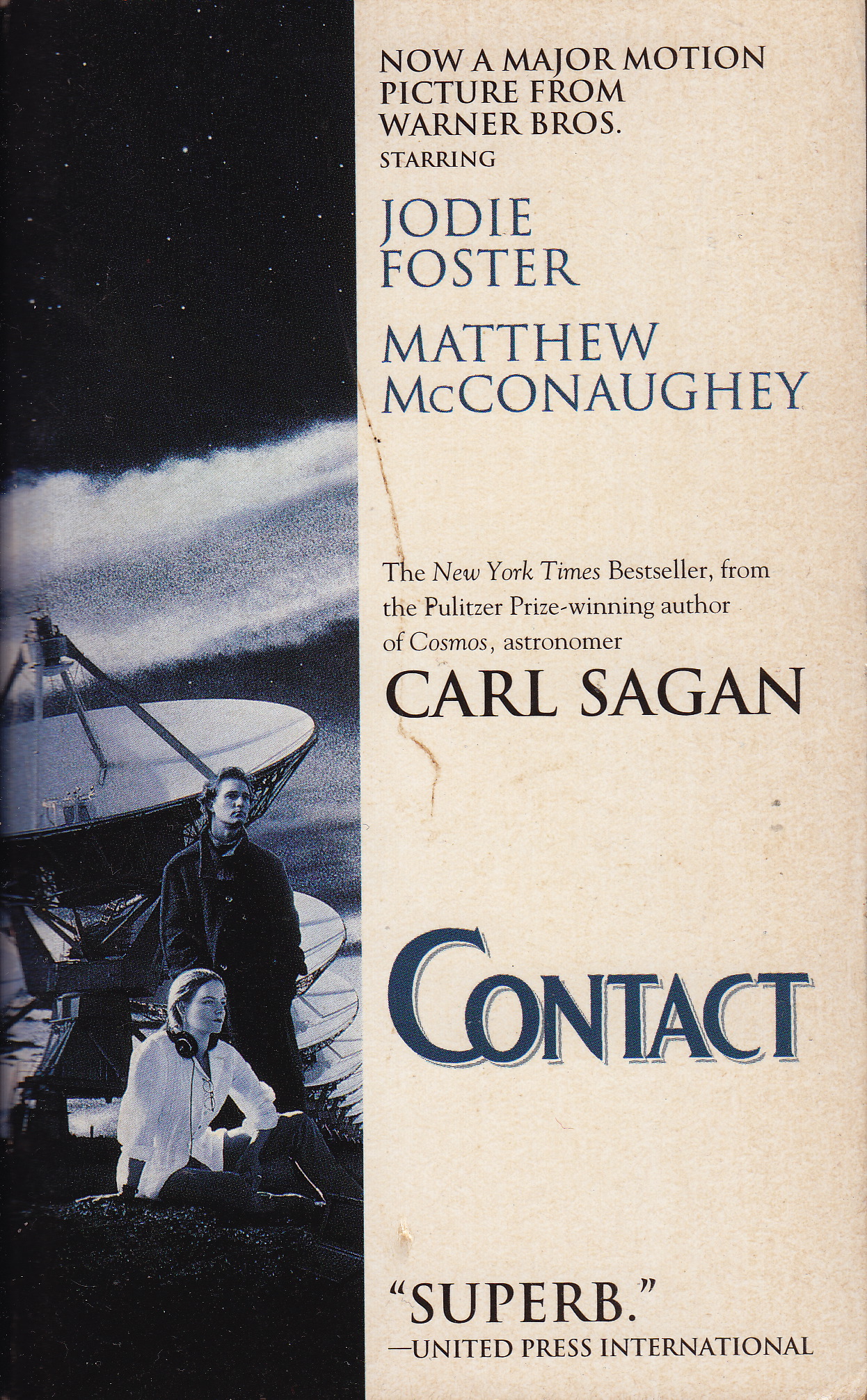
Contact_0001Sometime after the movie Contact came out, I saw it while on a flight to somewhere here or there. As with most movies on airplanes, it didn’t receive my full attention and I seem to recall not hearing a lot of the sound. Having always been intrigued by the possibility of aliens, however, I told myself I’d watch it again. Several months ago I did just that, but as Carl Sagan hoped, much of the story had become somewhat dated. I finally finished reading the novel, and this was a case of the book being better than the movie (as is frequently the case). A number of things surprised me about the story, the primary one being just how prominent religion is in the plot. In the movie some crazy preacher sabotages the first machine just as it’s nearing completion, and even though Ellie Arroway is long connected to Palmer Joss, their relationship doesn’t seem to dominate the script the way it does the book.

Almost immediately upon reading about adult Ellie, it became clear that religion was a major interest that Carl Sagan had. While the chiliasts receive many scathing comments throughout the novel, thoughtful Christian thinkers, such as Palmer, find a way of being taken seriously by Ellie, despite her own personal unbelief. Unable to understand how someone could not accept the evidence before their eyes, she wants to belittle religion but can’t when serious thinkers like Palmer remind her that they have a sophisticated worldview as well. The story represents a long struggle between alternative outlooks. While as a novel it doesn’t always flow, it pulls the reader along, partly based on the intriguing character of Sagan himself.

Carl Sagan believed in life on other planets. He was less sanguine about the possibility of either ancient astronauts or current-day visitors from space, but he kept an open mind. While he was the respected author of numerous scientific papers, other astronomers didn’t always know what to make of such a popularizer. Of course I never knew him, but I have to wonder if his true beliefs didn’t appear in his fiction rather than in his factual writing. At times I found the novel slow and plodding, and as the machine gives ambiguous results, I wondered where the rest of the story could go. Sagan profoundly brings the end back to belief. Without evidence, Ellie finds herself in the place of the religious who believe on the basis of experience and faith alone. And she finds her best friend is a clergyman. Contact, with its God-like aliens, is really a story of finding oneself a place in an infinite universe. To do that well, Sagan seems to have believed, requires both science and religion.