Christian Nationalism

Apparently we’ve forgotten the Second World War. In our touch-screen, never-have-to-get-off-the-couch culture of convenience, we’ve completely disregarded the millions that, yes, died in vain. You see, Christian Nationalism is on the rise, according to a story my wife sent me from the Huffington Post. About as much an aberration from literal “Christianity” as you can get, this movement believes America’s success is tied to its role as a Christian nation. Such believers, if they can even see that such rhetoric leads to war, don’t care. For the fact is that the economy of China is poised to pass, if it hasn’t already done so, the economy of what used to be United States. Call it Confucian Nationalism, but I have the feeling that when two giants try to get into the same compartment things tend to get unpleasant.

Serious thinking is a natural resource of which America has clearly run out. Easy answers, empty of content—junk food of the mind—are easily tweeted out from a personality that declares his own opinions truth. Everything else is fake news. Evangelicals, it’s sorely obvious, need to read The Analects. Don’t claim that its obscure; I’ve read the Bible. If you think you can figure Paul out, well, that’s what I’d call “fake news.” Oh, and by the way, Paul was anything but a nationalist. For all his faults, he knew that Christianity is nothing if it’s tied to nationhood.

Instead we puff out our chests and, ignoring the Bible on this very proverb, become the blind following the blind. If God has a plan he’d better reveal it to his 45th prophet soon because there are some enormous gulfs in the road and he insists on walking without a cane. American exceptionalism is built on the backs of the poor and helpless. They are also the ones most easily swayed by its perverse rhetoric. Nations must separate themselves from their religious beliefs. We’ve seen what happens when incompatible religions become the identifying factors of countries. As long ago as the 1970s I’d learned that nationalism was a powerful force for evil. I hadn’t been alive during the Second World War, but the world into which I’d been born was entangled in Vietnam. We were halfway around the world playing the bully, but it was because of capitalism, not Christianity. The end result, however, was the same. Unimaginable human suffering. Death, pain, and sorrow. And we’ve decided that the Prince of Peace wants us to head down that road again. “Vanity,” I hear Qohelet whisper.



Plain Floods

Erschrecklichewasserfluth

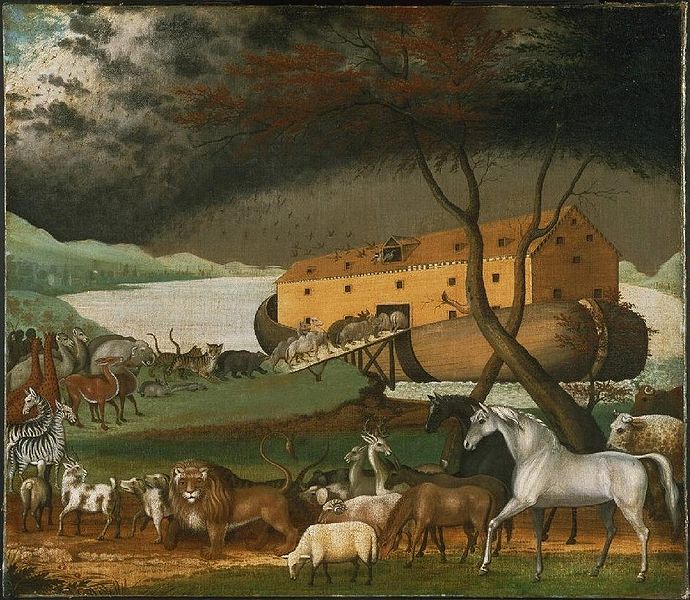
Floods are the stuff of legends. In fact, one of the most pervasive myths of all times is the world-wide flood. While some would see this as “evidence” that such an impossible flood actually occurred (some believing so fervently as to build replicas of imaginary arks), others recognize the flood as a basic human dilemma. We require water, and therefore we build our cities near a source of it. Rivers worldwide are prone to floods. While recently stuck in a holding pattern waiting for space for our flight to land at Newark, floodplains were more than evident from high above. My hometown regularly experienced floods when ice jammed the Allegheny River during the spring thaws. The floods of the Tigris and Euphrates rivers were, literally, epic-making. A piece in the Washington Post rather surprisingly reports “Legends say China began in a great flood. Scientists just found evidence that the flood was real.” The story by Sarah Kaplan demonstrates the universality of unruly water.

I know little of Chinese history and mythology. There’s no reason, however, to doubt that stories of ancient floods were as common there as elsewhere. The flood is, pardon the Christianization, the baptism of civilization. Things have to be washed clean before “civilization” can begin. In this case, according to the story, Yu, the founder of China’s first dynasty, tamed the flood. Now scientists are finding flood deposits from the Yellow River that match the 1900 BCE time-frame of this mythical founding. We can be certain that some will latch onto this date noting how Abraham was said to have emerged shortly after the flood (Genesis chronology says Noah was still alive when Abraham was born) and therefore this is proof of the Biblical flood. Even Sir Leonard Woolley advertised that he’d found the biblical flood in the river deposits of Mesopotamia. When it comes to literalism, any old flood will do.

No doubt many ancient flood stories go back to some historical event. The world was never completely covered with water in human times (before that nobody was here to see), but it’s easy to understand how people might have believed it could have happened. Our view tends to be local, often at the expense of universal costs. Consider global warming, for example. It’s difficult for us to see something that impacts us as such a distance. Taking care of the planet is so hard when we realize just how big it is. Our neglect, however, will definitely cause floods to come. Our denial makes myths for future generations. Headlines millennia down the road, if anyone’s left to read them, will, I’m sure announce with surprise that the devastating floods we’re creating now were indeed real.


Only Takes a Spark

Fireworks have been the main event for Independence Day celebrations ever since I was a child. The fourth of July is a day for playing with fire. As a child I remember spending the meager allowance I had on sparklers and snakes. I haven’t seen one of those ash snakes for decades now, but the impression they made remains strong. A plug of some kind of carbonish material—you’d light the top with a match and it would flame and hiss and start to grow into a long, twisting exoskeleton of ash. They left a blackened circle on the sidewalk, and when they were cool enough you could try to lift the fragile snake in your hand, but it almost always broke apart before blowing away in the breeze. We also wasted our money on smoke bombs with their multi-colored smoke, but we never had actual firecrackers. Given the trouble we could make with an ordinary roll of caps, that was probably a wise decision on our mother’s part. All of this, however, was just a prelude to the fireworks.

As I sat under a cloudy sky last night wondering why every July fourth seems to rain, it occurred to me that fireworks are a violent form of celebration. Indeed, they are designed to imitate the sounds of battle—before the nuclear age—and we all know the thrill of when the loud, bright burst of pure light sends a shock wave through you. It is like a canon rocking your soul. Like many stirring experiences, fireworks had religious overtones from the beginning. Invented in China, fireworks were used for religious festivals. They were believed to be effective at driving away evil spirits and bring good fortune. Pyrotechnics, however, clearly have military applications as well. It is this strange nexus between religion and violence that makes, I suspect, fireworks displays so compelling.

IMG_2287

The local display here in Somerset County, New Jersey, was impressive for a region without large cities. I couldn’t help pondering the strange aesthetics of contained violence as the colorful explosions took place over my head. Illusions, I know. We always talk afterward about whether some of them are meant to represent anything. Did you see a smiley face, the United States, or even New Jersey? It depends on your angle of view. Is this a religious display or a celebration of violence? Looking around at the amazing diversity of peoples gathered here in this park with me, I feel strangely satisfied. I hear languages I don’t understand, and see people from all over the world here for a good show. Although thousands of us try to get to our cars at the same time, spirits are positive, for the most part, and all go home in a celebratory mood. Maybe the ancient Chinese were right and these pyrotechnics do drive away evil spirits after all.


Rorschach Test

Rutgers University, College Avenue Campus. I recall coming out on a sweltering night once in a while during a summer term, only to find a street evangelist inveighing against undergraduate evils. He, and it was invariably a he, may have delved into the darker sins of graduate students, but I didn’t stay around to find out. Colleges attempt to educate while street preachers try to halt the process. Shall we go forward or retreat? I occasionally run into off-campus preachers on my university visits. I still look like a professor, I suppose, so I am treated to their version of salvation along with the people less than half my age, facing all the temptations of adulthood. The last evangelists I saw were handing out tracts about the evils of tattoos. I know tattoos are very popular, although I’ve personally never seen the draw. With one eye cast warily ahead, I think of what happens when that firm bit of skin starts to sag and the bold decoration begins to shrivel to make us look less like rebels and more like crepe paper left too long in the rain. Besides, I could never think of a picture that I’d want attached to me for the rest of my life. Too many changes come along, best leaving tattoos for those who appreciate a strong dose of irony.

Tattoo

Our evangelist friends, of course, object because tattoos are expressly forbidden in the Hebrew Bible. “Ye shall not make any cuttings in your flesh for the dead, nor print any marks upon you. I am the Lord,” so the Lord declares in Leviticus 19. I resisted the urge to ask my ersatz savior if his clothing contained any blends of materials, forbidden earlier in the same chapter. Or if he trimmed the hair on the sides of his head. Or rotated his crops. The problem, according to the tract, is that tattooing was considered a heathen or pagan activity as Christianity spread to new lands. Presumably the very popular cross or crucifix tattoo design had not yet evolved. The tattoo is a tribal mark, indicating loyalty to a (presumably unChristian) group. My tract sets itself out on a history of tattooing, and suggests that it became popular as a form of entertainment, suggestively knocking on the door of that devil, idleness. They even cite Rick Warren as making church too entertaining. This isn’t supposed to be fun, people!

The real problem is that tattooing is getting society prepared to receive the mark of the beast. With echoes of Hal Lindsey’s Late, Great Planet Earth (now severely dated), the tract tells us that the mark is a tattoo and that among the most popular designs is the dragon. China, which venerates the dragon, is hostile to Christians—coincidence?! And, it should be noted, “Studies have shown that WOMEN who get DRAGON tattoos become more SELF CONFIDENT and ASSERTIVE” (emphasis in the original). And that, they want us to believe, is a bad thing. At least with Fundamentalists, agendas are rarely hidden. Too many assertive women and scheming foreigners are trying to lead us to the very tattoo parlor of the beast. Who knew that so much could be unpacked from half a verse in Leviticus? The name Levi, by the way, some suggest, comes from the same root as leviathan, the dragon.


Zongfu’s Ark

While riding the elevator up to work last week, I glanced at the little LCD screen that plays single-page news stories for those who only have the seconds in an elevator to catch up in what is happening outside the world of commerce. That’s where the really creative stuff occurs. The picture on the screen appeared to be a large, orange, smashed ping-pong ball. I caught the words “Noah’s Ark” in the caption before the busy screen flashed onto a new and more pertinent story, such as who is winning what in the Olympics. I remembered the odd image when I got home and tried an Internet search and discovered only a small bit of information. This ark is in China, which may account for the lack of full coverage. Here in God’s own America, stories that potentially validate biblical myths are sure to attract readers and/or watchers, so there must be more to the story than I can find.

The details I’ve been able to locate note that Yang Zongfu, a Chinese inventor, designed an improvement on Noah’s ark. His ark is a sphere and really doesn’t have much room for animals beyond the occasional tapeworm or wayward spider. “Noah’s Ark of China” is a six-ton ball that costs nearly a quarter of a million dollars to build. Five people can live for ten months inside, sheltered from heat, impact, and, of course, water. Like a latter day bomb shelter, this is the place you would go to survive a disaster. The odd number of survivors, however, made me wonder about the repopulating of the earth part. Even in the Bible God made sure that instead of any individuals the ark was populated with couples. The more I thought about attempting to survive in a world with only four other people, the more frightened I became.

This is old school ark building.

Our lives are intricately inter-connected. Most of you reading these words will never have met me, yet here we are, sharing the same cyber-head-space. Movies like I Am Legend make it seem that a single man, whether Vincent Price, Charlton Heston, or Will Smith, could survive for a great length of time alone. This is pure science fiction. With the exception of Vincent Price, I doubt that any of our omega men could have successfully planted and raised a garden, let alone survived more than a few weeks. We need each other. The picture of Yang Zongfu popping triumphantly from his ark fills my head with a strange vision. A post-apocalyptic world in which the toxic runoff of our irradiated rivers will have a jumble of orange balls at their deltas and a bunch of confused, somewhat nauseous millionaires inside. As I stare out over this valley of dry balls, I think to myself, Who’s winning ping-pong at the Olympics?


King Hong

When the same religio-historic event is described in three consecutive books I’ve read on diverse topics, I start to consider what strange form of coincidence is operating here. Coincidences are some of the potent spices that give life flavor—the tragic death of Suzanne Hart on Wednesday when an elevator crushed her to death occurred the very day my bus was late and I took the route directly past her building to avoid the crowds on 42nd Street. What was the series of uncanny events that led me to where someone was about to die? It hardly seems within the divine character. So coincidences have been on my mind of late.

The last three books I read have all discussed the Taiping Rebellion that took place in the mid-nineteenth century. Despite having studied religion all of my life, I had never come across this religiously motivated violence until reading Daniele Bolelli’s 50 Things You’re Not Supposed to Know: Religion. Unrest in imperial China had existed before, but Hong Xiuquan, the leader of the rebellion, was motivated by religion. Xiuquan was a Christian (no doubt the fruit of missionary activity) who came to believe that he was Jesus’ younger brother. His motivation for the rebellion was based on his aberrant version of Christianity that quickly grew into a full-fledged movement calling itself the Heavenly Kingdom. Basing itself in Taiping, the movement adopted the early Christian practice of communal property and came to rule over about 30 million people. The numbers are what is truly stunning about this tragedy. When the conflict with the Qing Dynasty ended, about 20 million people were dead. The number is so high as to shut down comprehension. So many dead because of religion. It has a corporate feel to it.

Religion evolves. When it is spread into new cultures, syncretism takes over. Many religious believers, through faith, insist that their religion is the same as the founder propounded. Such simplistic understanding is not true. Culture, just like biology, lives and grows through evolution. The American Christian dressed in expensive clothes in a phenomenonally costly mega-church with a shining preacher bearing a million-dollar smile is about as far from a property-less, vagabond carpenter from Nazareth as you can get. Yet we still pretend. If that pastor says he is Jesus’ younger brother, chances are good that many will believe him. Stranger things have passed the lips of televangelists. Emotional involvement in religion easily leads the zealous to extreme action. History has demonstrated this time and again. The Taiping Rebellion of the Heavenly Kingdom proves the point, even if we’ve never heard of it. Maybe it is no coincidence after all.