Shadowy Clouds

Okay, so it had Chloë Grace Moretz in it, and her face is on the cover of Holy Horror.  And it was tagged as action horror.  And apart from many highly improbable situations, Shadow in the Cloud is a perfectly serviceable movie.  Part “Nightmare at 20,000 Feet,” part Aliens, and part Indiana Jones and the Last Crusade, with any generic war movie thrown in, the movie is fun and a tribute to indy productions.  The plot is, admittedly, convoluted.  Moretz’s character (“Maude Garrett”) is a pilot officer who comes aboard a B-17 on a top secret mission.  She has a high priority parcel that must be kept safe.  The all-male crew use just about every sexist trope in the book but one of the crew takes her seriously.  While in the ball turret, she spies a gremlin.

This is a real gremlin, as implied in “Nightmare at 20,000 Feet.”  Set in World War II, the film has other threats.  Japanese Zeros find them and a dogfight begins.  In the meanwhile it’s revealed that the one crew member who doesn’t dismiss “Garrett” had an affair with her and the secret parcel is actually their infant son.  Meanwhile, the gremlin and the Zeros keep up their attacks, killing several of the crew, including the pilot.  Maude takes charge, and oversees the crash landing of the bomber and when the gremlin, still angry at being shot and hacked by her, steals the baby.  This leads Maude to beat the gremlin to death with her bare hands.  Improbably, both her lover and baby survive intact, along with two other not too bad crew members.

The film manages to be pretty heavy on social commentary, and even shows archival footage of women in various Air Force roles during the closing credits.  The production values and the message are what really save this from being a bad movie.  I mean, this entire mission would’ve ended with everyone dead if not for Maude, driven by maternal instinct, keeping her baby alive.  She’s a pilot, a dedicated mother, an acrobat, and, if you’ll pardon the expression, a total badass.  The film is kind of a tribute to women who served in the military despite the innate sexism of the period.  And it has a monster, so what’s not to like?  From the first few minutes on there’s nothing really believable in the plot, but a woman leading the way, both as the star and as her character, is reason enough to pay attention.
Reading Connections

It’s flattering to have someone notice your work.  The other day I had the very first email from someone who’d read Holy Horror and wanted to discuss it.  It was from an undergraduate, no less, who was doing a report on religion and horror.  She’d read my book (and yes, it’s undergrad friendly) and wondered if I’d be willing to talk about it.  I can’t express how surprised I was (and still am).  You see, I have emailed authors after reading their books.  Many of them show no interest in carrying on a conversation with someone they’ve “met” through email.  I’ve had so many single-sentence responses with no enthusiasm whatsoever that I’ve begun to think of those employed in academia as hopelessly stuck in tunnel vision.  If you write a book you’re wanting conversation with those who read it, I should think.  At least I am.

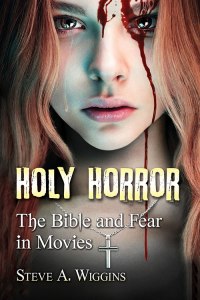
Those of us outside academe don’t have tenure committees to please or effectiveness committees to placate.  We write books to try to engage readers.  Unfortunately Holy Horror is priced for the library market.  During our phone interview, my interlocutor asked about the cover.  She said something publishers should hear: when walking around with Holy Horror her friends asked what the book was about because the cover is intriguing.  (It’s actually based on Chloë Grace Moretz from the reboot of Carrie, discussed in the book.)  In the midst of a pandemic, this first show of interest made my day, like seeing the first crocuses after a long, hard winter.  I do welcome conversation about my book.  I don’t have a classroom of students to force to buy and read it.  It’s out there for discussion.

Nightmares with the Bible is nearly finished.  Of course, publishers have hit a bit of a slow patch with many of their business partners shutting down.  Some publishers have gone into hibernation during the pandemic.  Books, though, will get us through.  A colleague of mine said the industry reports are showing that novels continue to sell while nonfiction is suffering.  Well, I’m no expert, but I do wonder if nonfiction might do better if authors would be willing to respond to this who express an interest in their work.  I know it’s a radical idea.  I also know that my books reach nowhere near what most publishers consider a viable readership.  What people are looking for during enforced isolation is a sense of connection.  Reaching out to find someone reaching back.  Books can do this, even if we never physically meet.


Amityville Revisited

Remakes, standard wisdom holds, are seldom as good as the originals. When the original wasn’t great to begin with, the bar should be lower. Should be. I’ve been curious about the Lutz haunting in Amityville, having just read the book that started the phenomenon back in the late 1970s. I saw the movie first. That was several years ago now, but I do recall that even as horror movies go it had its failings. Some of that goes back to the book (presuming that anything happened)—nobody had a solid grip on whether this was a ghostly haunting or a demonic infestation. What the movie did do well is show how fragile family relationships can be, especially when under the pressures of supernatural supervision, not of the positive kind. Although, as is to be expected, the book was scarier.

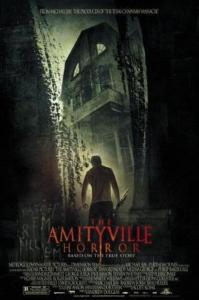
Overcome by curiosity I finally watched the remake from 2005. Clearly I’m not the only one still curious about this alleged haunting, alleged hoax. I also have the alleged burden of looking for religion in horror. Only on this final count was it not disappointing. Well, that and in featuring burgeoning scream queen Chloë Grace Moretz. Although Father Callaway’s role is late in the film and brief, early on religious ideas are implicated. If the movie hadn’t tried so hard to be The Shining these themes might’ve been developed to good advantage. Instead it introduces Rev. Jeremiah Ketcham (also late in the film) as the first owner of the house in 1692 (did the real-estate agent’s mention of that date make you shiver?). Ketcham was a sadist to the Indians under his care, torturing them to death in the house. No time is left to explore the sinister minister’s motivation as the family implodes in its attempt to escape the house by boat.

As is frequently the case with the supernatural, we’ll likely never know what happened at the Amityville house. The story Jay Anson told is now generally classified as a novel. The preternatural can be judged neither in the courtroom nor the laboratory. The best that we can do is make celluloid adaptations to make some money on the deal. The DeFeo murders happened in living memory. The Lutzes left the house in a hurry shortly after purchasing it. Anson’s Indian “asylum” was never really there—and there were no such Native American practices in any case. What the remake left out was demons. Although the movie attempted other religious scares, the house just isn’t the same without them.