Life Course

Curriculum vita.  The course of a life.  I see quite a few CVs, although I’m not on any search committees.  As I was examining one the other day I recollected how, when I first tried to put one together, I was told to leave high school and its achievements out of it.  Nobody’s really interested in that anymore.  Presumably college is an indication of choice whereas high school is a matter of where your parents live.  Or how much money they have.  College says something indicative about you.  Although many parents—not mine, to be clear—help bankroll college and may have a say in where you go, college is “your choice.”  Unbounded by geography, young people mostly old enough to take care of themselves, are given a really tremendous responsibility here.  And it was certainly influenced by high school.

Some choices are economic, and that also says something about a person.  Some are faith-based, which definitely says something about you.  Some are terribly ambitious, and those tend to get you the biggest head start on your life course.  Of course, some of us did not realize that.  Some of us, not sure if college would work or not, chose somewhere close to home.  Somewhere where escape, if needed, was possible.  And of course, your college shows up ever after on your CV.  I often wonder if things would’ve worked out differently if I’d gone somewhere else for college.  I needed somewhere understanding to shake me out of the false narrative I’d been told.  Had I gone somewhere more strident I might’ve retrenched in my pre-decided ideas.  Of course, those pre-decided ideas are what made me decide to go to college in the first place.

How can we possibly measure the course of a life?  From big event to big event?  So many of the meaningful bits occur in small spaces wedged in-between the large markers of who we are.  We can’t possibly know all the consequences of our choices, even as we attempt to select the right option at each step of the way.  And there’s no guarantee regarding the outcome.  Were it a feasible option I’d go back to college again—I would start at a different place this time—to test the results of my first decade of higher education.  For, I know, although a CV can reveal more than it might intend, it leaves much more unsaid than it can possibly say.

First Choice

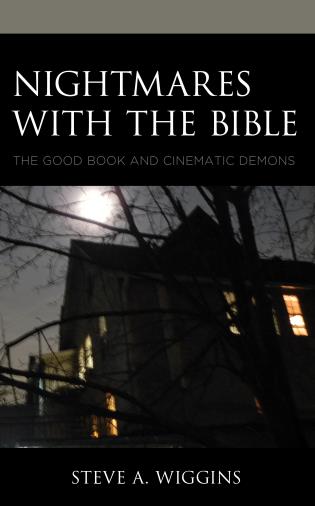
One of the first things I do when I finish a book, unless I know about the author already, is ecosia (google) her or him.  I want to know who it is that wrote this, and the internet’s right there!  So it came as a surprise to see my first (two-star) review for Nightmares with the Bible on Amazon, where the reviewer did no follow-up.  The reviewer is quite upset that I don’t take the Bible literally, but at least s/he bothered to leave a review.  A more positive rating might bring me up to three stars, but I’ve failed classes before.  I’m a big boy, I can handle it.  In any case, if you ecosia me you’ll quickly come upon this humble website that’ll tell you what you need to know.  No, I am no longer a Fundamentalist.  And the book was about demons in movies.  (I was actually searching for reviews of the series.)

I scrolled down.  The named reviews solicited for the book I knew, so I was surprised, and delighted, that further down the page I had a Choice review.  Even a disgruntled evangelical couldn’t bring me down after that!  In case you’re not a librarian, or an academic publisher, Choice is THE periodical librarians use for deciding on which books to buy.  It is very difficult to get a review in it—I work at a prestige publisher and seldom see our books in there.  If you’re a trade author that’s not so important, but if the only sales, or majority of sales, are for libraries, to get a “recommended” status is a big deal.  That’s worth celebrating.

If you’re wondering, authors do not get notified of reviews.  Some editors will let them know (my editor at McFarland hasn’t been in touch for years).  The journals are too busy doing what journals do to send every author a copy of their review.  So I swung by Amazon’s Holy Horror page.  I’ve got four ratings there now, mostly on the lower end of the scale.  If you’ve read it and liked it (not something I assume, of course) a nice review would go a long way.  Disgruntled evangelicals (aren’t they all, these days?) may make the books look bad, but colleagues who’ve read them seem to think differently.  I hold to the publishing adage that there’s no such thing as a bad review, but good reviews feel so pleasant.  I’ve only written one negative book review in my life, and that was because I felt any other would be utterly dishonest in that particular case.  It’s a choice I make because of the Bible: “For with what judgment ye judge, ye shall be judged: and with what measure ye mete, it shall be measured to you again.”