Twilight on Christmas

We have too many ornaments for the single Christmas tree we can afford.  There are few reasons for this.  One is that I married into a family with Christmas ornaments.  While on my own I never set up a tree and I owned very little beyond books and some LPs.  Besides, I went home for Christmas.  Another reason is that although I seldom think of Christmas before December, we tend to buy ornaments as souvenirs.  Not for everywhere we go, but we did start a ship sub-collection when visiting coastal locations.  We also have a moose sub-collection.  I spent quite a bit of my early adulthood out in the woods looking for moose, generally in Maine.  Then there’s the “other sub-collection.”  The one that’s be relegated to it’s own mini-tree.

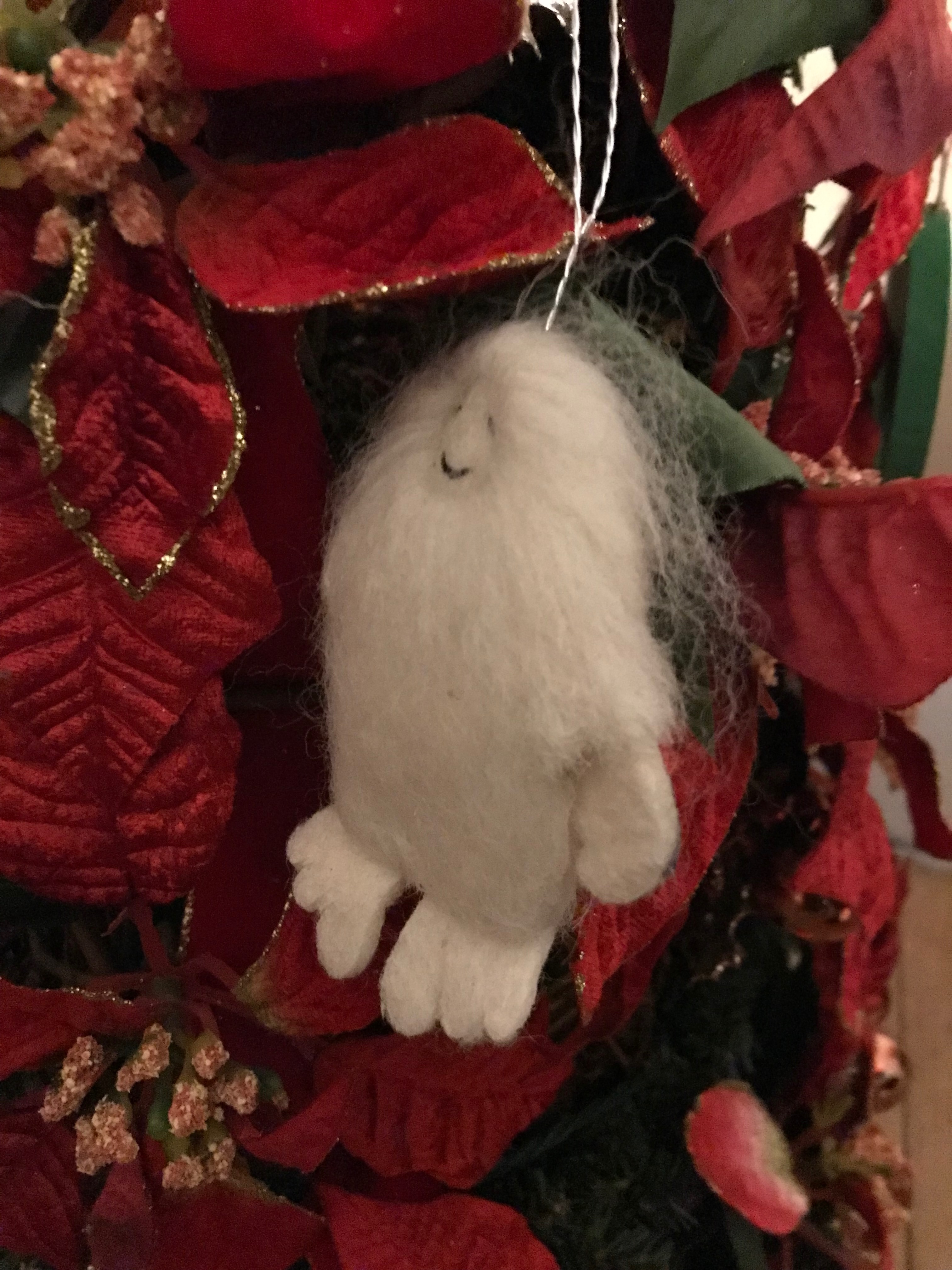
To understand this, let me begin by noting that Christmas is the birthday of Rod Serling (shoutout to my friend John Morehead for pointing this out).  Rod Serling is one of the reasons—he can’t take all the blame, of course—that I’m interested in strange things.  The Twilight Zone affected me profoundly as a child, and probably had more impact on my life trajectory than I might’ve realized.  The “other sub-collection” consists of the weird ornaments.  It began with a Cthulhu ornament I found online a few years back.  Then, at a fair trade shop in Ithaca, I found a yeti ornament.  How could I not support fair trade?  This year at Christkindlmarkt I found an alien head made from a recycled Christmas tree trunk round.  It seems my strange Christmas ideas aren’t unique.
Bethlehem styles itself “Christmas City.”  The celebration in the Lehigh Valley is palpable.  My family generally spends a December Saturday strolling up and down Main Street, visiting the quaint shops.  Last year one of them had ornaments of sasquatch skiing.  I didn’t buy it, thinking someone might pick up on my pointing it out.  This year I went back to the store but they didn’t have it any longer.  A quick online search, however, revealed many options for a cryptid Christmas.  What can I say?  These things make me happy!  This year I’ve been thinking quite a bit about ghosts and the holidays.  It’s an ancient connection that has been lost to the commercialization of Yule and Saturnalia and other December celebrations.  So, Rod Serling was actually born on Christmas day.  I hope that however you celebrate this day it will bring you joy, no matter how weird.


Poet Tree

Perspective often determines reality. Among those animals that can potentially live what seems to us a long time, humans measure centuries and millennia, looking for evidence of progress. An article reviewing Rachel Sussman’s The Oldest Living Things in the World, on a recent New York Times page, suggests reassessment might be helpful. When it comes to longevity, plants tend to have the advantage over animals. Although the Times article is only a sampling, here we find fungi and plants that have survived for thousands of years. Sometimes as collectives, sometimes as individuals, trees especially have proven themselves to be particularly vital. I was reminded of this as we recently went through the annual ritual of taking down the Christmas tree. We have, since returning to the United States after my doctoral program, visited tree farms where we select a still-living tree each December. Although they are grown to die, the Christmas tree becomes very poignant as it stands naked, ready to be dragged outside and dumped on the curb. The anticipation, the joy involved in welcoming it as a new member of the household, seems lost in the grayness of January. We have killed and now we abandon.

The Christmas tree is, of course, symbolic. Predating Christian solstice remembrances, the evergreen ironically reminds us that life has not ceased, despite the cold and snow. This particular tree has paid the ultimate price to bring another species joy for a few weeks. Can we so heartlessly throw it away? Of course, the community mulches the trees to give new growth to future generations, so there is a kind of sad resurrection here. Life dwells deeply with trees. Some of those highlighted by Sussman have survived since the Sumerians first learned to write on clay, to this very day. Some have survived even 8,000 years.

DSCN0869

Life is tenacious. Our tree by the curb still looks green and healthy to me. It has given life to a holiday season that always seems too brief, with its carefree days and sense of togetherness. We now have another year to survive until we might take a few days and ponder if there is indeed more to life than work. Without moving from its spot, simply being grounded in the earth that brought it forth, a tree can survive millennia as human civilization emerges with its frenetic madness and insistence that there is so much more to do and earn. I do wonder, however, if perhaps our long-lived forest dwelling companions might have some deeper wisdom for us. We can be born, grow old, and die in the shadow of a tree that was planted by generations past, or simply found its own way into the world. And after we’re gone there will be some who will look to trees and find an answer.


The Last December

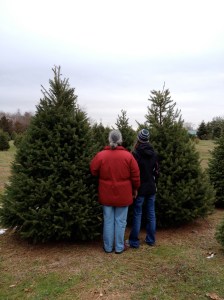
December 2012—it is supposedly the last month in the world. Yesterday did dawn with the date being 1212012, but since the local tree farm opened its gates yesterday, my family set out to select a tree anyway. As we wandered amid the pines it was clear that for many the iconic sign of Christmas is the tree. We learned on our first year in New Jersey that you’d better not wait until reasonably close to Christmas to pick out a tree—we visited this very lot then only to discover that precut trees were all that were available (and they were from Pennsylvania) and we had established a tradition of picking our own. Getting to know the tree first. Walking around and looking from all angles, trying to learn if it was healthy or too dry. Were there any gaping gaps that would be an obvious problem? Hard to tell when the tree is wrapped up in fishnet plastic and tucked into a corner like an old umbrella. Here, so close to the Big Apple, you need to claim your tree early. If you don’t want to cut it down right away, you can tag it—claim it as your own and come back later to chop it down. We weren’t the only ones taking great care in selecting.

IMG_0514

Tree farming is a business with a long view. Trees don’t mature overnight. When it’s the last month of the world, one must take these weighty things into consideration. Even before this terminal date, you would need to make an awful lot of money in just one month of the year to keep the business going. Maybe they need a green Christmas. Of course, greenery in winter symbolizes life in the midst of death. The germanic originators of the tradition were keeping a very appropriate pagan idea alive when they dedicated their trees to Christmas. Last year when we couldn’t have a real tree, it felt like we’d lost a friend. Our tree farming friends know that feeling very well.

The “Keep Christ in Christmas” signs and bumper stickers have begun sprouting up in yards and on bumpers in their annual exuberance. Funny thing is, Christmas has its base in ancient pagan customs. To hear the Bible tell it, Jesus’ birth was an understated event. The only people who had an angelic concert were some shepherds (we don’t know how many) on the hills outside of a small town. And, as far was we can tell, it would have probably been in April. As the days grow wearily short, however, we need a little light to keep us going. That was the pagan wisdom behind the Yule Log and various festivals of light to encourage nature to bring some brightness back. These short days can be difficult enough even in the age of artificial light and constantly glowing electronic screens. And knowing this is the last month of the world, we want to festoon our trees with tiny pinpoints of expectation and hope that nature somehow gets the message that we’ve had enough of darkness and wish for a 2013 redolent with light. But we’ll just have to wait and see.


Darkest Night

One of the more endearing of human weaknesses is our fear of the dark. For those who live north of the equator, we have just experienced our longest night. It is no coincidence that the religious holidays that occur in winter feature light. In our helplessness against the encroaching darkness, we light our Christmas trees and Hanukkah candles, adding just a bit more light to the world. Among the oldest of all holidays is the day that marks the birth of light’s resurrection. One need not be a pagan to appreciate the solstice and the inherent hope it bears for the return of the sun.

In this season we often see signs and hear laments about the absence of Christ from Christmas. Jesus was not born in winter, according to our best reckoning. One of the carols that drives me mad with distraction is “In the Bleak Midwinter” with its maudlin description of “snow on snow on snow”—clearly written by someone with limited experience of winters in Israel. Christmas falls near the solstice because people have from earliest memory recognized the sacredness of this season. When Jesus was born nobody knew he was to become so famous as to have one of the most popular Facebook pages ever, and so nobody thought to write it down. Even the Gospels the disciples never give a rousing chorus of “Happy Birthday” while on the dusty highway. What we’re celebrating is that night will not reign forever.

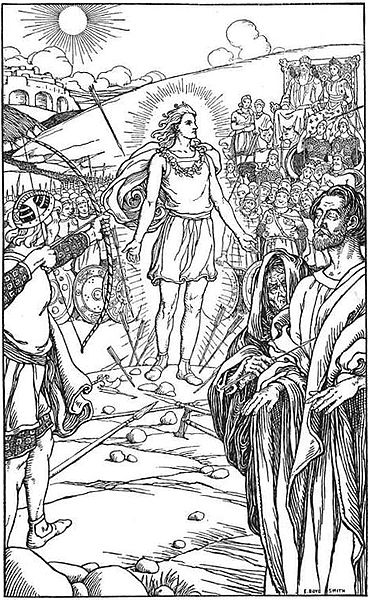
Having evolved to favor our eyesight, but lacking the standard mammalian nocturnal nature, we feel vulnerable in the dark. Even if Jesus hadn’t been born we’d be celebrating at this time of year. It might have been the re-living of the mythic Golden Age of humanity under Saturn that the Romans called Saturnalia, or it might have been the rejoicing over the resurrection of the beloved god Balder among the Norse. We might have had to wait until the days were noticeably longer to fete the goddess Brigid with the Celts at Imbolc, but we would have marked the occasion. Instead of cursing the pagan darkness, as the saying goes, we would light our feeble candles as a sign of hope. The reason for the season is the fact that the longest night is over and once more our days will slowly return light to our lives.

Here comes the sun


O Tannenbaum

Today we put up our Christmas tree. As we drove home with it strapped to the roof our car yesterday we felt like pariahs since everyone else in New Jersey seems to have collected their tree a week or two before Thanksgiving. I have spent too long among Episcopalians to appreciate such eager chomping at the bit. At Nashotah House Christmas trees were discouraged until about Christmas Eve, since a hearty Advent celebration was considered a sign of true piety. Well, with a small child in those days, we didn’t care to deprive our daughter of the childhood anticipation of Christmas, so we received the ugly stares due to those so uncouth as to set up a tree a week in advance. Now people think we procrastinate to wait until the weekend before Christmas to set up our interior conifer.

A few years back I wrote a book on holidays for teenagers. I haven’t found a publisher yet, but I did quite a bit of research that I’d rather not waste. Sometime soon I will post the Christmas section under Full Essays. It is chock-full of traditions and facts and impressions about Christmas and what it has come to mean to us today in the United States, but since today is tree day for us, I thought I’d start out with a little of the story of the humble Christmas tree:

The modern use of Christmas trees can be traced directly back to Germany in the 1500s. The earliest written reference comes from 1570 when a fir tree was set up in guild houses and decorated with apples, nuts, pretzels, and small things for kids. On Christmas Day the kids of the guild members could come and take the hanging gifts. The apples may go back to plays in the Middle Ages with Adam and Eve; sometimes plays of the Garden of Eden had apples hung on a fir tree. A tradition says that Martin Luther, the monk who started the Protestant movement (the Reformation) was walking home one winter night when he saw the stars twinkling through the branches of the pines. He set a tree up in his house, the story goes, lit with candles, to try to recreate the effect.

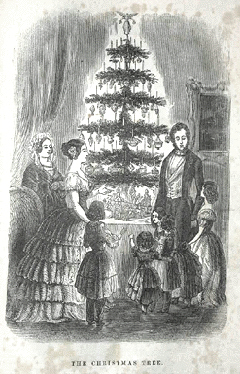
We do know that the Christmas tree (originally Tannenbaum) was a German invention. Until the 1800s it was almost completely limited to Germany. Candles were used to light the trees – talk about your obvious fire hazard! Royalty from other European countries were presented with Christmas trees as a novelty in the 1800s. Soon other well-to-do families started to set them up. An engraving of Queen Victoria in England with a tree from her German husband Prince Albert captured the public imagination and Christmas trees became the rage in England. Charles Dickens took over and the rest is history.

A Christmas Tree primer