Sweet Tooth

I don’t have a sweet tooth. I count that as a personal flaw, but the fact is I don’t seek out sugary snacks. Still, who doesn’t enjoy a nice chocolate once in a while? My wife and I attended a local chocolate tasting event recently. This was a new experience for me. Being of working class vintage, I tend to look at comestibles in a purely pragmatic way—food is for eating. It shouldn’t taste too bad, and ideally it should be healthy. Between meals I seldom think about eating unless the time stretches too long and hunger kicks in. I’ve read a couple books about chocolate, however, and I was curious what I might learn.

Apart from learning the disturbing fact that much American chocolate isn’t really technically chocolate, it was an enjoyable evening. The proprietors of Carol’s Creative Chocolatez know their stuff. The event began with a history of cacao beans. Native to the Americas in the equatorial regions, it was only after Columbus’s fourth voyage that Europeans discovered chocolate. Indigenous peoples used cacao beans as currency, and chocolate was the food of the gods. Its technical name, Theobroma, means just that. When Columbus appeared, a white man with European garb, and horses (as well as exotic diseases), he was ironically thought to be the returning god of chocolate. Instead, he took the previously unknown delicacy to Europe where various means of preparing it began. Eventually we ended up with the sweet, sugary variety that is considered standard today.

Theobroma plants contain a compound that creates feelings of euphoria. Chocolate, in other words, rewards you for eating it. It’s easy to see why indigenous peoples assigned chocolate its own deity. It’s also perhaps not surprising that what was mistaken for a god became a deadly plague. While Europeans were mostly interested in gold during the early period of exploration, they eventually realized that exotic foods and spices could be almost as good as gold. Chocolate, the food of the gods, could be mass produced and degraded and sold as an addictive treat to children. Such we do with our divinities. If only obesity were the same as obeisance! Instead, we are presented with a treat that tastes good and makes us feel happy. Like most gifts of the gods, it’s best enjoyed in small quantities. Even a little gold will go a long way. And after this evening, I think theology may help to explain the fascination with Theobroma.

The Open Sea

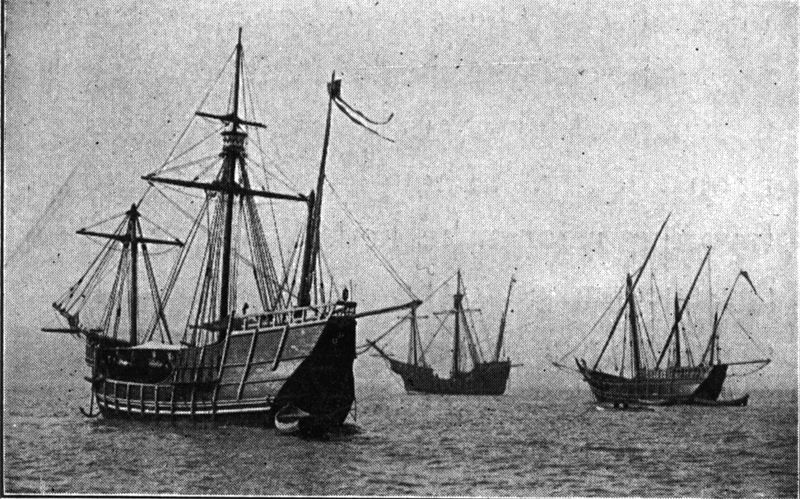
498px-Christopher_Columbus“In 1492,” they tell me, “Columbus sailed the ocean blue.” As a feat of science in the age of discovery, there is no doubt that this was an event worth celebrating. Over time, however, the luster has diminished somewhat. Although I can speak only for myself, I often feel that being a male caucasian is a decided liability. It certainly has been in my professional life. Although my ancestors were probably busy grubbing an existence from the soil as Columbus nobly stood on the forecastle, spyglass in hand and India in his heart, we are classed together. Attitudes toward divine destiny were much different then. The European powers that had made the world they discovered in their image could only see this as the will of the Almighty. That’s the liability of omnipotence. What happens is, by definition, God’s will. As technology led from success to success, Columbus set off to shrink his world. And get rich in the process. What’s so wrong with that?

The view among the displaced may be very different. People, if pagan, happened to be living in Canaan before Moses arrived, according to Holy Writ. They were, however, an annoying inconvenience to a God who had it all planned out. And since that torch had been passed to the Christian leaders of Europe, although contested by the Muslim leaders elsewhere, they had to follow their destiny to these sacred shores. Oh, I’m sorry! Were you sitting here? And those who march in the parades do it a bit more self-consciously while the majority of us continue to work in New Amsterdam as if nothing extraordinary had happened. As if a genocide hadn’t led to prosperity. As if, although God has disappeared, this wasn’t manifest destiny after all.

Humans can’t be blamed for being curious. It is part of our nature. I do wonder what will happen when we finally stop fighting one another and land ourselves on another inhabited planet. One where they haven’t achieved the technology that we have. Will we have learned anything from the St. Columbus Day massacre or will we still be guided by our confidence in lenses that can see billions of years into the past, see the havoc we’ve visited upon our own planet and still say, “it is good”? Even on the bridge of the Enterprise there is only one alien standing, and he is wearing earth clothes. Can we be disinterested observers when potential wealth lies below the feet of those we meet? We respect your culture, but hey, what’s that you’re standing on? Mind if we take it? You’re not using it. And once their voices have been silenced, we’ll seek other oceans blue to sail.


Believing is Seeing

A story has long circulated that as Christopher Columbus approached the coast of the “New World,” Native Americans staring out at the water—straight at his ships—could not see them. This instance of perceptual blindness has been adequately explained, of all places, in the Fortean Times. The best explanation: the natives could see the ships but did not have the referential framework to know what they observed at first. The story still circulates, however, that to them the ships were invisible. An interesting analogue arose when I was reading about Thomas Edison recently. The phonograph was first developed for speaking voices, not music. It was not an immediate success. One of the observations that Edison made also applied to the telephone: when people first heard it, not knowing what it was, they could hear voices but couldn’t make out what they were saying. Once it was explained to them what was going on—a voice had been recorded and was being played back, or a person’s voice was being carried over a distance through a wire—they immediately comprehended what they heard. Not exactly perceptual blindness, but very human indeed.

When people encounter something completely unexpected, surprising, they don’t quite know what to make of it. So we see anthropological pictures showing natives replicating airplanes from grass and twigs, ascribing to these strange birds some kind of divinity. Imagine an iPad in the hands of Moses. Neuroscientists are rather new to the coterie of specialists trying to explain the origins of religion, but a gap remains between perception and science. Active areas of the brain can be traced, but what the experiencer feels remains utterly subjective. It is a realm into which science cannot go. Perception, it is supposed, is simply an evolutionary tool to find food while avoiding being eaten, oh, and also to reproduce. The experience of the perceiver is much more profound. Consciousness, a sense of selfhood, why some are poor while few grow rich, these are facets of life that add dimension to perception and make me wonder just how far down the rabbit hole it goes.

Religion is all about perception. The problem is not that no one tells us how to interpret our experiences, but rather too many interpreters are only too eager to step forward. Perception, it is said, is reality. When encountering the unknown our best road-guide is our senses. In the case of religious phenomena, that guide is supplemented by tradition. What do you see when you look out on that horizon? The answer will indicate what you believe.

I saw three ships?