God Discount

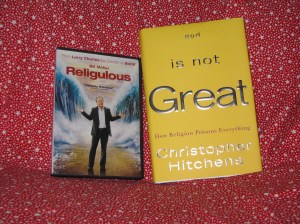
God is great, despite what Christopher Hitchens wrote, at least, that is, if you want to save 15% without having to talk to a gecko. According to Mulder’s World—I want to believe that what I find on this site is true, but often I find myself feeling more like Scully—Mary’ Gourmet diner in Winston-Salem, North Carolina gives a grace discount. Well, perhaps this is believable. Praying in public has a long pedigree. This past Corpus Christi as I was driving back into town after a day out, I saw a procession walking down the street a few blocks from the local Catholic Church. Vested and carrying a monstrance with a humeral veil, the priest led the faithful out in public for a little recognized festival many suppose to be named after a city in Texas. Actually, I was an acolyte for Corpus Christi one year at the Church of the Advent in Boston. The well-heeled of Beacon Hill, however, knew to expect us out on the genteel streets. Private prayer in public, however, is something quite different.

As a very religious teen, I often went to United Methodist Youth events with the other faithful young. We would stop into restaurants on our long drives and make a show of praying amid the heathen. Some of us (not me, I assure you) even left Chick tracts instead of tips. If we’d ever ventured into Dixie, we might have had a discount. The problem with offering a praying in public discount is that it is impossible to tell if such shows are sincere. I have sat through many such episodes, wondering about Jesus’ statement “But thou, when thou prayest, enter into thy closet, and when thou hast shut thy door, pray to thy Father which is in secret; and thy Father which seeth in secret shall reward thee openly.” Well, that was only the Sermon on the Mount. Here we’re talking fifteen percent! “For where your treasure is, there will your heart be also.” This gecko winks.

IMG_1502Public displays of piety are not uncommon. I spent yesterday at the local County 4-H Fair on a rare day off of work. The Gideons, as always, were there handing out New Testaments. Let your light so shine—they are bright orange. Religious freedom ensures that prayer in public is kosher, as is agnosticism in public. Who is harmed by a public prayer? In that diner, who is made uncomfortable? Sometimes the innocuous act of kindness is a sign of mature morality. How many times—isn’t it nearly always?—does that car cutting you off in traffic have a Jesus fish plastered to the back? “I drive my car,” Daniel Amos sings, “it is a witness.” What you truly believe shows up when you’re behind the wheel more than when you’re behind the napkin. The truth may be out there after all. In the meanwhile, my tip’s on the table.

Without a Hitch

I’m not really afraid of dying. All those years of being taught that “to die is to gain” have obviously done their work. At the same time, it is a poignant exercise to read the posthumous memoirs of a dying man. I remember my first funeral. Although I don’t recall the name of the poor, deceased honoree, I still see the reactions of the living vividly. I was under ten at the time, and the funeral home in Franklin, Pennsylvania was in a very somber mood. The man, who had been a friend of the family, “was not a Christian.” Having been buffed and rubbed in the Fundamentalist tub from my earliest days, I didn’t realize that what was meant was actually that he hadn’t been an active member of our particular church. Nevertheless, as a child, you get deeply impressed with these kinds of things. “I’ll never go to the funeral of a non-Christian again,” I remember my mother telling a friend. “The minister couldn’t find anything comforting to say.” While funerals are sad occasions by definition, this one left a crater that is still fresh over forty years later.

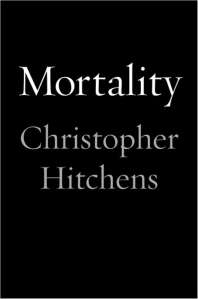
MortalityChristopher Hitchens is someone I found through his book God is Not Great. I don’t have time to read magazines, and I hadn’t read any of his previous works, but he raised some extremely valid points in this diatribe. My wife recently bought me his final oeuvre, Mortality. I felt as if I were back in that funeral home. It is not that I still hold to the odd belief system of Fundamentalism—of this my regular readers will have no doubt—but it is the forlorn feeling of reading the words of someone dying who hopes for nothing. Yes, it may be Stoic, and even noble. Certainly it seems far more worthy than visions of living in opulence with lots of available virgins with whom to toy while angels strum their harps overhead, but the certitude that one’s final days will be nothing but prolonged suffering—ouch! Maybe there isn’t a heaven, and if there’s a hell there’s something morally wrong with the universe, but doesn’t some residue of a human life remain? Even if it’s just the memories, the marks that we’ve made on others’ minds, don’t we somehow survive? Dying without hope nevertheless feels like milling about in that doleful crowd of specific Christians years ago.

Hitchens does offer a chapter in his final words devoted to those Christians who responded to his cancer with an unholy Schadenfreude, trying to torture the thoughts of a dying man with the promise of an eternal hell after experiencing a temporary hell of cancer treatments. This chapter made me sick. Anyone who so completely misses the message of compassion that suffuses the Gospels can hardly claim the designation Christian, I would insist. No one, no matter what their eternal plans, has the right to try to fracture anyone’s tenuous tranquility to make their own crown shine a little brighter. Such weekend warriors likely imagine that they are defending their fragile God, but in reality they are demonstrating that some of the criticisms of Hitchens were very well placed to begin with. No religion will live up to its full potential until it succeeds in the most basic practice of all—treating all people with respect and dignity. Until then, death has the final word.


Coexistence

Sometimes I think I’m a punching bag. Not uncommon among scholars of religion, I suppose. I have read my fair share of overt attacks on religion: Hitchens, Dawkins, and even Jillette, and sometimes limp out of the ring wondering why I even bother. Still, science doesn’t completely explain the universe I inhabit either. Thus is was with some glimmer of hope that I read a story in Monday’s Chronicle of Higher Education entitled “Does Religion Really Poison Everything?” There can be no doubt that religious behavior has a track record of some execrable atrocities—some very bad behavior has been engendered by fervent religious belief. At the same time, those who despise religion have a hard time explaining it. As the Chronicle piece points out, religion is likely an evolved trait. There is some survival value in it, otherwise it would, by natural selection, disappear. Religion is seldom a rational enterprise. That doesn’t mean that it can’t be rationally studied, but rather that religion is primarily experienced as an emotional phenomenon. We find ourselves motivated by feelings, although reason will often drive us to do things we don’t feel like (like going to work). And emotion is necessary to be truly human.

It is often difficult to respond to those who castigate religion as an evil or poison, not for lack of reason, but because of feelings. Having spent most of my life with religion, it is not surprising that attacks on it often leave me feeling ashamed. But ah, that is an emotional response! It seems rational on the surface, but really, shame and embarrassment are typical emotional responses. This is the realm of religion. Reason may indeed indicate with great accuracy the way the universe works—of this I have no doubts. At the same time, I’m not sure the entire universe is something that humans can adequately comprehend. I have a hard time remembering what’s on a short shopping list if I accidentally leave it at home. Our brains aren’t equipped to the task of comprehending universes. Feel overwhelmed when facing a physics test? That overwhelmed feeling is an emotional response. With considerable cheek, might I suggest it might even be a little bit religious?

The Chronicle is a high-profile source for academic rectitude. I am pleased to see Tom Bartlett pointing out that the line-drawing in the sand between religious Fundamentalists and pro-science New Atheists will not solve anything. Religion is often guilty as charged. It is not, however, pure evil. There is enough evidence out there to suggest that religion is a tremendous coping mechanism for billions of people. And coping is not a bad thing, all things considered. Wisdom that is often attributed to the Greeks suggests that “all things in moderation”—the golden mean as it’s known—is the way to human happiness and success. The idea is older than the Greeks, and indeed, can even be found in the Bible for those who are willing to look. One need not be religious to see that, like most human inventions, religion has both good and evil uses. Evolution gave us religion, and it gave us science. It also gave us brains divided down the middle and strong reasoning that must dance with creative emotion in a tango that frequently makes abrupt shifts of direction. Our job, as humans, is to learn the steps to the dance.

Different, but equal.


Bible Experts All

I seldom write follow-ups to my own blog posts – I’ve always found self-referential academics somewhat distasteful, and besides, what is creativity without some variety? Nevertheless, it seems that yesterday’s post has garnered a bit of interest in the disaffected outlook of a self-professed biblical scholar. (Actually, I have three “higher education” diplomas rolled up neatly in tubes in some untidy closet that show that some universities also accuse me with this charge.) Perhaps I need to clarify.

When reading a blog post, it is very difficult to determine the position of a writer’s tongue in relative proximity to his/her cheek. (Those with eyes to see, let them hear!) The subject might be funny if it weren’t so deadly serious. Despite my reservations with Christopher Hitchens, Sam Harris, and Bill Maher, they have all underscored a vital point – biblical literalism is very dangerous. This is even more so the case when, in their own minds, all people are Bible experts. We attend school and learn to read. Some learn to read more deeply than others, yet all “know what the book says.” There is no way to dispute that belief. Belief is belief, requiescant in pacem. Some commenters wondered why the opinion of “Bible experts” should matter at all.

When I’m feeling ill, I would prefer to ascertain the opinion of someone who has actually earned a proficiency in human physiology. When the car breaks down (again), I prefer to have someone who understands machines well as the repairer. When many, many people want to know what God doth require of thee, they turn to individuals who have not been thoroughly trained in Bible. I taught in a seminary for many years, and as an administrator, became quite familiar with the accrediting requirements of the Association of Theological Schools, the nation’s main seminary accrediting agency. I may unequivocally state that few seminarians emerge as full-fledged Bible scholars. Some “denominations” do not require any seminary training at all. So when your spiritual life breaks down, most folks head to an “expert” ill-equipped to handle the Bible, a homeopathic (no slur intended) literary diviner.

Purely from my own perspective, I would prefer to know what the Bible, in its own context, language, and words, is more likely to have meant. Delusions and all. Can’t buy that at your local church, with rare exceptions. That is the role of the humble Bible expert. As with any field of study, it is obvious when you have found a true expert. Such a one will readily admit that she or he has more questions than answers.


The Call of the Apocalypse

In discussing various polemics against religion, such as those by Christopher Hitchens and Bill Maher, I have frequently stated that they have a point, but they have ignored the good that religion hath wrought. It is like an Anti-Julius Caesar – the good is oft interred with the bones. Then the news goes and validates their polemic. The arrests yesterday of the leadership of the Christian militia calling themselves the Hutaree (I’m sorry, but it sounds like a happy Boy Scout gathering) highlights once more the danger that religion poses to an already unstable society. I’d not heard of the Hutaree before, and chances are I would never have heard of them had they not plotted an apocalyptic war against the United States’ government that landed them on the front page.

Few people are willing to admit just how dangerous apocalyptic thought is, or how deeply rooted it is in American politics. Tracing the roots of this form of belief is not difficult – apocalyptic first appears in the Bible when revelation through prophecy met and mated with Zoroastrianism’s dualism. The offspring of this union was the belief that a new, and better (!), age was about to dawn. God would usher in an era of peace, but it had to be precipitated by an era of war. Presidents drawn from the Religious Right have held this belief. Some have even eagerly begun wars in hopes that this ancient Afghanistanian religion would lead to the Christian apocalypse. At least the Hutaree were up-front about it: they believed that armed conflict with the government would flush out the Antichrist and usher in the end.

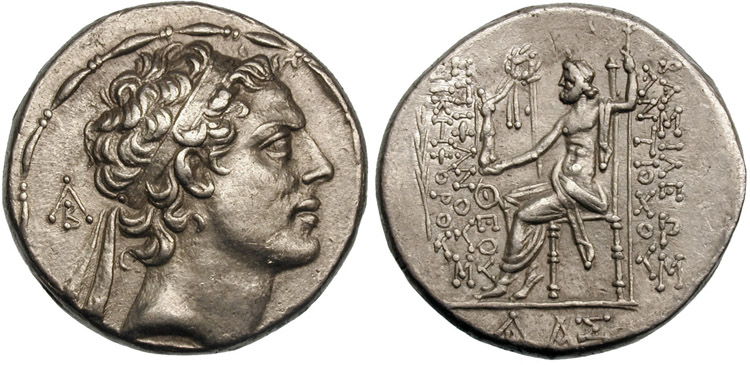
Last night in my Prophets class student questions indicated just how much interest there is in apocalyptic. We live in an era when information is all-too-easy to find, and yet many otherwise intelligent people believe that a hidden knowledge about the future is available in the Bible. It is not. For those who have ears to hear, Daniel was written about Antiochus IV Epiphanes. Revelation was written about a Roman emperor (perhaps Nero or Domitian) who threatened nascent Christianity. The apocalyptic battle was already underway. The future they longed for was peace. Modern apocalypticists see all of this as future prediction and believe that they must start the war. All of this makes me feel strangely vindicated. The FBI and other government officials are starting to demonstrate an awareness that to prevent religious extremism you must understand it. Now if only universities would catch on and realize that the study of religion is vital to national security I might end up with a full-time teaching post after all.

The original Antichrist


Religi-Religi-Religi-Religulous, That’s All Folks!

Tell me where is fancy bred,
Or in the heart or in the head? (Shakespeare, The Merchant of Venice)

Every great once in a while, a must-see movie comes out even for religion specialists. We have to lay aside our Biblia Hebraica Stuttgartensias for a while, stare at one of the talkies and scratch our heads. Last year my students asked me what I thought of Bill Maher’s Religulous, but I didn’t have a chance to see it (couldn’t afford it on the big screen, and who has time during the school year anyway?). So I finally got together with a friend to watch it on the small screen.

First off, the film is funny — hey, it was written by a comedian, so it’d better be funny! As Maher ticked off point after point after point where religion falls short of the mark, I felt as though I were watching Christopher Hitchens’ God is Not Great on the television.

Let's be friends

Let's be friends

Maher scores some big points for having done his homework on mythology and pointing out the mythical elements in mainstream Christian thinking, but I was left with some very basic questions: what about those who hold to religion for good reasons? What about those who don’t strap bombs on in the name of religion? What about those who promote humanitarianism for religious purposes? Can they be classed together with dangerous folk who use religion for nefarious rationales to get back at their enemies (generally anyone they don’t know)? The scenes of religion-inspired violence were extremely disturbing, but I was curious about the benign varieties of religion. Do they do any more harm than taking a toke, as Maher does a time or two in the film?

It occurred to me that religions offer a way out from what can be a very humdrum world. Evolution is certainly fact, but the long, slow process of evolving into something better fit for its environment doesn’t spur on the emotions like the Battle Hymn of the Republic. But isn’t that it in a nutshell? Religions show their flashier colors when they are in conflict, like peacocks competing for the affections of a peahen. Even those interviewed by Maher tended towards the more flamboyant practitioners of their faiths. What should really be on the docket is hatred. Religions may aid and abet those looking for excuses to harm those different from themselves, but religion is often the catalyst, not the cause. As religion goes through the long, tedious, and often painful process of evolution, it is sure to breed virulent strains that are nasty and evil, but once in a while the panda’s thumb emerges and humanity is ready for its next painful step forward.