Degradation

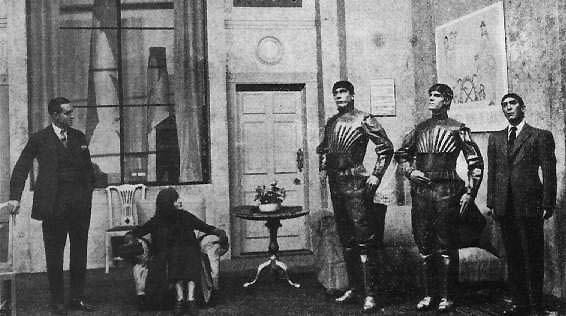
Having felt like an automaton in the realm of higher education, I was occasionally overwhelmed by the number of students and lack of resources. One of my fervent beliefs is that multiple-choice tests do not really demonstrate what a student knows, but playing the numbers, I sometimes had to resort to them. Being an adjunct, I didn’t have access to Scantron, so I devised a method of stacking the sheets precisely and grading them with a power drill. It was my one bit of notoriety at Rutgers—I was the guy who graded with a drill. All the while, however, I knew that a truer method would be to allow students to write for themselves. Even that, however, is going the way of automation. A recent story in the Chronicle of Higher Education reveals that student papers are sometimes being graded by robots. Real robots. The truly scary part of the story is that the robots provide grading almost indistinguishable from the professor, a species quickly becoming obsolete. I tell myself not to panic.
“Don’t panic,” of course, was the catch-phrase popularized by Douglas Adams in the Hitchhiker’s Guide to the Galaxy. In a world overwhelmed by forces we can’t hope to understand, panic is a natural enough reaction. Adams gave us Marvin the Paranoid Android. Higher education has given us the paranoid professor. Parents who pay extraordinary—mythologically high—tuition rates often ask me where all that money goes. It certainly doesn’t line the pockets of humanities professors; indeed, many of the classes are taught by adjuncts who are the penny dreadfuls of academia. I don’t know where the money goes. I do know that university presidents and football coaches are not wanting for material goods, but even their greed can’t account for the entire greenback drain.

If I were still a professor I’d be tempted to ignore the sage advice of Douglas Adams about now. Courses can be covered by an overwhelming army of competent adjuncts, and grading can be contracted out to robots. Students really don’t even need to come to class any more as distance education has taught us. College becomes little more than an excuse to drink while away from home with a hefty tab being picked up by the folks back home. Higher education may have had the seeds of its own destruction always planted within itself. We’ve confused technology with the desire for increasing comfort and ease of lifestyle. It was only a matter of time before universities caught up. Standing by the grave of Douglas Adams in Highgate Cemetery I’m thinking that his bizarre vision of the future was more sensible than what has actually evolved in our culture. That, and I’m glad I learned to use a power drill.


Lower Education

Is there anything that can’t be sold? I think in the context of the free market, with its oxymoronic name, the answer must be a resounding “No!” A concept may be sold as a piece of writing or a patent or a trademark. Souls may be sold to the devil, at least according to the entrepreneurship of demons, if centuries of folklore are to be believed. A person who has betrayed his or her ideals is a sell-out. We can sell anything. Two related stories in the Chronicle of Higher Education confirm, in very different ways, this truth above all truths. The first piece, “More Notes on the Rise of Thrun Credits,” by Kevin Carey, notes how universities are in the business of selling academic credentials. Those of us who’ve gone through the educational grind-mill that leads one to poverty with the dubious benefit of a Ph.D. diploma to hang on the wall of our cardboard hovels, found this out the hard way. What matters is not what you learned or how well you learned it: where did you go to school? That is the most important commodity that a university sells—its name. It is sad that academia has gone after Wall Street, but there’s no changing the direction of this charging bull.

The second article, which I only spied because of a link on the first, was a tribute to Irving Louis Horowitz, world-renowned social scientist and founder of Transaction Press. In my days of desperation at Gorgias Press, looking for a new position that would make use of my editing and higher education (sales) background, I had contacted Transaction and ended up having three lengthy interviews with Dr. Horowitz. He was well known for his quirks, but he always had a kind word for me, and even read my book to find out more about me. Such determination and depth of investment are rare these days. In the end, I never did find a place at Transaction, although it was literally a ten-minute walk from where I taught my Rutgers classes on Livingston Campus. Publishers, it stands to reason, are also in the business of selling on the basis of reputation. Once Dr. Horowitz said as much during one of my interviews. “Without reputation, what does a publisher have to offer?” he asked.

Both of these ventures in which I have participated began as sources of disseminating knowledge. I was naïve enough to suppose that such ideals could survive the onslaught of that hissing serpent called finance, yet it is sad to be in a world where nothing falls outside its coils. Long before the birth of capitalism universities managed solvency and provided the intellectual inquiry that eventually led to its own demise. Publishers always sold their wares, but many pieces were published for the sake of their content, not their earning potential. That world no longer exists. In order to be paid you must have something to sell. All other transactions are null and void. We send our children to college to find jobs, not to learn. Maybe it’s just as well. Schools are busy with marketing and branding, so let our young ones learn the only system that works. For those interested, I have some swamp-land in Florida to sell…


Brother, Can You Spare a Term?

Last Friday the Chronicle of Higher Education had a blog post asking how NTT (Non-Tenure Track) faculty pay the rent. In the light of recent news stories about the nascent gathering of data on the forgotten generation of scholars, universities are finally starting to scratch their heads and wonder, like Frankenstein, what they’ve created. Well, the article asked a question and invited responses. I couldn’t help myself—six scary years of my life were spent in that dark chasm of no security—and since I offered a few sentences about my experience, email reminders popped up for the next several hours when other comments were added. It made for a depressing day. All day long stories appeared of women and men with PhDs who live on food stamps, fall behind in their rent, and even cancel the classes the unsuspecting parents pay so much for because they can’t afford gas for their cars. Meanwhile, let’s build a new stadium.

Education is the most important invention of all time. Without it we’d still be warming our toes around the fire in our cave, wearing smelly animal skins. The natural enemy of education is sometimes the institution. Institutions, especially those that continually turn an envious eye towards corporations (often among the least enlightened of human ventures) as a model for emulation, are steering a sinking ark. Both church and university have become poster children for the corruption that creeps so insidiously into organized structures that have lost the way of pure intentions. The call of the wealth is far more savage than the call of the wild. The wolf pack does not devour its own.

Well-paid industrial analysts, I’m sure, are being offered handsome sums to figure out how to make universities more efficient. University presidents and sports coaches drawing down six-or-seven figure salaries shrug their flummoxed shoulders—what could possibly be the problem? Perhaps we need even more upper-level administration to sit and think this out. Meanwhile parents stressed to their financial wit’s end are slowly beginning to learn that the ones teaching their daughters and sons are the adjuncts who now make up well over half the teaching force in higher education. I would not presume to guess which direction higher education is going. It does seem entirely probable, however, that when the wolves are done with this meal, a scattering of bare bones will be all that’s left. After all, in the wild a lone wolf is a dead wolf.

The corporate emblem.


Academic Omelets

As an erstwhile accidental adjunct, I came to see a side of the academy increasingly rare these days: the professional who must earn his or her keep. That life is less than half-a-year away and I still look to see what is happening as higher education crumbles under its own excessively disproportionately top-heavy infrastructure. An article in a recent Chronicle of Higher Education outlined how an adjunct, on his own initiative, began a survey of working conditions for those in similar academic situations. The results went viral and universities felt the need (only occasionally) to justify their actions. Expediency at the cost of a few eggheads nobody worries about, but when the news starts to leak like so many yolks, it is about time to at least act concerned. The phrase that stuck in my shell as I read the piece was this: “many adjuncts nevertheless feel they embody a lower class in academe.”

I felt like a bulls-eye had just been struck, and that bulls-eye had been painted on my forehead. Higher education has always been subject to claims of elitism and exclusivity. I entered the industry because at every stage along the way my instructors encouraged me to continue since I thrived in that atmosphere. I had entered higher education, however, from a humble, working class family. No dreams of power drove me—it was the sheer joy of learning. When I tried to situate myself among those who had had a leg-up in life, it was an uneasy fit. It’s like that uncomfortable feeling when a homeless person sits next to you on the subway. You know you could help, but you know there is an invisible wall that separates your world from his or hers. And hopefully, somewhere deep inside, you also realize that that homeless person could have been you.

The adjuncts are the working class among higher education. At some schools the full-time faculty teach very little and get to earn their lights as the brilliant minds who write books. I’ve written a couple myself. The difference is, they are bona fide. Privileged. Education used to be considered a great leveler. As in most myths, the truths in that sentiment are heavily metaphorical. Education could level the playing field if people weren’t prone to accept privilege when it is offered to them. What adjunct would not just as soon become the full professor with a light load and the fame of being featured on television and interviewed in Time? I don’t mean to single out universities—people in all situations tend to behave that way. No, I don’t single out universities. It was just that I hoped they might have been above this kind of thing.

This is your life, on adjuncts.


Adrift

We all have the gift of critical thinking to thank for the world of relative comfort in which we live. That doesn’t mean we always appreciate the source of the gift; in fact, America has had a long history of anti-intellectualism, a distrust of those educated “European style.” Nevertheless, universities in the United States far outnumber those in most nations. Overall they represent a tiny fraction of our culture and workforce, however, and when any institution become elite trouble will follow. I just read a review of Richard Arum and Josipa Roksa’s Academically Adrift in the Chronicle of Higher Education. Arum and Roksa, sociologists, have done a study of university outcomes in the United States and the results are failing. More specifically, a large proportion of students emerge from college having learned little and heavily in debt for their effort. Having just learned of the book, I haven’t had the chance to read it yet, but Kevin Carey, in his review, notes that the disparity breaks along the lines of privilege.

Those students who enter college from well-to-do backgrounds, having attended fine schools, learn a great deal and are very unlikely to end up unemployed. The other group, by far the larger of the two, is comprised of students from schools mediocre or worse, hails from somewhat humble financial circumstances, and will like find unemployment at the end of four years with little true education. There can be no excuse of ignorance, for universities have known of this for many years. In the words of Carey, “Academe was so slow to produce this research because it told the world things that those in academe would rather the world didn’t know.” Some of us emerged from higher education in profound debt, but even with good study skills, lack of connection equals great uncertainty. Classism is alive and well in America, but unfortunately universities have been quietly playing a supporting role.

The truly sad part is that many people already assume the worst about higher education. We like to claim education to be a great equalizer, but that will never change the fact of who your daddy is. The upper crust looks out for its own, and when it comes to the tremendous costs involved to maintain universities, the bulk of the tuition comes from those who benefit least. How long before university presidents with their pseudo-corporate salaries start asking for a federal bail-out? How many times can those who have too much cry that they can barely make ends meet? It can cost a lot to ensure your kids get the jobs they deserve. Universities have increasingly modeled themselves on corporate America, and the product has become shoddy and cheap. Perhaps those who distrust intellectualism have been right all along. Perhaps the logo outside campus should read “buyer beware.”

A rare view.


Revealing the End

I knew the end of the world was near when I saw the phrase “butt crack” in the Chronicle of Higher Education. As I turn over the February page in my 2012 Apocalypse Survival Guide calendar, I find that the Romans predicted an end of the world to arrive at 634. B.C.E. I’d say the Romans are still waiting, but they are long gone, the only residue remaining of their empire being the Vatican and its spiritual, rather than political, power. So why did the Romans think the end was near? It had, according to my calendar, to do with a dozen eagles being seen at once. In the spirit of Hal Lindsey we can parse that vision a bit. 634 was just 32 years after the infamous 666 B.C.E. Of course, no one knew it was 666, or even B.C.E. for that matter. Nevertheless, when God picks his super-three he stays with it. Thirty-two turns out to be nearly the traditional age ascribed to Jesus, but minus one year. Keep that in mind.

Eagles make occasional appearances in the Bible, but since God is a forward-thinking deity, the reference is surely to the United States! And how many colonies were there originally? Was it not 13? Again, the significant number is off by one. In some cases we might count this up as poor arithmetic, but with the subtle destroyer of the universe we know it is not only intentional, it is also significant. So, Rome saw the 12 eagles—the United States—in 634. What they really meant was the Maya, obviously. That would account for the missing one, since central America is less than the greatness that is the United States. And besides, there were twelve apostles, but when Judas was replaced by Matthias there were 13. What more proof do we need? These dozen eagles were indeed a divine sign. Only the world did not quite end in 634.

Maybe the problem was with the Julian calendar, or maybe the eagles were just confused. As my calendar says, “Antichrists been and gone” and yet we are still here. The transient nature of apocalypses never dampens the truly hateful spirit. We can’t comprehend this cobbled-together doomsday without at least trying to understand the evangelical despising of the world. This view is based on a quasi-biblical determinism that emphasizes God’s ultimate plan to destroy the universe that is only revealed in piecemeal fashion throughout select books of the Bible. But God is like a mystery writer who sadistically leaves out the last chapter of the book. The tension is unbearable. How much more before we begin to crack? But isn’t that what started this whole apocalypse in the first place?

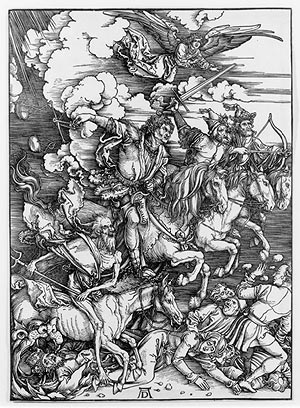
The horsemen close in


Facebook Apocalypse

Facebook can be a fickle friend. Oh yes, there are rules that we know everyone doesn’t quite obey. You are not allowed to falsify evidence about yourself on the great FB, although characters like Jesus have their own pages. The Chronicle of Higher Education this week followed the efforts of a University of Nevada at Reno librarian who tried to use Facebook for educational purposes. Donnelyn Curtis had set up Facebook accounts for two students early in the twentieth century to give current students an idea of how times had changed. The pages were summarily removed by Facebook staff, leading to the unfortunate second deaths of Joe McDonald and Leola Lewis. Second deaths always get me thinking about the book of Revelation. After all, we are now into the fatal year of 2012.

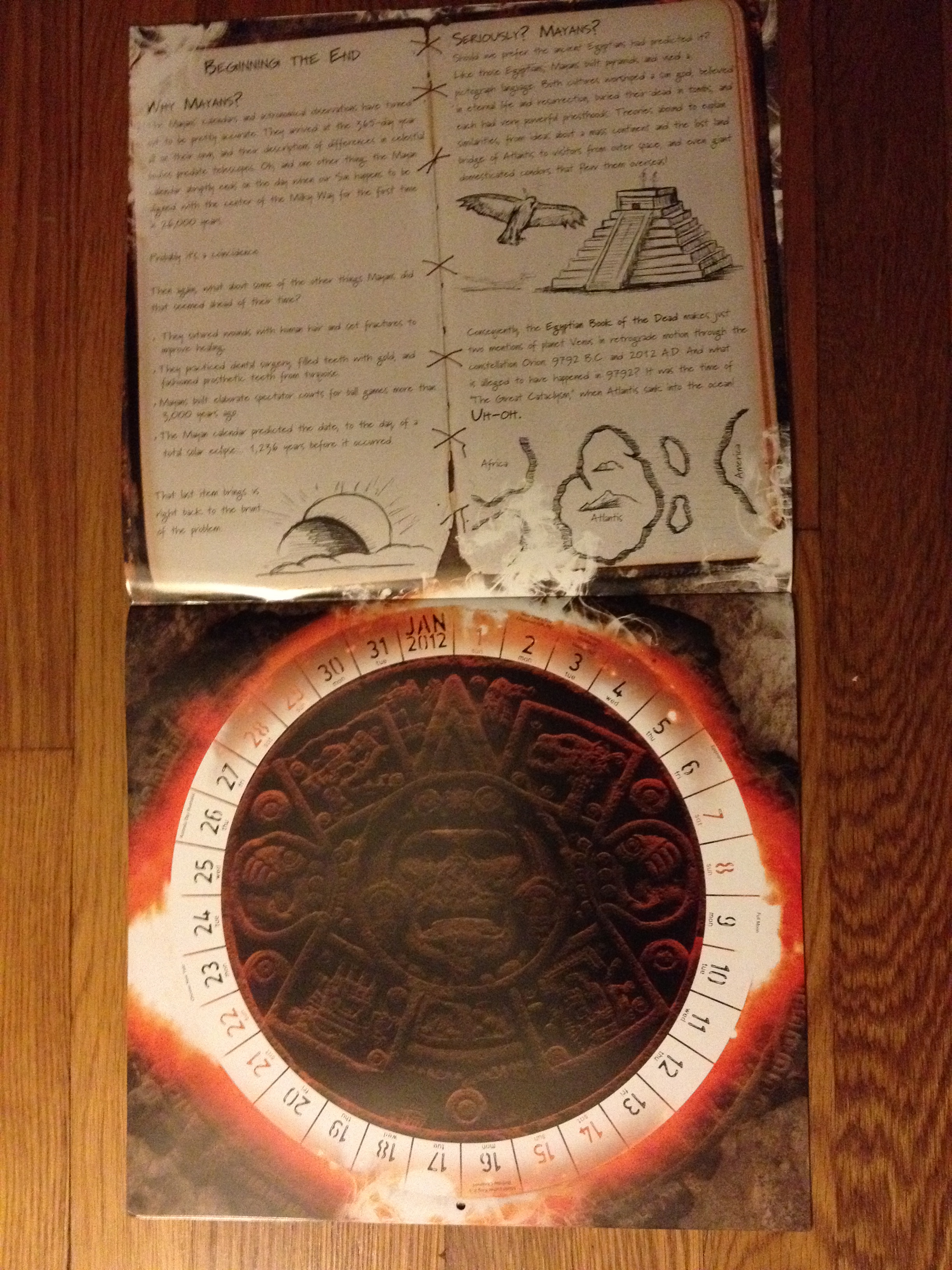
My Mayan Calendar

Few events elicit religious fervor like the end of the world. In the most highly touted end-of-the-world scenario since 2000, 2012 has emerged as the great contender for wrapping up the show we call life on earth. When I spotted a calendar to prepare the user for the end of the world, well, how could I resist? Each month on this terminal calendar features facts pointing to the culmination of this strange experiment that evolution hath wrought. If we can’t pull off a good, old-fashioned Evangelical rapture (sorry Rev. Camping), maybe the Maya can get the job done. They certainly managed to pull off an impressive vanishing act a few centuries back. Or did they? Despite the overrunning of enthusiastically avaricious Christian invaders, the Maya accommodated themselves to less-than-ideal circumstances and survived. They are still among us. Their culture, however, didn’t fare so well at the hand of the church. Nobody’s asking them about any of this.

Apocalyses occur all the time. When religions meet, one inevitably tries to vanquish the other. No one walks out of that arena without a limp. And the winners look over their shoulders for ever after. To prepare for this apocalypse, the January on my new calendar narrates how the Mayans and Egyptians shared some cultural secrets—such as how to build pyramids. How did they know about one another? My calendar says they could have walked across Atlantis, or they might have been carried by giant, domesticated condors. Either alternative seems as likely as the other. Either alternative seems about as likely as the world ending this year. But then again, already in 2012 a couple of promising young people have already been kicked off of Facebook for being dead. I think I feel the apocalypse beginning already.


Chronicle Illness

In a completely innocent blog post on the Chronicle of Higher Education, Geoffrey Pullum wrote about the use of singular “they.” I won’t try to summarize his work here—it is quite fine the way he writes it. What I would like to note, however, is what was likely an unintentional grammatical association that is quite profound. In two consecutive paragraphs, Pullum requires a synonym for someone who is unwilling to listen because they’ve already made up their mind. His choices are those who believe in “unquestioned dogma” and those who hold a “resolutely and hermetically theological view.” Both phrases indicate those who unswervingly accept religious belief. The article is lightheartedly written, and quite witty, but there is something serious here. Religion has built itself into the great bastion of intolerance.

The more I contemplated this correlation, the more it became clear—when we need to express someone’s complete devotion to unquestioned propositions, even when reason dictates conclusively that they are wrong, we are in the realm of religion. Religions may accept one another, but as long as truth is at stake, and as long as truth is one, there will always abide that smug satisfaction of knowing that my religion is at least a smidgeon closer to that truth than yours. Such thoughts, when matured and fully-grown, are bound to cast the seeds of intolerance abroad. Religions don’t take prisoners. Having spent a lifetime studying religions I’m not so crass as to put them all in the same cage together (that would be cruel), but history has demonstrated that when properly provoked any religion will turn intolerant. The provocation is mostly just daily life.

Literary folks have thousands of tomes full of words and ideas from which to draw. One of the joys of reading is finding so many ways of expressing that which we experience in fresh and insightful ways. With all these words and concepts from which to choose, the most immediately recognized to express unwillingness to listen belong to religion. Listening to Pat Robertson or Pope Benedict XVI, it is not hard to see why. Religions give the world much more than reasons to fear, distrust, and hate others. But they do include these components as well. The only way to change this image is replacing the arrogance of dogma with the willingness to listen with humility. If religions would do this, there would be room for everyone in this conversation; they’d like that, wouldn’t they?


On the Move

Truth is increasingly a moving target. And when the Chronicle of Higher Education runs an article about religion, academics take notice. Actually, the article is about irreligion. An interview with Routledge author and Pitzer College professor Phil Zuckerman was the centerfold for November 23’s Chronicle Review. Zuckerman’s article, “Taking Leave of Religion” follows up from the book I reviewed on the sociology of religion. On the very same day, in an article my wife pointed out to me, MSNBC online published an article about the church and the Internet. Interviewed was Heidi Campbell, another Routledge author, at Texas A & M. What struck me in both of these cases was not so much what was said, but how.

In these days of higher education under siege, the media has come to love the young scholar. It has gotten to the point that I can hardly watch a documentary on the ancient world without seeing a friend or colleague on screen. I suppose the interviewing of scholars is not itself new, but the burgeoning of the celebrity scholar gives pause. Was a time when scholars wrote for other scholars. There are problems with that approach, mostly the issue of social irrelevance. Let’s be honest—when’s the last time we read a heavily footnoted, dry, academic monograph for fun? Honestly. So scholars have taken to the media. In popular forums with trendy words they make scholarship accessible.

What could be wrong with that?

The fact that I am writing this blog demonstrates that I believe in the public sharing of knowledge. I find it crass when experts charge for sharing what they’ve learned, but, I suppose knowledge is a kind of commodity in the marketplace of ideas. Herein lies the rub. The business of education. Scholars have become entertainer-specialists in the realm of commerce. Back in the day you had to seek the guru on the top of the mountain. Now he, or not uncommonly she, can be accessed from the comfort of your own couch or chair. Frequently there is no debate. Truth handed down, byte after exotic byte.

Perhaps we have lost the capacity for honest, if dusty, debate. Not only that, but the media now reserves the right to determine the truth we will receive. The target is moving, but the receiver is not.


Moral Monsters

trees

Everyone likes to feel vindicated. From my childhood I have felt marginalized because of my interests in monsters, and now a book has just been released from Oxford University Press that vindicates my interest! Stephen Asma, a philosophy professor at Columbia College, Chicago, has written a monograph entitled On Monsters: An Unnatural History of Our Worst Fears. Further vindicating my idiosyncratic interest is the fact that the Chronicle of Higher Education even has an electronic front-page article on the book this week. I am overcome with credulity! I haven’t been able to lay my hands on the book yet, but I hungrily read the article and look forward to the whole product.

Readers of this blog know my assertion that monsters originate in a mental space shared by religion. Both are responses to the unknown. Asma writes in his Chronicle article, “The monster concept is still extremely useful, and it’s a permanent player in the moral imagination because human vulnerability is permanent.” Indeed, his article is entitled “Monsters and the Moral Imagination.” The thesis he promotes is that our morality (again tied to religion for many people) benefits from its struggle with monsters. We imagine our moral responses to being faced with the truly horrific, and the monsters themselves are less frightening than our imaginary responses. The top box-office winner this past weekend was Paranormal Activity, a movie noted for not showing the menace, but implying it. There is an evolutionary advantage here; we learn about coping with real danger by imagining danger.

So as I look out the window on yet another cold, gray, rainy October morning, and see the trees swaying in the wind, my imagination takes flight. Those Saturday afternoons and late nights filled with cinematographic visions of even worse things that could happen are cast in a new light. Instead of scaring myself, I was building moral character! As my friend K. Marvin Bruce likes to say, “monsters are only mirrors.” Sometimes the mirror reflects a truly untamed world, and Dr. Asma informs us “inhuman threats are great reminders of our own humanity.” I would simply add, “and of our religions.”