Edifices

In a process that’s been going on for decades, church buildings have been sold and repurposed.  Part of the reason is the fact that spirituality has come to resemble a free market and there’s increasing competition from the Nones.  Thinking back over a lifetime of attending various services, many of which seemed to do nothing more than demand I pull out my wallet, I can understand this lack of public engagement with established religions.  At the same time the rather shallow, but emotionally based evangelical tradition continues to grow, largely based on the emotional payoff it gives.  Ironically, it makes the claim that it’s the doctrine responsible for this appeal, but it seems more likely that it’s the way the doctrine allows you to feel about yourself that’s the key.  And still the wallet comes out as the mega-churches grow.

There’s a profound beauty in dereliction.  Some of the more solidly built structures—for even the way a church was constructed was a theological statement—have lent themselves to creative reuses.  I’ve visited churches converted to used bookstores, and this seems fitting.  The trade-off of doctrine for knowledge is appropriate.  In Pittsburgh, years ago, I was intrigued by the Church Brew Works.  Occupying a closed Roman Catholic Church, the brew pub is a trendy gathering place and the titillation of drinking in a once hallowed location is part of the draw.  People find such irony irresistible, it seems.  Better than letting an abandoned building simply fall to ruin.  When it first opened some were scandalized—a lingering belief in sacred places may account for this.  People were married here.  Baptized.  Funerals were held.
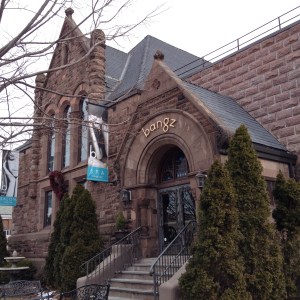
While walking through an unfamiliar neighborhood recently I found a church building that has been converted to a spa.  The idea struck me as so counterintuitive that I had to think through the implications.  Churches, for all their faults, are places advocating spiritual growth.  Whether or not it takes place is quite a different question, of course, but this is all about interior life.  Spas are about the surface, physical beautification.  Indeed, often personal pampering.  This is building space come half circle.   An edifice built of heavy stone, implying the gravity of the business inside might have eternal consequences is now a place to beautify the body.  Perhaps the building itself has gone through a similar process.  What used to advertise to the world that depth could be found  here has now become merely an exterior.  Market forces dictate what it will become on the inside.

Pope of Deliverance

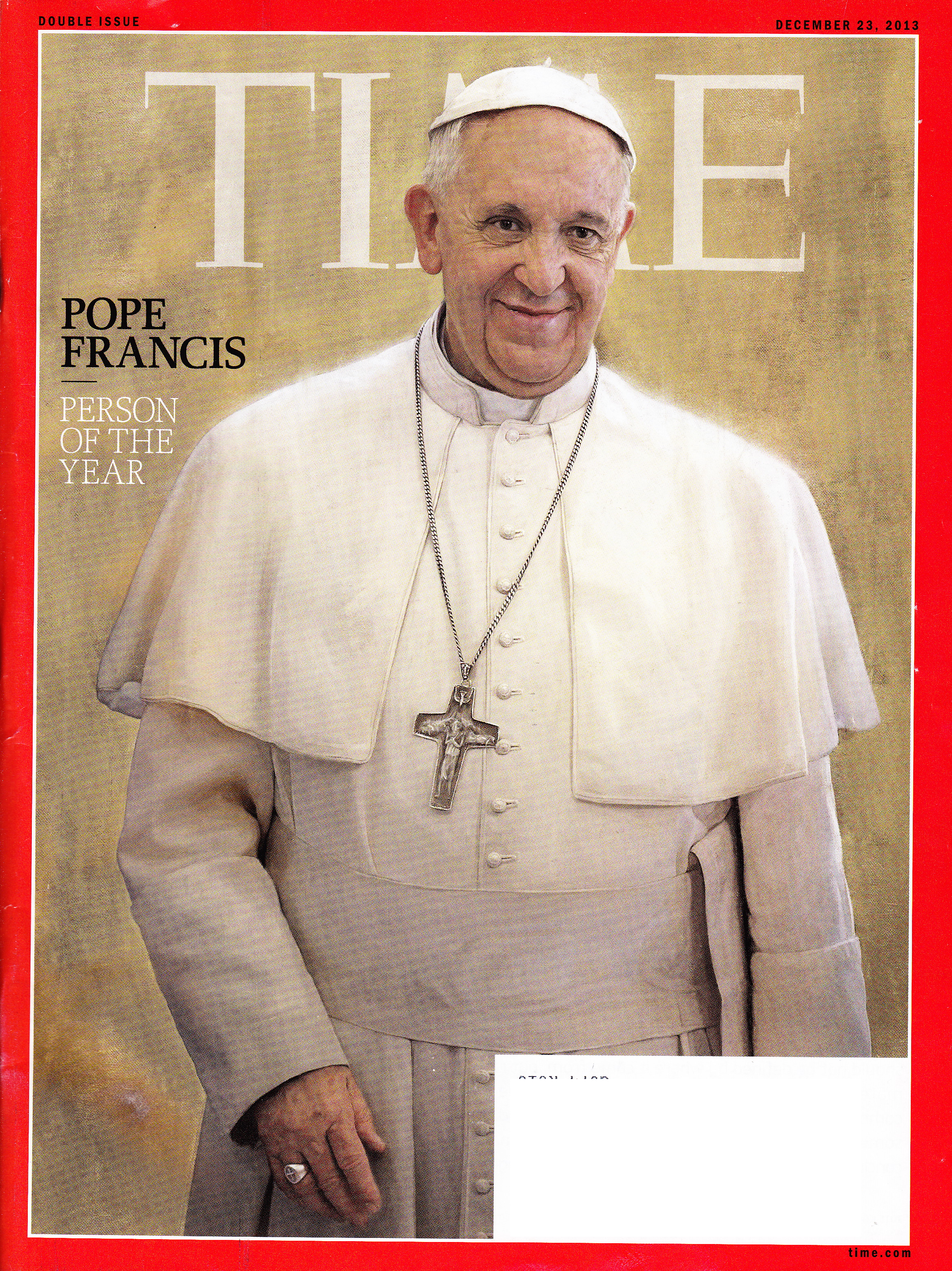
TimePopeIt’s the Time of year. The time of year Time chooses a person of the year. Not for the first time in recent memory, a religious figure has been chosen. Granted, Time declares the person of the year is the most newsworthy, not necessarily the best to emulate morally. Notorious scoundrels have made their way onto one of the nation’s top news magazine’s covers, while many more worthy will never be selected because they just don’t garner the notice. Despite this, Pope Francis is certainly the most deserving pontiff in living memory. Over this year he has demonstrated that the Catholic Church does have some historical memory of its original call and mission to the Christian faith.

Ossification is a natural tendency with institutions. We tend to think the earliest universities are still the best (in some cases that may be true), while in fact better educations are often found elsewhere. We want to believe that as it was in the beginning, is now, and do I really have to finish it? Times change, institutions evolve. Within half a millennium the Christian movement went from a bunch of persecuted, fearful peasants hiding in corners to the power brokers of a powerful empire. Problem is, once you’ve tasted empire, there’s no going back. Until now. How odd it is to see a person who could live a life of opulent self-service giving it up to be kind to his fellow humans. It is almost as if the Vicar of Christ has somehow become incarnate. A pope who is one of us. And the world stares in wonder.

I don’t mean to pick on the Catholics here. We see it in many religions. Someone humble and spiritual joins a religious movement for obvious reasons. They then grow through the ranks, acquiring a craving for power. What a temptation it must be to stand before an audience of thousands, knowing that by television hundreds of thousands more are watching you—hanging on your every word. Our underlings tell us we are great and it isn’t so hard to believe them. The man who steps down from his kingly throne to mingle with the laity, who doesn’t ride bulletproof cars to represent a man who willingly, so the story goes, gave himself up to die. What saddens me is that this is newsworthy. Not to detract from the spirit Francis has injected into a stony Vatican, but that we find it incredible is a comment on what has come to pass for religion in this time. Thanks, Time, for holding up this important mirror to our society.


Deliverance from?

At times it seems strange that I missed so many formative movies when I was growing up, but then my wife pointed out that many of the films were released when we were minors. That, combined with the fact that most of them bore R ratings, acted as an effective deterrent at the time. So it was that we only saw Deliverance yesterday. References from friends, colleagues, and even The Simpsons made us feel like we’d missed a part of American culture that everyone else had seen. Of course we knew the basic story, but seeing it played out intact is a much more satisfying experience. Since I am scheduled to do a church talk on Christianity and the movies later this morning, I was interested in the way the church is portrayed in the movie.

After the three survivors make it back to civilization, the first building that meets them at the riverfront is a plain white “Church of Christ.” At the moment of their eponymous deliverance, the church is there. As Ed and Bobby are being driven to the hospital in a taxi, however, the church appears again. The valley is being flooded to bring hydroelectric power to Georgia, the reason the men set off to see the river in the first place. Since the town is shortly to be flooded, the church is being moved. The taxi driver tells the men, “We might have to wait a minute for the church to get out the way.” In the extras director John Boorman spoke about the highly symbolic nature of the film, including the way that the symbol of stability in the community, the religious establishment, could not hold its own ground.

I also sensed another element of irony here. The church had been, symbolically, in the way of the advancement of civilization. Paralleling this inhibition is the utter, and bewildering freedom from the law experienced by the men following the murder of the mountain man. The viewer is left to decide which is the worse fate. Now that I have seen the film, I think I can understand the depth of struggle it represents. As the continuing debate on the relative merits and demerits of religion in society rages on, there is always a very human aspect that stands beyond simple formulae. Perhaps we save religion in the hope that it will save us.