
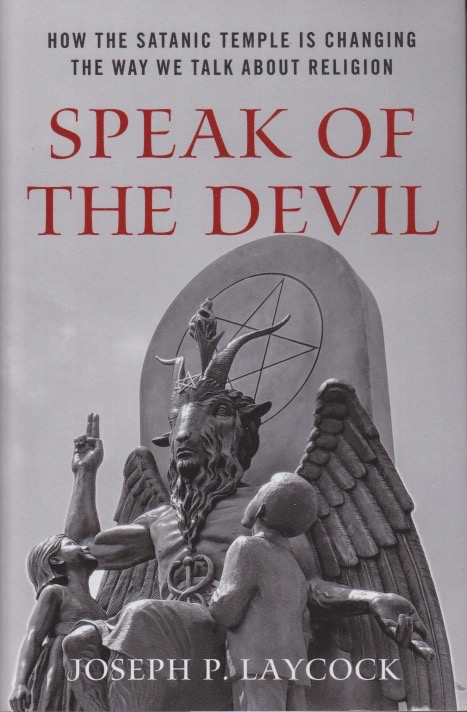
Around here, an after-school Satanic Temple club, prompted by an after-school evangelical club, led to a lawsuit where our tax dollars are being wasted. Many local people wondered what was going on and I knew I had a book on my shelf that would help to answer that but I had to find the time to read it. Joseph P. Laycock has been writing fascinating books for a few years now. I picked up his Speak of the Devil: How the Satanic Temple Is Changing the Way We Talk about Religion just after it was published, but it always takes some time for me to get to books that I know I’ll have to spend time with. I was right about spending time—there’s a lot packed in here that requires some thought. I was vaguely aware of what the Satanic Temple is but had difficulty distinguishing it from the Church of Satan. (I have a book on the latter, but it’s quite big and I haven’t found the time for it yet either.) Laycock spells it out clearly.
The book begins by discussing how the Satanic Temple entered public consciousness in 2013. Yes, it’s only been about a decade. If you think it’s more than that, you may be confusing it with Anton LaVey’s Church of Satan. They are different organizations. One thing they have in common is that neither promotes belief in a literal Satan. Both also rely on shock tactics to get their point across. The Satanic Temple is a socially conscious organization that reacts to provocations of conservative Christian groups to try to establish their brand of Christianity as the officially sanctioned state religion. And the evangelical groups have been making in-roads for years. Playing the innocence card, “We’re just mainstream America saying what everyone’s thinking,” they put religious monuments in public spaces, start public meetings with Christian prayers, and receive state funding for their programs. Often unchallenged.
Laycock’s not discussing evangelicals, but rather how the Satanic Temple arose in response to efforts to establish one form of Christianity as state sponsored. There’s a ton of information in this book. Among the many takeaways for me was the discussion of how good and evil are determined. This is obviously directly relevant when Satan is involved, especially since the Devil is a post-biblical development. The Satanic Temple, which doesn’t teach that there’s a literal Devil, attempts to counter the standard narrative by doing good deeds in the name of humanism. You might be able to guess the conservative Christian response to that. If you can’t, this book will help to spell it out for you.

 Steve A. Wiggins