
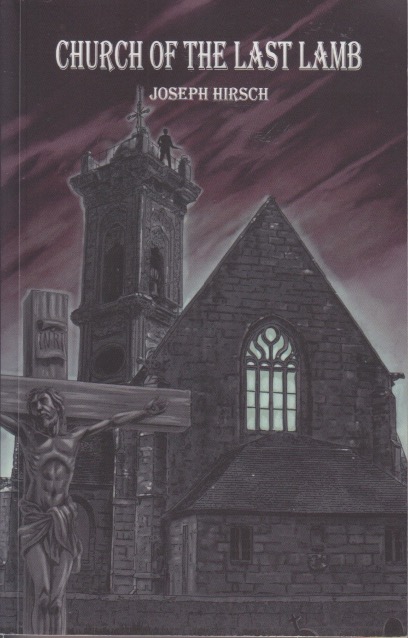
Zombies never quite add up in my brain. I’ve read a few zombie novels, nevertheless. Joseph Hirsch’s Church of the Last Lamb is one such novel. I’ll try to avoid spoilers in the note below. The story begins with zombies already a part of the landscape. An Army outpost in Ohio is trying to hold out until mortals get the upper hand and reestablish civilization. The outpost is run by the military and civilians, “softies” have menial jobs as well as other support duties. One of these civilians, Jon, has dreams of saving enough to be able to settle down and have kids with his girlfriend. In this world, however, this privilege has to be purchased and generally only those in the military can afford it. Violating rules about conjugal visits, Jon is brought before the colonel in charge and given the duty to accompany five soldiers on a dangerous mission out among the undead.
Surveillance has shown that a private individual living in the Church or the Lost Lamb has found a way of repelling—killing, actually—zombies. The squad’s mission is to find the secret and bring it back. Chances of returning aren’t great. Zombies respond to the canonical head shooting, but ammunition is in low supply. Swords and axes play a part in the tale. The soldiers make it to the church, but one of them dies when zombies swarm their transport. The others make their way into the church, where a scientist takes on the persona of a priest. He has, however, come up with a formula to make zombies really dead. In exchange for it he has a mission of his own that he wants the remaining men to undertake. Two more die on the adventure.
Jon was a teacher in previous life. He has to learn how to adapt to this new way of thinking to survive. Making things more difficult, there are rival groups fighting against the surviving remnants of civilization. There’s lots of combat and a fair bit of gore. But then again, this is a zombie novel. I won’t say more than that. I enjoyed reading this more than World War Z, but it underscores how much those of us who are softies have trouble understanding military culture. I found it engaging that religious imagery was drawn into the story as well. As I’ve often noted on this blog, horror and religion interact well. The church plays a pretty central role in the narrative, underscoring this winning combination.
 Steve A. Wiggins