Don’t Let Go

We watched Hugo, as a family, over a decade ago and quite enjoyed it.  At that time I only really blogged about horror movies or those with a religion element that I could spot.  Over the years, I’ve taken to reflecting on movies themselves and so, since we rewatched Hugo recently, I thought it might be time to talk about it.  This is one of those movies that was critically acclaimed but a box office flop.  It’s still a wonderful film.  As a side note, working in any media (including academic publishing) introduces you to familiarity with the project, such as a book or movie, that becomes widely praised but just doesn’t sell.  Public taste is very difficult to predict (note who’s in the White House) and sometimes a book, movie, record album, or any media hit, becomes highly acclaimed while losing money.  Hugo is worth re-watching and, despite the financial hit, is quite good.
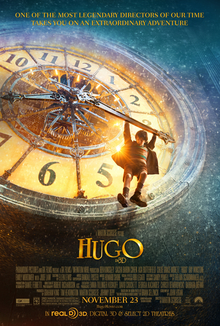
Hugo is based on a children’s book, Brian Selznick’s The Invention of Hugo Cabret (which I would like to read).  The movie is a paean to early filmmaking and involves some real history, especially around the life of George Méliès.  Watching the film a second time, I was struck with how Hugo ends up reenacting several scenes from early films in his own life.  The film also captures how movies are more than simply entertainment.  They have become an integral part of life in some cultures, and, for some of us, a source of meaning.  That’s why I wanted to see Hugo again.  It struck me as a compelling story—a redemption story—bringing a sense of meaning to a life where George Méliès went from fame to obscurity because his contribution to film was unrecognized since movies hadn’t yet become a major industry.  Look at Disney today and wonder, dear reader.

Or consider Hugo itself.  With a gross profit of “only” about 15 million dollars over the budget, it barely covered its costs.  Lots of people are involved in making a movie and this is quite an expensive venture.  Anyone who earns a paycheck knows that the net is always disappointingly lower than the gross earnings.  Cinema in general struggles with the need to adapt to streaming culture where profits are parsed out in small bits rather than drawing large crowds to fill seats.  And yet, movies act in many ways like the modern mythology.  They tell important stories.  They provide touch-points for society.  Unfortunately, however, this is often only the case when they make a lot of money.
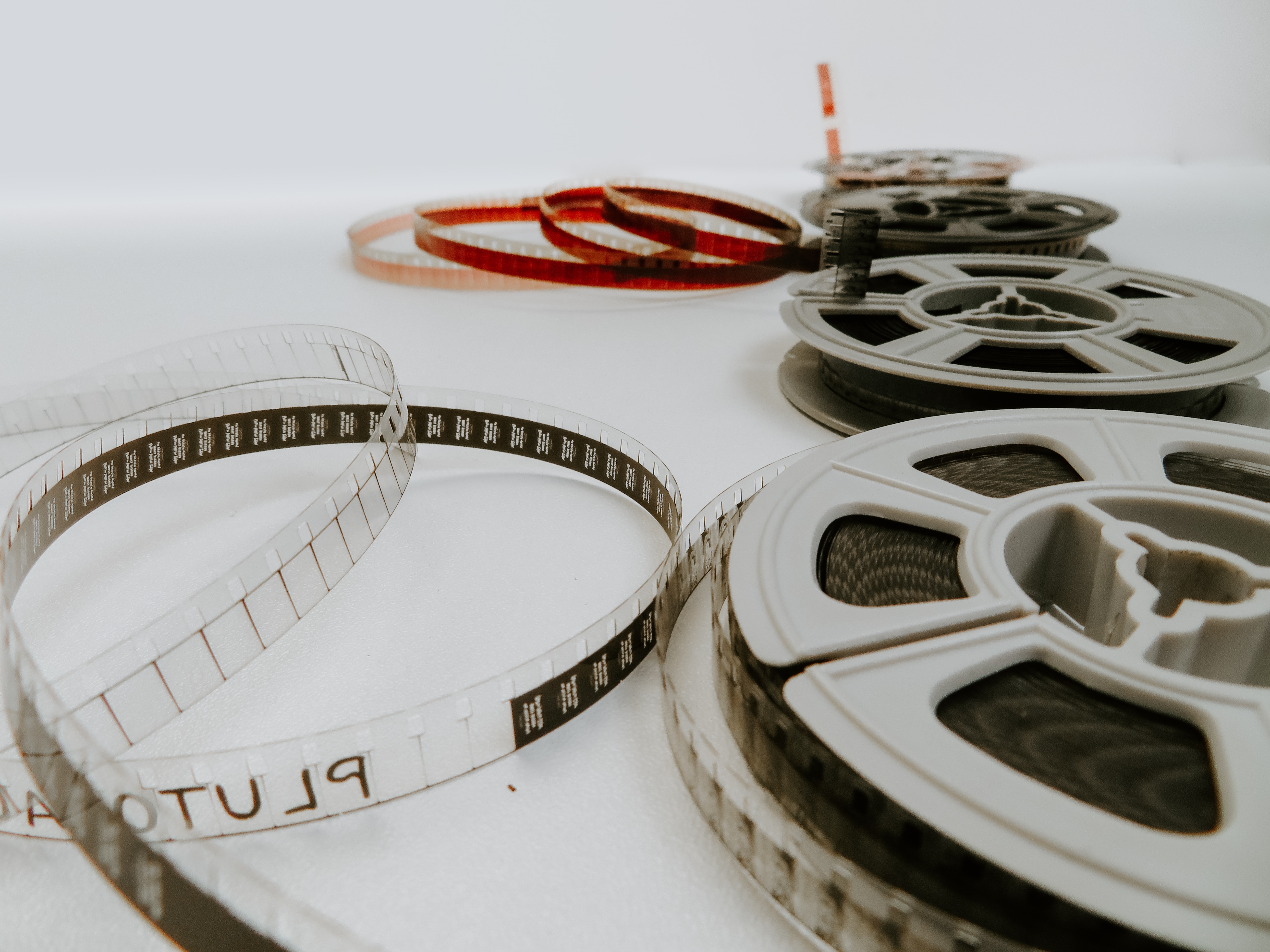

Old Movies

Something strange is happening.  (“How’s that new?” you might well ask.)  There seems to be a bifurcation taking place in my brain, what techies might call “partitioning.”  Specifically it regards what I think of as “old movies.”  By this I don’t mean movies from the sixties or before.  No, I mean movies I saw some time ago, often on DVD or even VHS, sometimes in theaters, that became part of my standard repertoire.  I imagine most cinephiles have certain films to which they keep coming back.  But for me, the “old movies” are those I haven’t blogged about.  Also, they predate streaming so, in that sense, they are “old.”  You see, I’m not a very internet-savvy thinker.  It took me quite a few years to figure out I could link my posts with other posts on my own blog so that in the rare event that someone might want to read more they could click on the links like you do on Wikipedia.  (Now that you’re here, stay a while!)

Photo by Denise Jans on Unsplash

This blog was started in 2009.  For most of its history it has been daily.  I didn’t automatically start blogging about movies, though.  For a few years I tried to tie all my posts into religion, widely conceived.  Then, kind of establishing my own “brand,” I started writing about less ethereal topics.  Including movies that don’t have religion in them.  By far most of the movies I discuss on this blog are first-time films for me.  Occasionally I’ll go back and address one of my “old movies.”  This occurred to me the other day when I went to link to Tim Burton’s Corpse Bride.  I thought I’d posted about it, but it’s one of my oldies, so I hadn’t.  I don’t even remember when I first saw it.  If feeling nostalgic, I’ll look backward, as an historian is wont to do, but it doesn’t happen often.

Since we can’t see ahead in our lives with any real clarity, I didn’t anticipate this blog focusing on darker themes. When I started, finding a position back in academia seemed like a possibility.  For me this blog is therapy, but this is as good a place as any to talk about movies, and most of mine fall into an ill-fitting genre called “horror.”  Even among these, my “old movies,” like The Exorcist, The Amityville Horror, Sleepy Hollow, or even Paranormal Activity, which now more or less define my research, were missed out for having been too old (having been seen too long ago).  Most of the movies discussed in the past few years here have been streamed.  Many of them are easily forgotten.  But the old ones, they’re stuck, apparently for good. Such is the power of old movies.


The Movie Maker

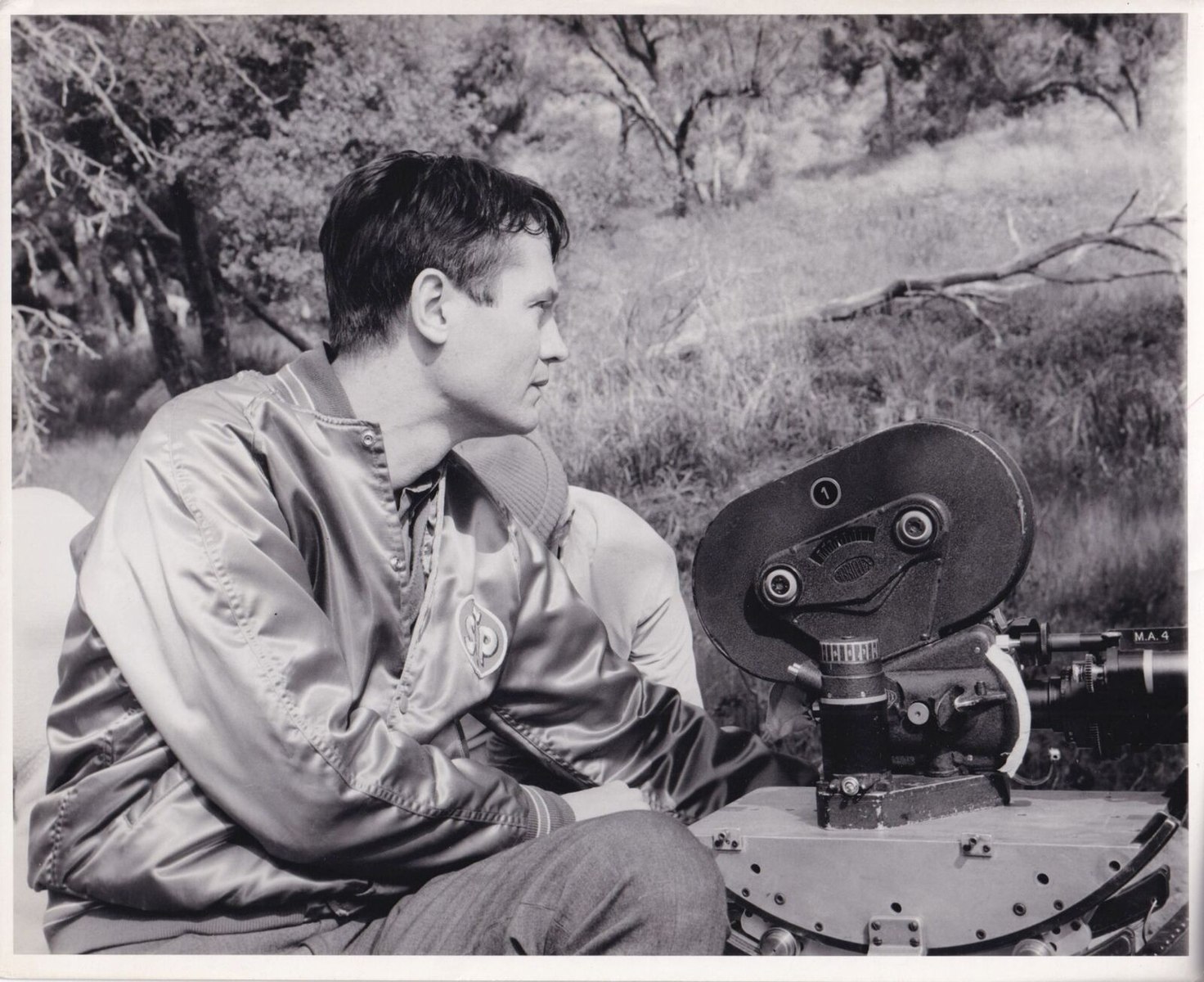
Roger Corman has died.  So passes an era.  I’ve always had an appreciation for the speculative films of the fifties and sixties.  Many of these involved low budgets and content intended to shock.  Or at least excite youngsters.  And Roger Corman was a huge name among directors, producers, and promoters of such schlock.  He entered the realm of horror in 1955 with Day the World Ended.   Attack of the Crab Monsters a couple years later put the focus firmly on monsters.  Producing and directing three or more movies a year, he built a reputation for being cheap and quick, but that didn’t prevent him from creating some good movies.  A film’s producer is the one responsible for overseeing the production.  Often they come up with the ideas of what to film.

Roger Corman, publicity still; public domain via Wikimedia Commons

As the sixties were dawning, Corman produced several films “based on” work by Edgar Allan Poe.  I remember seeing some as a young person and wondering what they had to do with the Poe I’d been reading.  Still, he managed to grace cinema with House of Usher and The Masque of the Red Death.  These are good films, despite limitations.  At the same time, Corman was still producing creature features as well, wracking up an impressive list of nearly 400 produced films.  As an established player in cinema he also took on the role of distributor from time to time.  When The Wicker Man was being ignored in Britain, Corman undertook the role of US distributor, likely saving the movie from total obscurity.

Circling back to Day the World Ended, we’ve become accustomed to believe that some kind of divine or human ending is in the offing.  These ideas get embellished over time, as I suggested in my new piece on Horror Homeroom.  Corman knew that this putative end would get the attention, whether or not there was any truth to it.  Perhaps that was the genius of his work—he knew how to attract attention.  And he wasn’t afraid to do so.  The business of cinema is one of attracting viewers.  Telling stories we want to hear.  We remember reading Poe, and even if the movies differ from the stories he penned, they are nevertheless reminders, reminiscent of what we’ve read.  If there are monsters they are somehow perhaps even more effective for not really being believable.  In short, Corman was a showman.  He made a living doing what he loved.  And he influenced many lives along the way.


Wolfing Hour

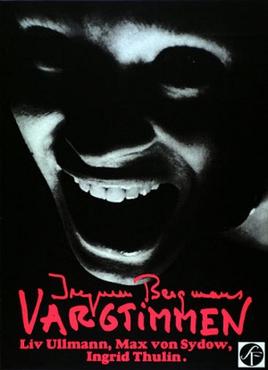
It’s not that I didn’t grow up watching horror; it’s that I didn’t grow up watching horror in theaters.  I’m sure Mom wouldn’t have had it, and besides, we could only afford movies spread apart by wide intervals.  You’d think that now I’m an earning adult (or so I’m told) that I’d have more control but watching is a kind of addiction and money’s still not abundant.  Every once in a while, however, I’ll splurge and pay for a film.  Mostly when they’re not available via any streaming service.  Like many Christians who’ve never read the whole Bible, I know the canon only piecemeal.  So I came to watch Hour of the Wolf, the Ingmar Bergman classic.  Now (at least then) streaming nowhere.  Intellectuals have always flocked to Bergman films since they’re full of symbols and not easy to understand.  (If you want to “get” Robert Eggers, though, you’ve got to do your homework.)

Hour of the Wolf is generally considered psychological horror.  It’s black and white—how scary can it be?  Pretty, depending.  The story of an artist’s wife (Alma) who lives with him in a small shack on an island in Sweden, it’s a tale of unraveling.  Nightmares become difficult to distinguish from waking realities.  The wife reads the artist’s diary, foreshadowing Wendy in The Shining, to discover that he seems to be going insane.  The island’s not abandoned, as they thought.  Soon Alma begins seeing other people too.  And attending their awkward dinner parties.  They speak freely of her husband’s previous affair.  There also seems to be an instance of a real person on the island that the artist keeps secret.

If this doesn’t give you enough to piece it together, well, it’s a Bergman film.  In college we watched The Seventh Seal.  And at least part of Wild Strawberries.  But in 1968 I wasn’t an intellectual and we were poor.  If I’d even heard of Ingmar Bergman it was via reference in some TV sitcom.   I knew to expect strangeness.  These days the box elder bugs are mostly gone from the house.  The weirdness started when, having never seen the film before, I began to pour a glass of water at the very second the artist picks up and begins to pour a glass of wine.  Strange coincidence, I thought.  Several minutes later I saw something edging around my glasses.  A box elder bug crawled right over my right glasses lens.  Like a scene in a Bergman movie.  I knew I’d have to ponder this for some time.


Not All Vampires

Early film research owes great debt to YouTube.  Many historic and significant films cannot be purchased or watched anywhere else.  Even in this uber-greedy late capitalist era, few (if any) are willing to sell that for which many would pay.  This is brought on by my learning about Alice Ida Antoinette Guy-Blaché, also known as Alice Guy.  Guy was the first female film director.  She left a substantial body of work and is credited with being the maker of the first narrative-based film in history.  If you’ve not heard of her, you’re not alone.  Even during her lifetime she wondered why she was never recognized for her cinematographic achievements, incredible though they were.  She filmed one of the first adaptations of an Edgar Allan Poe story known, The Pit and the Pendulum (1913).  This one is partially lost—many early films are.

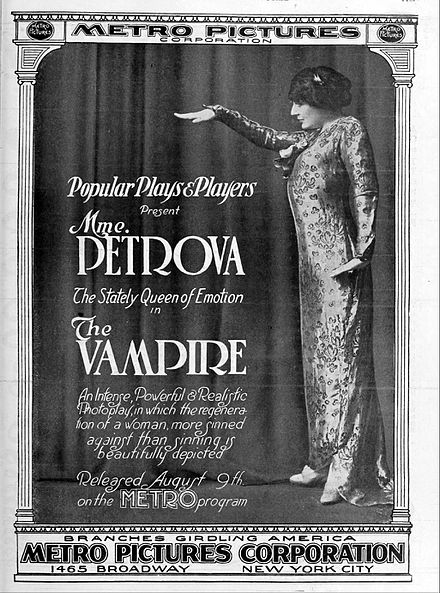
I wanted to see her 1915 film, The Vampire.  Given the date, you will have correctly guessed that it’s a silent movie.  It still survives and the only place it can apparently be found is on YouTube.  Before you run off and watch it, be aware that it’s not about a literal vampire, but rather “a woman of the vampire type.”  The current term is “vamp.”  The movie, which takes a feminist approach, is framed around Rudyard Kipling’s poem, “The Vampire.”  It runs for about an hour, which was pushing the envelope in those early days of cinema.  It tells the story of a happy, wealthy family broken apart by a “vamp.”  The husband receives a government appointment in Europe and his wife and daughter can’t follow for a month.  On the way over by ship, the vampire seduces him, after compelling her current love to shoot himself.  This isn’t a comedy.

The film doesn’t end happily—the statesman, aging prematurely, just can’t break the vampire’s hold on him.  Still, friends and family urge his wife to wait for him because divorce is wrong.  The film lingers on the suffering of the wife and on how much his young daughter misses her father.  The film quality is quite good for the time, although the YouTube version has been digitally restored.  So this isn’t a horror film, but watching it is a tribute to a woman who influenced filmmaking and then was summarily forgotten, largely because of her gender.  Alice Guy was the first woman to run her own movie studio.  Sadly, her husband left her and their children just three years after The Vampire.  Shortly after that Guy’s filmmaking career was over.  Fortunately for history, Guy has been rediscovered and has been receiving credit for her pioneering work.  Although The Vampire was about a dangerous woman, the reality is, and was, that patriarchy continues to ruin women’s lives.


Movie Ancestors

I’ve read quite a few Very Short Introductions, but this one struck me as particularly good.  Donna Kornhaber knows how to write for non-specialists, and she knows how to single out what’s interesting in the vast collective known as Silent Film.  As is the series trademark, this book is very brief, but it covers the essentials.  Kornhaber divides the silent film era, roughly 1895 to 1927, into three periods: early cinema, the transitional period, and the classic era.  During each of these, new developments demonstrated the sophistication of the industry and groundwork was laid for cinema as we know it today.  I learned quite a lot from this short treatment—so much that it’s difficult to know how to summarize it here.  Of course, it’s short so you can read it for yourself if you’d like to learn more. 

Perhaps what stood out to me the most was the correction of a misperception that, I hope, is not unique to me alone.  I’ve always thought of silent films as being grainy, poorly exposed, and choppy when showing people’s movements.  Kornhaber explains that most movies were of sound quality in their day, when projected properly.  Early film stock deteriorates, however, and not all stock was properly preserved.  This accounts for the graininess and the sometimes “overexposed” look of such films.  Even modern projectionists don’t use the proper speed and that leads to choppy motion.  In their own day, and with film handled by people who knew their business, early movie goers would have experienced realistic, well-rendered images.   These issues are our issues, not those of the original footage.

Another feature of the book is its focus on diversity in filmmaking.  Early silent film was dominated by France and the United States, but several other nations contributed to what we now think of as standard elements of cinema.  And the fact is that until sound was introduced many women played important roles in the development of what we expect from films.  Women directed.  Became business-savvy.  Ran their own studios.  Once the industry established itself as particularly lucrative, men began to edge women out.  The majority of early films—Kornhaber suggests around 80%—were lost as studios saw no reason to preserve them once “talkies” were the way to make money.  Consequently we’ve lost a good part of that early history.  We pretty much take movies for granted.  We can stream them any time, and we know what to expect (roughly, anyway).  What we don’t often consider is how much we owe to those who established what the movie-going experience should be, and did so before sound was added to the mix.


Sights of Silence

To an historian who cut his teeth on deep antiquity (if circumstances were different I would’ve ended up a Sumerologist), my current fascination with film feels manageable.  The form of communication we call “movies” really only began around 1895.  For those of us who find 1000 BCE a bit too modern, the nineteenth century seems strangely contemporary.  Simon Popple and Joe Kember offer a service, therefore, by giving us a Short Cuts on Early Cinema.  I’ve never formally studied cinematography, of course.  I have watched movies my entire life—grew up with them—and have learned to write about them (with some degree of intelligence, I hope!).  The history of the industry itself is fascinating.  Short Cuts are written for students, and this one covers the first twenty years of cinema, 1895–1914.  The cutoff coincides with the start of World War One, although not the introduction of sound, but it works nevertheless.

Although I learned a lot from this little book, the writing was sometimes verging on the technical.  Also, and this is a personal pet peeve, many of the paragraphs were too long.  This is an academic epidemic, not applying to this book only.  Look, I know the whole topic sentence and development thing, but paragraphs may be divided in different places, hopefully compelling the reader on.  When I see books intended for “general readers” with a wall of unbroken left margin, I shudder.  Give the eye a break.  This little digression shouldn’t be taken to imply that this book does it a lot, but there are some long paragraphs and they can make you lose your way.  In any case, there’s lots of good info here to balance out the occasional academic framing.

I especially found useful the year-by-year breakdown of major development in the early film industry.  Movies required quite a few breakthroughs, not the least of which was photography itself and also film stock that could be measured in hundreds of feet.  The machines to both film movement and project film.  Although not by 1914, syncing sound.  Color photography.  Movies are technical marvels.  And my approach to anything that is so gripping is to research its history.  In the case of cinema, it’s not a terribly long history.  Although 1895 is getting further away each passing second, it wasn’t even a century before I was born.  For those of us who look backwards, length does make a difference.  A lot was going on behind the scenes as movies went from one-minute side-show attractions to feature length productions where people went to specially designed theaters to view them.  This little book gives a walk through that world and what helped make cinema what it’s become.


Movie Moving?

If you don’t know me personally, you may not realize how frequently I quote movies.  On a daily basis, films I’ve seen—particularly multiple times—are the source of some of what I say.  Films have tremendous impact.  Some theorists have even argued that they are the new mythology.  So imagine my distress when an opinion piece in the New York Times suggested that movies are losing their relevance.  Media comes in so many varieties that we can take our choice.  YouTube and TikTok have given television its first real competition in my lifetime.  Our local CD store is a rather sad place, and does anybody even remember Blockbuster?  But movies—the media of entertainment for over a century—irrelevant?

What of the movie star?  It doesn’t matter which one.  The phenomenon of it.  The person recognized as a household name.  Now we seem to be losing yet one more frame of reference.  There’s no firm ground left for culture, it seems.  Is this why things are falling apart?  Movies weren’t the only glue, of course, but I wrote three books on movies.  The larger implications are sobering.  Media, of course, is always changing.  Movies are but a modern form of story-telling.  Already decades ago the weight for this began to swing towards what we used to call video games.   The younger generation prefers stories where their actions decide the ending.  To a point.  Someone had to program this thing and has predetermined possible outcomes.  Like a movie, it’s a story.

Stories are probably the oldest form of human entertainment.  The nonfiction books that sell the best are those with a narrative arc—they tell a story.  Nonficionados may be reluctant to admit that they’re drawn to stories, but we all are.  It’s human nature.  While I prefer books to movies, there are times I just can’t settle down to read.  And also, horror novels don’t quite scare the same way that horror movies do.  Movies have their place.  They can be tremendously expensive to make and many now have so much CGI that actors are disguised beneath layers of code.  Kind of like The Matrix.  Even so, they are telling stories in a format that has become a huge industry that ties culture together with common references.  Can you image a world where there was never a Star Wars?  The internet has perhaps blurred the line a bit and movies are evolving.  As long as we tell one another stories, however, we’re still human.

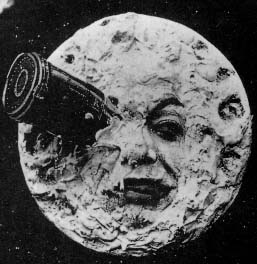
Image credit: Georges Méliès

Moving Movies

I read something recently which began something like, “Do you remember when you first saw…?” (fill in the blank with a title of a movie).  This got me to thinking.  Movies used to be community events.  I’m not the first to notice this, but your community would wait (especially if it wasn’t especially urban) until a hyped up movie came to a local theater.  Everyone would see it and it was all that they’d talk about for days.  The internet makes all of that rather obsolete.  Even the part where you were the less popular sort who had to wait for the film to be shown on television to get in on the fun.  You can set up an account to see the movie at home while those who aren’t afraid of Covid go to the theater.  Or you may be like me—so busy that years pass before you get to it.  Hopelessly behind.

There is definitely a benefit to being able to catch a movie you missed at the theater when it’s convenient to do so.  You might be a bit late to the party, though.  And, depending on your tastes, you may be watching the movie alone.  I can’t recall having ever gone to a theater alone until recent years.  Once when my wife was away, pre-pandemic, I went to a local theater to catch the latest Annabelle movie.  Since I’m an early person the theater was pretty empty—at least one guy and his girlfriend, or a girl and her boyfriend, depending, were there with me.  Maybe a couple others I didn’t know.  Nobody to talk it over with.  Like bowling alone, I suppose.  The last movie I saw in a theater, The Conjuring 3, I was literally the only one there.

Photo by Denise Jans on Unsplash

I did recall the first time I’d seen the movie in the article.  I was watching with headphones on, sitting in my bedroom.  Sometimes it’s the living room.  I do recall my reaction, which is, after all, what the article is about.  Still, it was a movie that was watched without discussion, without seeing the reactions of others.  Watching it was, nevertheless, an enjoyable enough experience.  An intellectual one, even.  But as a former teacher I still have this haunting sense that if there’s no-one with whom to exchange information, remembering that first time becomes somewhat muted.  I suppose that’s why I keep this blog going.  I can interact with others on the internet and, collectively, recall seeing our movies together.  Attempt to be part of the discussion.


Used or New?

A recent post on a used book got me to thinking.  Back when I was acting like a trained researcher my reading was very specialized and focused.  Even so, my personal reading was eclectic.  I think that’s the result of having been raised poor.  With no bookstore in our town, and no Amazon (or Bookshop.org), book purchasing was catch as catch can.  Since my fortunes haven’t dramatically increased in life (long story), my purchasing habits have remained pretty much the same.  I’ll buy used books or movies if I can.  Since these are about the only things I buy, they loom large in my mind.  And the thing about buying used is that it’s often opportunistic.  I can pretend it’s intentional and say I’m trying to be well-rounded, but the fact is I try to save money where I can.

This really struck me as I was reading something written by a film maker.  Now, I’ve penned two books about horror films, and I tend to watch them quite a lot.  What struck me about what I was reading was just how many films the writer knew.  Academics can be that way—knowing everything about a subject.  When researching my first book, A Reassessment of Asherah, I read everything I could find in pre-internet days about the goddess.  That is a thoroughly researched book.  When you’re a graduate student your job is to become as familiar as possible with your subject, no matter the language of the research (within reason).  As just an editor my movies and my books are a matter of what I find in my eclectic life.

I often imagine what my life would be like if I could’ve remained a professor.  In those days I read fewer full books—research is often a matter of reading only the parts relevant to your project—and certainly less fiction.  I was never a well-paid academic, teaching at a small school that considered on-campus housing a large part of the compensation package.  I didn’t buy many books then, either.  Some of the most important ones were, you guessed it, used.  I wonder if I would’ve ever have shifted my interest back to horror.  During those days I didn’t need horror (it was a gothic campus and I was beginning family life).  Since then I’ve become an even more eclectic person.  My fascination with geology began then and still comes back when the stars are just right.  And even they, I suspect, might be remnants of even older, used stars.

Photo credit: NASA

Appily Ever After

While in the theater to see The Nun (which ended up being the biggest take) this weekend, I couldn’t help but notice that the pre-movie adds were all about apps.  I couldn’t help it because, much to my own chagrin, I’d left the house too quickly and I hadn’t brought a book to read while waiting.  This may not be news to some people, but different cinema chains have different “channels” of what passes for entertainment and ads to try to draw viewers in early.  The movie house we used to frequent in New Jersey had a variety of goods on show, most of the time.  The one we visited here in Pennsylvania presumed that everyone had their phones in hand, waiting for the show to begin.  On screen was the idolization of the app.

My phone is old enough that most modern apps don’t work on it.  Most of the time that doesn’t matter to me since I’m not addicted to the device.  Of course, when you’re trying to park your car in a town that offers only online options for such a convenience, I sometimes wish I could download the relevant necessary software.  Otherwise, I often wonder what we’ve lost in our lust for connectivity.  Coming out of New York on the longer distance bus recently, the driver called out, as leaving the Port Authority, “Lights on or off?”  The unanimous chorus, for I didn’t speak, answered “Off!”  I glanced around.  I was surrounded by devices.  I carry a book-light with me on the bus, for this has happened before.

“Drink the Kool-Aid” has become post-Jonestown slang for simply following the suggestion of someone without considering the consequences.  I sometimes wonder if our smartphones come in more than one flavor.  I’m not talking about features or physical colors.  As apps chip away at our money, a little bit at a time, they also take larger pieces of our time.  I’ve experienced it too, but mostly on my laptop (I don’t text—my thumbs aren’t that limber, and besides, the apocopated messages often lead to misunderstanding, emojis or not), the wonder of one link leading to another then realizing an hour has disappeared and I still feel hungry.  Perhaps that’s the draw to the modern commuter.  Or movie goer.  I’m sitting in the theater, taking a break from unpacking.  In my version of multitasking, I’m also doing research by watching a horror movie.  Around me eyes glow eerily in the dark.  I’m lost in the forest of unsleeping apps.


Reel Salvation

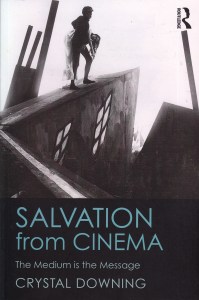
salvationcinemaSalvation is a fraught concept. It’s one of those topics that’s been commandeered by the evangelical camp so that mainstreamers are afraid to touch it, as if it’s catching. The thing is, Christianity is built around the idea that people require saving. The question is how you go about getting “saved.” Some insist it’s being “born again,” while others take a more gradual, one might dare say “evolutionary,” approach. Either way the end result in the same—being rescued from that which threatens you. Like many people, I watch movies. Sometimes I do so with manic intensity, not really knowing why I do it. My personal rationalization is escapism. Living in a world of harsh realities such as Trump (and even before there were sources of great anxiety) one needs an escape hatch. You might say I’m seeking salvation through film.

Crystal Downing suggests I may not be alone in this. Salvation from Cinema: The Medium is the Message is a book that explores the salvific function of movies. These are not just Christian or Bible movies she’s talking about. Indeed, she spends some time wrestling with that preposition “from” in the title. Is cinema something from which one might be saved, or by which one might find salvation? The latter is her focus and she sharpens it by looking at theories which might make it happen. The stories, the stars, and even nudity are put forward as ways the silver screen has been thought to bring salvation to viewers. She also includes a very interesting discussion of breaking the fourth wall. This technique brings the contents directly to the viewer. The second half of her book is more theoretically dense, engaging with modern theorists about what salvation from cinema might mean. Her selection of films to discuss is wide and intriguing.

There can be little question that cinema has a deeper significance than it’s usually supposed. Part of the reason is, as Downing discusses, the easy marriage of capitalism and celluloid in the United States. Movies make money. To counter this she also discusses foreign and art house films as well. There can be little question that those who stand in the queue are seeking something. While cheaper than many diversions, going to the movies does involve a small investment and as capitalists we expect a return on that. So it is that we sit in the dark and allow others to guide us toward the light. That’s as fine a metaphor for salvation as any that the preacher might proffer.