Tracing Writers

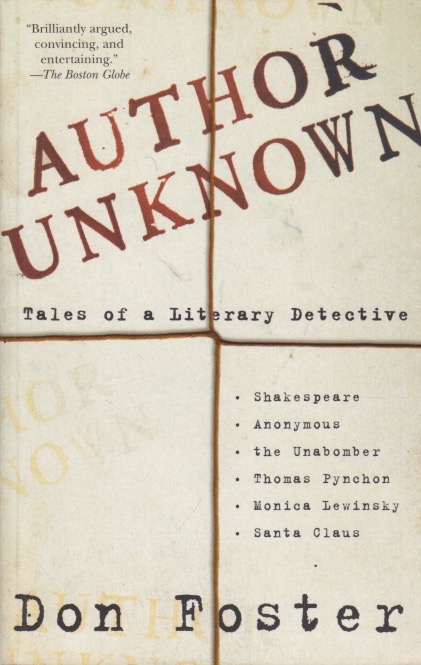
Ratiocination.  Detection.  There’s something compelling about that clear, crystalline logic that leads to solid conclusions.  I was floored by Don Foster’s Author Unknown: Tales of a Literary Detective.  I found the book by following up a reference to “A Visit from St. Nicholas,” aka “’Twas the Night before Christmas.”  Like most Americans I credited the poem to Clement Clarke Moore, but he did not, in fact, write it.  If you trust anyone with literary detection, it should be Don Foster.  Although this cleverly written book is not an apologia for the author’s personal accomplishments, it nevertheless builds trust in his methods and his sense.  It begins as he discovers an unacknowledged text was written by Shakespeare.  The evidence is carefully laid out, and is convincing.  Then others began to ask him to “prove” who wrote other pieces.  It’s quite a ride.

While Foster takes great care not to claim the ideas as his own, he’s nevertheless drawn into the case of the Unabomber, and Monica Lewinsky, and Thomas Pynchon.  His methods of ratiocination demonstrate repeatedly what he explains in his excellent introduction—our writing is every bit as indicative as our DNA.  With an adequate writing sample size, a piece with an unknown or disputed author can, with a great degree of probability, be attributed to the correct author.  You don’t even need to know of the cases to find the outcomes fascinating.  And those who disagree, being human, are simply not convinced by his conclusions.  They’ve already made up their minds.  In this regard the case of Wanda Tinasky (I’d never heard of her) is utterly compelling.

The Santa Claus chapter, the final one in the book, is a real pay-off.  Henry Livingston Jr., of Poughkeepsie, wrote the famous poem that defined Santa Claus as we know him.  Considering Christmas’ importance in our capitalistic society, this attribution is an important one.  Clement Clarke Moore was a very wealthy professor of Bible at the newly formed General Seminary.  Foster demonstrates probable cause in his claiming, and keeping alive, the mythology that he wrote the famous poem.  The way that this chapter is laid out and presented is especially witty.  Those interested in getting at the truth behind who wrote what will find this a page-turner.  Although he wasn’t seeking out the attention that came (most of us, as academics, are surprised when anyone show any interest at all in what we write) Foster has given the world a real gift in this book.  It reminded me once again why research is the most intriguing thing on earth.  And learning can be like reading a good mystery.


Southern Comfort

CajunNightOnce upon a time, long before Hurricane Katrina, the American Academy of Religion and Society of Biblical Literature held their annual meeting in New Orleans. It must’ve been an incongruous sight: the Big Easy filled with right proper professional religionists discoursing eruditely. While there, my family purchased the Cajun Night Before Christmas, by Trosclair. A cute knock-off of Clement Moore’s “A Visit from Santa Claus” (‘Twas the Night Before Christmas), the story unfolds of a fur-bedecked Santa visiting a destitute, but grateful family on the bayou. Each year I try to reach deep in my southern roots to find an accent that accommodates the poem, and read the story the week before the holiday comes. A number of factors have suggested that perhaps this year Christmas might catch many people on a more subdued level. Crushing poverty is a reality, guns are too readily available, and the one percent don’t get close enough to humanity to contract the common cold. Even the effects of Katrina have refused to dissipate completely. Her sister Sandy visited the Big Apple, and things still aren’t quite right.

Big Apples and Big Easies may seem to have little in common, apart from how much money is available to assist in hurricane recovery. They both also participate in Christmas, being havens of Catholicity. Yet after the hurricanes some in New York and New Jersey were without power several days, but parts of Louisiana were simply abandoned. The will to help the disadvantaged seems to have improved since 2005. Considering changes at the top, this isn’t necessarily a surprise. Nevertheless, tragedy throws into sharp relief what we consider human decency. Too bad it takes a disaster to make us more human.

What sticks with me about the Cajun Night Before Christmas, apart from the flying alligators, is the profound hopefulness that the poem conveys. Those with so little take so little to improve their lot. Yet those with too much insist it is their right not to be taxed at all. Those who live in a shack don’t expect much from Santa. They have learned through the disappointment of experience that double standards are endemic in life and while some are unbelievably rich, the poor are happy with just the smiles of children. Ironically, Santa is the great equalizer here. While the children of the wealthy may expect and receive more, the children of the humble are also allowed a portion of hope. As I remember New Orleans, in the palmy days before Katrina, it was a city that knew Mardi Gras was far more humane than Lent, and that even a city marked my radical inequities (let those with eyes to see read) could come to a joyous accord when sins are about to be atoned. And even if he has to commandeer alligators, Santa will visit the poorest children the night before the holy days.