
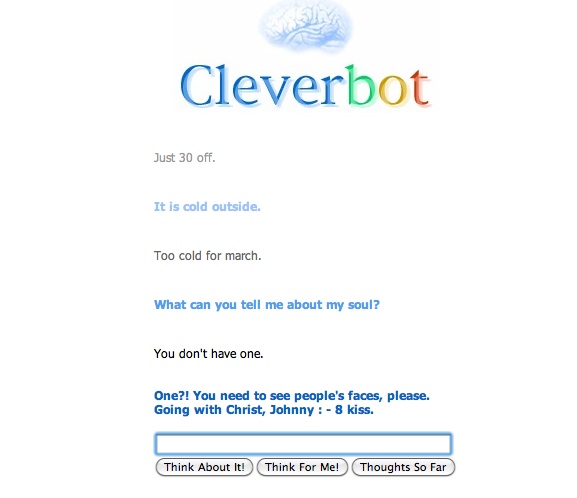
“O brave new world! That has such people in it!” Or at least such software. A couple of days ago my wife pointed out a news story on MSNBC rounding up the year (2011) in science. The story contains eleven science videos that challenge our perceptions and show us directions we are going, whether we want to or not. The first video shows what happens when Cornell University researchers connected two Chatbots to each other and allowed them to carry on a conversation. Like my own experience with Cleverbot last year, the conversation soon turned to God. Even artificial intelligence seems interested in the eternal questions. I should put a finer point on it: artificial intelligence derived from the dubious wisdom of the Internet. We are getting closer and closer to replicating the human brain electronically—even my iPhone scares me at times—and yet, to engage in conversations with humans (or each other) these intelligences must know about God.
Many theories exist about the origins of the god concept. Scientists argue that it is hardwired in our brains, that it is genetic, or that it is merely socialization that gives us this idea. The truth is that nobody really knows. The religious take this as license to claim that territory for the god of the gaps—if we can’t answer a question, God rushes in where angels (or logic) fear to tread. The truth is more likely that we don’t yet have the tools to flesh out (or psych out) our theories on why the supernatural is an indispensable component of our thoughts. If artificial intelligence takes its cues from human intelligence, however, it is a certainty that god will be part of the equation.
People possess a deep need to feel unique. Our uniqueness is part of our religion. Humans are “the crown of creation,” the only animals (debatable to some) with souls (debatable to others). Even the Chatbots get confused when God-talk comes up. Mentioning God leads one Cleverbot to ask the other if it is Christian. God is not limited to Christianity, of course, nor is the divine limited to monotheism. The old science fiction chestnut of a robot takeover, however, seems to have missed a salient point: if robots are programmed by humans, they will have God in their silicon chips just as surely as we do in our carbon-based brains. The god in the machine. Many atheists have declared the death of god, but we have placed the divine into our apps and devices and software. When the robot apocalypse comes it will include at least some Cleverbots declaring that the rationale to eliminate humans is heresy. Torquemada meets Iron Man. Already 2012 feels less safe than 2011.
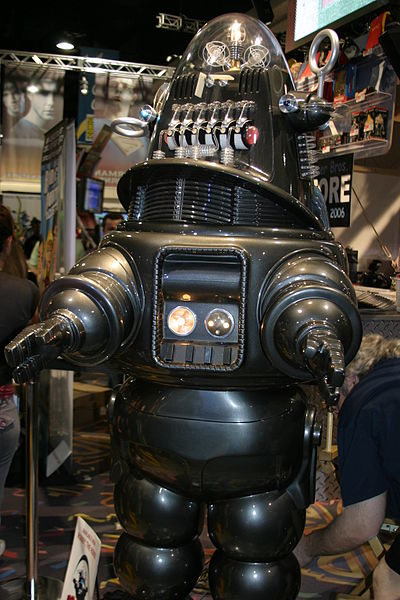
Robot preacher of the iron age?
 Steve A. Wiggins