Neander Valley

Because we can—but should we? This is technological ethics in a nutshell. While we are still debating what it means to be human and the majority of people in the world address that question in religious terms, is it right to play with our own genetics? This is an unavoidable question when considering George Church’s search for a volunteer. Church, currently at the Harvard School of Medicine, would like to grow a Neanderthal baby. With DNA extracted from fossils, it is theoretically possible to clone a Neanderthal with a loving mommy. The usual argument against human cloning is, well, it’s human. Neanderthals are often considered not-quite-human, although our common ancestors hung together in the biological family tree much longer than our chimpanzee cousins. I still recall from my school days that a Neanderthal dressed in a suit and put on the streets of New York City would pass for a large, barrel-chested human. I think I may have seen him on my way to work once or twice, in fact.

Genetics are ethically frightening because they go down to the level of what used to be called essences. Some scientists today dispute that there is anything called an essence; all we have is building blocks. What you make of those blocks contains no essence—you can’t see it in a microscope or cyclotron, or spin it out of DNA. Therefore it must not exist. If there is no human essence, what is the problem with experimenting around a bit? Funnily enough, the question of natural selection enters into this equation. In the arboreal climes of Pleistocene Europe Homo sapiens sapiens bested their big-breasted cousins in the struggle for survival. Would the same be true in our technological era of easy obesity where work is considered tapping on a keyboard all day? After all, Neanderthals had bigger brain capacity—are we ready for that kind of competition? Neanderthal economics might take care of the one percenters even.

I have no insight to offer on such a thorny ethical issue. I do, however, believe in essences. I’ve never seen or measured one, but even concepts like good and evil are meaningless without their essences. What is the essence of a Neanderthal? I suppose it is such a question that leads Dr. Church to seek a volunteer to bring one back into the twenty-first century world. I have to admit I’m a little curious too. Just think of all the opportunities for cute commericals. Still, if natural selection already vetoed the race, maybe we should abide by that decision. This time around we might find ourselves on the losing end—who knows what Neanderthal ethics consist of? Secretly I think their essence might just be trickle down economics and they’ve been among us all along.

Me, on the way to work.
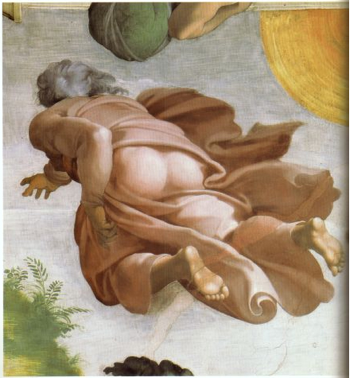
Me, on the way to work.


The Splice of Life

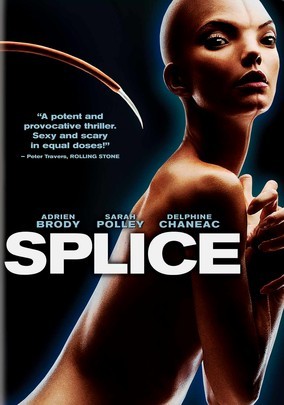
Splice Although not really scary, and although almost attainable with current technology, Dren is a curious monster. Many movies of the horror genre have explicit religious elements, but Splice may be a little too much science fiction for that. Or is it? The story is simple enough: a couple of geneticists have gene-spliced a couple of viable creatures that can be farmed for important chemicals and enzymes to solve diseases. So far, so good. But then the idea occurs to them: if the chemicals that can be used to help cure animal diseases had a human element, couldn’t they be used to cure our own diseases? And here is where the ethical quandaries begin. Adding human DNA to the mix, even when in small portions, suddenly throws open the moral dilemmas. Dren is the somewhat human result of these experiments, but the movie ends with the haunting, unanswered question—what is it to be human?

Although today the field of ethics is largely claimed by philosophers, morality is a measure of beliefs about right and wrong. In many cultures, including our own, religion has quite a lot to say about the issue. Once human DNA is mixed in the creature morphs from a bumpy slug into a creature that looks mostly human. The ethical dilemmas that surround human potential—abortion, stem cell research, cloning, and in past ages eugenics—all focus on the rights of the human person. Once a person is born, however, we almost immediately begin to curtail those rights until most of us become cogs in an unfeeling corporate machine. We are valuable, but for whose purpose? Who, sitting in their cubicle, or on their assembly line, or behind the wheel, says, “For this they defended my right to be born”?

Oddly, we privilege the potential of life without tirelessly working to improve the lot of those who’ve already been born. Perhaps, indeed, this is some form of evolutionary advantage—protect the future of the species at all costs. This idea becomes religious when it is deemed God’s will. In the movie, Dren’s creators ultimately deem her unhuman, a monster who must be destroyed. They, however, nurtured her humanness all along. While not the most profound movie ever filmed, Splice highlights the fact that ethics reflect the values of society. And society sometimes withdraws even humanity from those who’ve lost its favor.


Life in the Laboratory

Nancy Gibbs’ essay “Creation Myths” appears in this week’s Time. Leaping off from Craig Venter’s “creation of life” in the laboratory, Gibbs asks who the final arbiter might be in this world we’re creating in our own image. The more I ponder the question, the more I realize that no person really decides how far we will go and the implications will only grow more and more unanswerable. We all attempt to construct the world according to our idea of how it should look; it is not a question of if we create the world in our image as much as it is whose image will prevail. As I noted in a recent post, no one person has all the answers. What each of us does impacts all the others just as a wave influences everyone in the sea. We fear science taking the prerogative of creating life because we are fully capable of imagining where it might go, but we just don’t know.

As an individual who has often been on the receiving end of other people’s visions of how this or that institution or company should look, it is my humble assessment that we have already lost control. We never really had control in the first place. At the end of the day, who will really be able to prevent another Gulf oil spill from occurring? Make what laws we will, other creators will find ways around them. And as in Gibbs’ article, the rest of us will simply have to react. No one is really in control.

Perhaps this is the real reason that religion is so appealing. It is terribly, terribly convenient to have an omnipotent divine entity on whose anthropomorphic shoulders we might cast our worries and burdens. Whether we believe in predestination or not, it is comforting to suppose that when it is all over God will somehow sponge up all that oil (preferably squeezing that sponge back out into BP’s great, sturdy tankards of crude), or stop that evil clone we’ve engineered, or stomp out that hyper-aggressive virus we’ve unleashed. We may make laws against creating life or human clones in the laboratory, but it will happen nevertheless. Gibbs wonders if scientists are about to cross some moral Rubicon. My answer is simple: we crossed that Rubicon long before the river itself flowed, when we first put our webbed feet out onto dry ground and began our still uncertain journey to the future.

God exits, stage left