Life Course

Curriculum vita.  The course of a life.  I see quite a few CVs, although I’m not on any search committees.  As I was examining one the other day I recollected how, when I first tried to put one together, I was told to leave high school and its achievements out of it.  Nobody’s really interested in that anymore.  Presumably college is an indication of choice whereas high school is a matter of where your parents live.  Or how much money they have.  College says something indicative about you.  Although many parents—not mine, to be clear—help bankroll college and may have a say in where you go, college is “your choice.”  Unbounded by geography, young people mostly old enough to take care of themselves, are given a really tremendous responsibility here.  And it was certainly influenced by high school.

Some choices are economic, and that also says something about a person.  Some are faith-based, which definitely says something about you.  Some are terribly ambitious, and those tend to get you the biggest head start on your life course.  Of course, some of us did not realize that.  Some of us, not sure if college would work or not, chose somewhere close to home.  Somewhere where escape, if needed, was possible.  And of course, your college shows up ever after on your CV.  I often wonder if things would’ve worked out differently if I’d gone somewhere else for college.  I needed somewhere understanding to shake me out of the false narrative I’d been told.  Had I gone somewhere more strident I might’ve retrenched in my pre-decided ideas.  Of course, those pre-decided ideas are what made me decide to go to college in the first place.

How can we possibly measure the course of a life?  From big event to big event?  So many of the meaningful bits occur in small spaces wedged in-between the large markers of who we are.  We can’t possibly know all the consequences of our choices, even as we attempt to select the right option at each step of the way.  And there’s no guarantee regarding the outcome.  Were it a feasible option I’d go back to college again—I would start at a different place this time—to test the results of my first decade of higher education.  For, I know, although a CV can reveal more than it might intend, it leaves much more unsaid than it can possibly say.
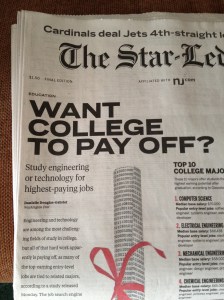

Paying off College

img_2985
“Want College to Pay off?” the headline asks. It depresses me. I’m an unapologetic idealist. Cost-benefit analysis has its place, but that’s not all there is to education. Or better yet, cost-benefit analysis isn’t just about money. The article has suggestions for finding good paying jobs, which is what higher education is all about these days. Getting an education to increase knowledge and to benefit society in that way has become the mark of true naivety. We tell our kids not to study the arts, humanities, or literature since there are no jobs in these fields. We want them to be able to survive in a culture that has cool devices but which has lost its soul. Pretty strange for an institution (or “industry”) that began primarily to study theology.

The earliest universities focused on the then-related fields of law and theology. Since people took religion seriously, this was not the mere diversion that it is today. There are those counter-cultural warriors who study theology to take parishes to combat their increasing irrelevance, but really, the study of law and theology parted ways long ago. Neither one guarantees the return on investment that they used to. Society’s interests are in racing ahead with technology—discovering even faster ways to text while driving, or better ways to ignore those walking down the street with you. Or making money so you can build large towers in major cities and name them after yourself. We call that success. Thinking deeply about an issue, looking at it from multiple angles, and critically assessing it, these are “luxuries” that aren’t “worth” studying. College must, as the headlines say, pay off.

The rapidity with which this has transpired is truly amazing. We allow electronics to drive our culture. Who has time to keep up with all the posts, tweets, and grams that populate every second of every hour? We crowd-sourced knowledge into some great wikipedia of human experience that substitutes for taking time to look closely and think through the implications. It’s not that I despise technology—I use it quite happily daily—it’s just that I think there’s something more. I studied ancient religions and I see many of those archaic patterns beginning to repeat themselves in electronic format. It’s as if by replacing theology with technology we’ve lost sight of just a piece of what kept progress moving forward. Maybe I need to go back to college. I’m just not sure of the cost-benefit analysis.


Playing God

College is a rare time in life. Unlike any time after you find yourself with a diversity of intelligent and talented people open to possibilities that life tends to close shortly thereafter. At Parents Weekend at Binghamton University we took advantage of this wondrous juxtaposition to enjoy student talent. One of those offerings was the play “God of Carnage” by Yasmina Reza. It isn’t literally about God, but rather about two couples whose children had a playground fight. Parents try to solve the crisis, only to end up showing that they are really the ones who need to grow up. One of the vexed parents claims he believes in a God of carnage—that all people will seek their own good first and will eliminate those who get in the way. Perhaps might is right.

IMG_2587

The play is quite funny as the negativity grows and hidden assumptions come to the surface. There are no heroes here. In fact, any factor that might divide people does: gender, socio-economic status, race, sense of importance in the work one does. Each is turned into a weapon to make oneself appear more acceptable than others. Ironically, acceptance is just what’s missing here. Each of the four characters is alone and only finds company in teaming up with another to point out someone else’s foibles. As in most plays, the circumstances are exaggerated, and as in real life, peace is harder to attain than it should be. The god of carnage here is the individual desire to exceed at the expense of others.

The play reminded me, in a rather literal way of the verse stating that a child shall lead us. Not that children are entirely innocent, for they are people too. They can’t be held accountable in the same way adults are. We do our best, but our intentions seldom rise to our ideals. Our own needs and desires get in the way. In my experience of over half a century, most of us never really grow up. Selfish behaviors are magnified in a setting like New York City where so many agenda are crowded in together. If we believe in a god of carnage—that our own desires are more important than those of others—our differences will only emphasize that. Apart from high school and college performances, I have been to few plays in my life. Each time I attend one, however, I learn a bit more about how art reflects reality. And if we could only learn to consider others to be just as important as ourselves, the god of carnage would be the one who ends up unemployed.