Comet Tales

Göbekli Tepe, apart from being impossible to pronounce correctly, is a site of embarrassment to historians. First of all, this archaeological site in Turkey is too old. Abandoned around 9000 BCE—some 5000 years before the Sumerians show up with their writing—Göbekli Tepe had already gone through several phases of elaborate building and willful destruction. A large “temple” has been unearthed there with elaborately carved plinths that suggest a mythology at which we can only guess. Conventional wisdom states that the state came first, then organized religion. Göbekli Tepe suggest that it was the other way around—religion came first. We have no writing to go by here, however, just towering monoliths that make us scratch our heads in wonder. We are the apes.
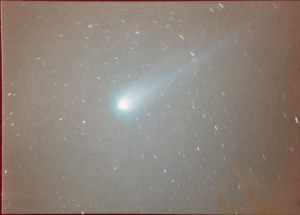
Hyakutake, 1996. My first comet.

A friend pointed me to an article in New Scientist that suggests one of the Göbekli Tepe “carvings show comet hit Earth and triggered mini ice age.” That’s a lot of ice. And eisegesis. Part of the problem here is that old scientists tend to sweep anomalous evidence off the table. It’s an admitted part of the empirical method. If a single anomaly stands against a host of conventionally expected results, the anomaly goes into the bin as an outlier. Göbekli Tepe, as real as it is, is an anomaly. Reputable books on it written in English by archaeologists and historians do not exist. Embarrassed turning away and staring at shoes ensues. The site is just too old, too sophisticated, and too far outside convention to be dealt with rationally. You can read a lot into an isolated carving, especially when accurate information is lacking.

To give you some perspective: the great pyramids of Egypt date from the Old Kingdom of Egypt, after 3000 BCE (remember, we’re counting backwards here). Stonehenge’s main phase (the famous blue stones) was a couple of centuries later than the Great Pyramid of Khufu (Cheops). Göbekli Tepe had closed up shop some 6000 years prior. By comparison, more time had passed between Göbekli Tepe and the Great Pyramid than between the Great Pyramid and us. We, with the internet in our pockets and humans walking on the moon, preparing to go to Mars, are only less than 5000 years from jolly old Khufu. Göbekli Tepe, with its inscrutable carvings, shouldn’t be there. And yet it is. Standard procedure suggests it be ignored. So far, conventional historians have done just that. And in my opinion that’s worse than an ice age brought on by comets written on a stone that nobody can read.
Rosetta’s Stone

Among the earliest forms of writing, Egyptian hieroglyphs were known long before they were deciphered. Despite the famed insanity of Napoleon, his visit to Egypt led to the discovery of the Rosetta Stone and we’ve been able to read what was once pure mystery for over a century now. A week ago today, Rosetta, a robotic space probe, landed on a comet in flight. For a guy who finds a rendezvous with a bus that runs on a supposedly regular schedule a challenge, this is nothing but mind-blowing. If you know the math, you’ll go far. Comets, you see, have long been the provenance of both religion and science. The ancients, apart from being very religious, we also first rate astronomers. Limited by a universe that circled the earth, they nevertheless figured out how to predict things like solstices and eclipses and phases of the moon. Some suggest that megalithic structures as impressive as Stonehenge and the pyramids of Giza were aligned to significant celestial events. The eyes in the skies.

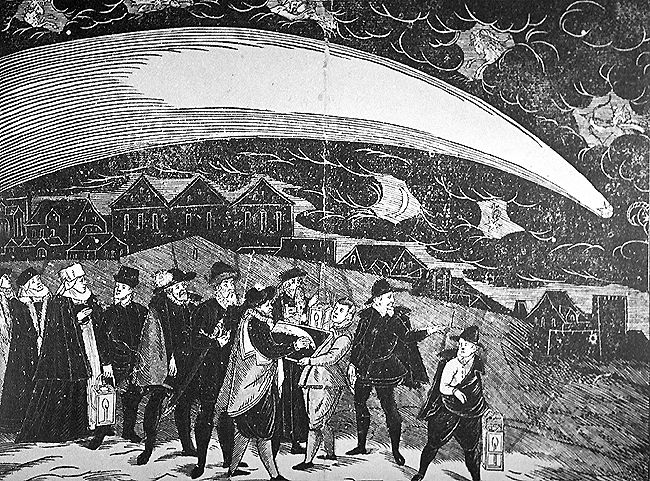
Great_Comet_of_1577

Comets were generally considered harbingers. Even in ancient times they were difficult to figure out; their orbits aren’t easily deciphered and some never survive their close encounter with Old Sol. Still, they can be impressive. Living in the cloudier climes, glimpsing comets is not a guarantee. Light pollution, especially on the horizon, interferes with all kinds of observations. Now, however, the European Space Agency has shown us that it can be done without seeing where you’re going. A decade of travel time, after at least as long of planning for the trip, and you can boldly go where no person has gone before. Recordings of the electromagnetic frequencies, translated into human audible range, confirm everything from Predator to Signs. 67P/Churyumov–Gerasimenko has its day in the sun and 2001 every day comes closer.

Just a year ago comet ISON disappointed many in its failure to live up to the hype. In our workaday world, we’re eager for a harbinger of some kind. A sign that something out there can still evoke wonder. Comets have long been stripped of their religious garb. They are merely rocks and ice lit up by the sun on their weary trek through the cold loneliness of space. Still, landing on a comet can’t help but change our perspective. It’s like looking at the earth from the moon. Or Mars. We name our planets after gods, but comets bear the names of human discoverers. And we have constructed our own Rosetta stone to read the mysteries of the universe. Meanwhile, the bus waits for no one. If you calculate the trajectory correctly, you’ll hopefully get to work on time. And that, after all, is what really matters.


Holistic Universe

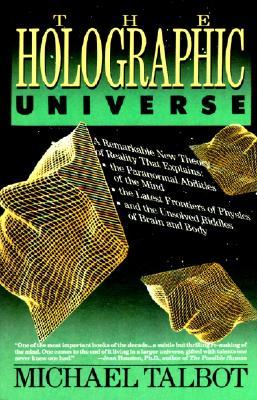
HolographicUniverseThings have been so busy that a satellite landed on a comet and I didn’t even know. I have always wondered about the universe. In fact, as a young man, vying with my tendencies toward ministry I had a vibrant interest in astronomy. The universe, however, has a predilection towards mathematics that frustrates my attempts to understand. I did well enough in my college astronomy class, but I knew it could never be my major. My recent reading reminded me of Michael Talbot’s The Holographic Universe—a book that has been on my shelf since about the time it was published. In my mind, holograph had translated into arithmetic, and every time I picked it up, fear gripped me anew and I vowed I’d read it later. Later caught up with me the last few days, and I found myself plunged down a rabbit hole that I did not even know was there. When I took physics there was no talk of quantum mechanics. It was all the three laws of thermodynamics and the angle of incidence equals the angle of reflection and things like that. Nevertheless, I continued to read science written for the laity, and Talbot’s book rather caught me off guard.

First off, I still have no idea how a holograph works. It is something that seems, to my pragmatic way of thinking, impossible. As Talbot explores this strange concept, however, he introduces a universe I began to recognize. This is one of those realities where the edges don’t quite meet and things that shouldn’t exist show up anyway. In other words, phenomena that are often called “religious” can be made to fit into a holographic universe. Talbot spends a great deal of time discussing miracles and healings. We know that they happen, but we’ve been conditioned to question them. They don’t fit into that universe Mr. Wynecoop told you about in eighth grade. And yet, there they are.

Even after reading the book, I can’t claim to understand how a holographic universe works, but I did come away with a model of reality that allows for the evidence generally swept off the table. Everything from ghosts to time warps are possible in a universe that is a holograph. I’d step off the bus never sure which reality I’d encounter. Still, glancing up at the dark sky, I knew that millions of miles away, someone had recently scored a direct hit on a comet and if we can’t even interpret all that we see on Mars, we’d better be prepared to open our minds for something new. After all, we only see what we allow ourselves to see. Society programs us, just as surely as any computer. And if, like a virus, you play by your own rules, you’ll be the enemy. If you’re willing to ask the uncomfortable questions you’ll be labeled as having tea down a rabbit hole. Maybe, however, I can find a home here. As long as Deacon Dodgson can take care of the math.