Artificial Hubris

As much as I love writing, words are not the same as thoughts.  As much as I might strive to describe a vivid dream, I always fall short.  Even in my novels and short stories I’m only expressing a fraction of what’s going on in my head.  Here’s where I critique AI yet again.  Large language models (what we call “generative artificial intelligence”) aren’t thinking.  Anyone who has thought about thinking knows that.  Even this screed is only the merest fragment of a fraction of what’s going on in my brain.  The truth is, nobody can ever know the totality of what’s going on in somebody else’s mind.  And yet we persist in saying we do, illegally using their published words trying to make electrons “think.”  

Science has improved so much of life, but it hasn’t decreased hubris at all.  Quite the opposite, in fact.  Enamored of our successes, we believe we’ve figured it all out.  I know that the average white-tail doe has a better chance of surviving a week in the woods than I would.  I know that birds can perceive magnetic fields in ways humans can’t.  That whales sing songs we can’t translate.  I sing the song of consciousness.  It’s amazing and impossible to figure out.  We, the intelligent children of apes, have forgotten that our brains have limitations.  We think it’s cool, rather than an affront, to build electronic libraries so vast that every combination of words possible is already in it.  Me, I’m a human being.  I read, I write, I think.  And I experience.  No computer will ever know what it feels like to finally reach cold water after sweating outside all day under a hot sun.  Or the whispers in our heads, the jangling of our pulses, when we’ve just accomplished something momentous.  Machines, if they can “think” at all, can’t do it like team animal can.

I’m daily told that AI is the way of the future.  Companies exist that are trying to make all white collar employment obsolete.  And yet it still takes my laptop many minutes to wake up in the morning.  Its “knowledge” is limited by how fast I can type.  And when I type I’m using words.  But there are pictures in my brain at the same time that I can’t begin to describe adequately.  As a writer I try.  As a thinking human being, I know that I fail.  I’m willing to admit it.  Anything more than that is hubris.  It’s a word we can only partially define but we can’t help but act out.


Not Intelligent

The day AI was released—and I’m looking at you, Chat GPT—research died.  I work with high-level academics and many have jumped on the bandwagon despite the fact that AI cannot think and it’s horrible for the environment.  Let me say that first part again, AI cannot think.  I read a recent article where an author engaged AI about her work.  It is worth reading at length.  In short, AI makes stuff up.  It does not think—I say again, it cannot think—and tries to convince people that it can.  In principle, I do not even look at Google’s AI generated answers when I search.  I’d rather go to a website created by one of my own species.  I even heard from someone recently that AI could be compared to demons.  (Not in a literal way.)  I wonder if there’s some truth to that.

Photo by Igor Omilaev on Unsplash

I would’ve thought that academics, aware of the propensity of AI to give false information, would have shunned it.  Made a stand.  Lots of people are pressured, I know, by brutal schedules and high demands on the part of their managers (ugh!).  AI is a time cutter.  It’s also a corner cutter.  What if that issue you ask it about is one about which it’s lying?  (Here again, the article I mention is instructive.)  We know that it has that tendency rampant among politicians, to avoid the truth.  Yet it is being trusted, more and more.  When first ousted from the academy, I found research online difficult, if not impossible.  Verifying sources was difficult, if it could be done at all.  Since nullius in verba is something to which I aspire, this was a problem.  Now publishers, even academic ones, are talking about little else but AI.

I recently watched a movie that had been altered on Amazon Prime without those who’d “bought” it being told.  A crucial scene was omitted due to someone’s scruples.  I’ve purchased books online and when the supplier goes bust, you lose what you paid for.  Electronic existence isn’t our savior.  Before GPS became necessary, I’d drive through major cities with a paper map and common sense.  Sometimes it even got me there quicker than AI seems to.  And sometimes you just want to take the scenic route.  Ever since consumerism has been pushed by the government, people have allowed their concerns about quality to erode.  Quick and cheap, thank you, then to the landfill.  I’m no longer an academic, but were I, I would not use AI.  I believe in actual research and I believe, with Mulder, that the truth is out there.


Nanowrimo Night

Nanowrimo, National Novel Writing Month—November—has been run by an organization that is now shutting down.  Financial troubles and, of course, AI (which seems to be involved in many poor choices these days), have led to the decision, according to Publisher’s Weekly.  Apparently several new authors were found by publishers, basing their work on Nanowrimo projects.  I participated one year and had no trouble finishing something, but it was not really publishable.  Still, it’s sad to see this inspiration for other writers calling it quits.  I’m not into politics but when the Nanowrimo executives didn’t take a solid stand against AI “written” novels, purists were rightfully offended.  Writing is the expression of the human experience.  0s and 1s are not humans, no matter how much tech moguls may think they are.  Materialism has spawned some wicked children.

Can AI wordsmith?  Certainly.  Can it think?  No.  And what we need in this world is more thinking, not less.  Is there maybe a hidden reason tech giants have cozied up to the current White House where thinking is undervalued?  Sorry, politics.  We have known for many generations that human brains serve a biological purpose.  We keep claiming animals (most of which have brains) can’t think, but we suppose electrical surges across transistors can?  I watch the birds outside my window, competing, chittering, chasing each other off.  They’re conscious and they can learn.  They have the biological basis to do so.  Being enfleshed entitles them.  Too bad they can’t write it down.

Now I’m the first to admit that consciousness may well exist outside biology.  To tap into it, however, requires the consciousness “plug-in”—aka, a brain.  Would AI “read” novels for the pleasure of it?  Would it understand falling in love, or the fear of a monster prowling the night?  Or the thrill of solving a mystery?  These emotional aspects, which neurologists note are a crucial part of thinking, can’t be replicated without life.  Actually living.  Believe me, I mourn when machines I care for die.  I seriously doubt the feeling is reciprocated.  Materialism has been the reigning paradigm for quite a few decades now, while consciousness remains a quandary.  I’ve read novels that struggle with deep issues of being human.  I fear that we could be fooled with an AI novel where the “writer” is merely borrowing how humans communicate to pretend how it feels.  And I feel a little sad, knowing that Nanowrimo is hanging up the “closed” sign.  But humans, being what they are, will still likely try to complete novels in the month of November.


Remembering Consciousness

I recently inadvertently read—it happens!—about anesthesia.  I’ve been relatively healthy for most of my adult life and have experienced anesthesia only for dental surgery and colonoscopies.  I’ve actually written about the experience here before: the experience of anesthesia is not like sleep.  You awake like you’ve just been born.  You weren’t, and then suddenly you are.  This always puzzled me because consciousness is something nobody fully understands and there is a wide opinion-spread on what happens to it when your body dies.  (I have opinions, backed by evidence, about this, but that’s for another time.)  What I read about anesthesia made a lot of sense of this conundrum, but it doesn’t answer the question of what consciousness is.  What I learned is this: anesthesiologists often include amnestics (chemicals that make you forget) in their cocktail.  That is, you may be awake, or partially so, during the procedure, but when you become conscious again you can’t remember it.

Now, that may bother some people, but for me it raises very interesting issues.  One is that I had no idea amnestics existed.  (It certainly sheds new light on those who claim alien abduction but who only remember under hypnosis.)  Who knew that even we have the ability to make people forget, chemically?  That, dear reader, is a very scary thought.  Tip your anesthesiologist well!  For me, I don’t mind so much if I can’t remember it, but it does help answer that question of why emerging from anesthesia is not the same as waking up.  Quite unrelated to this reading, I once watched a YouTube video of some prominent YouTubers (yes, that is a full-time job now) undergoing colonoscopies together.  They filmed each other talking during the procedure, often to hilarious results.  The point being, they were not fully asleep.  The blankness I experience after my own colonoscopies is born of being made to forget.

I think I have a pretty good memory.  Like most guys my age, I do forget things more easily—especially when work throws a thousand things at you simultaneously and you’re expected to catch and remember all of them.  Forgetting things really bothers me.  If you haven’t watched Christopher Nolan’s early film Memento, you should.  I think I remember including it in Holy Horror.  In any case, I don’t mind if anesthesiologists determine that it’s better to forget what might’ve happened when the last thing I remember is having been in an extremely compromised position in front of total strangers of both genders.  My accidental reading has solved one mystery for me, but it leaves open that persistent question of what consciousness really is.


Consciousness Conscience

Not so long ago—remember, I read old books—living to 60 was considered a full life.  I’ve passed that and while I’m in no hurry to shuffle off this mortal coil, I often think of how improved medical practice has prolonged many lives.  This is a good thing, but it does make death a more difficult fact to deal with.  If there is any good that came from my Fundamentalist upbringing, it was that it taught me early on to think about death with some frequency.  I’m not a particularly morbid person, but since we all have to face this, avoidance seems to lead to grief, shock, and acute mental pain.  I tend to consider watching horror movies a spiritual practice.  Little reminders, in case I forget to consider my own mortality today.

Our faith in science is a little bit misplaced.  Sure, it helps enormous numbers of people live longer, healthier lives.  But it may also detract from the necessity of attending to our spiritual lives.  I don’t care if you call it consciousness, your soul, psyche, or mind, but we have a life we’re accountable to, and it’s not all physical.  Since consciousness feels neutral enough, let’s go with that.  We don’t know what happens to our consciousness after death.  There are plenty of theories and ideas about it, but no certain knowledge.  There may be faith, and there may even be some evidence, but it is always disputed.  It does seem to me that facing death squarely on may help take care of at least some of the anxiety.  Fear of the unknown is probably the greatest fear our species possesses, so pondering it may take the edge off a bit.

Some people claim to remember past lives.  Sometimes I wonder if they might be tapping into the great unknown: consciousness.  Perhaps consciousness survives without a physical body.  Perhaps it’s large—expansive—and encompasses far more than we can imagine.  Maybe some people can access part of that consciousness that includes the past lives of others.  We have no way of knowing, but it seems worth thinking about on this All Souls Day.  Of course, I have the advantage of having lived what used to be considered a full life.  In it I have set aside at least a little time each day to consider what happens after this.  Do I have a definitive answer?  No.  I do have faith and I do have beliefs.  And I’m always reflective on All Souls Day.

Frans Hals, Young Man holding a Skull (Vanitas), public domain via Wikimedia Commons


Sleeping and Watching

The older I get, the more flexible my idea of reality becomes.  I’m starting to notice things that may have been happening for decades, but the reflection of age throws into sharper focus.  I’ve mentioned before that a good night’s sleep casts the day in a different light.  Such nights are sometimes hard to come by and unrelenting capitalism doesn’t offer enough “sick days” to sit out the bad ones.  But it’s not only that.  I watch a lot of movies.  Since I’ve been writing books on movies that only makes sense.  Still, I’ve begun to notice how movies stay with you after the credits roll.  Sometimes they remain the whole day until a night’s reboot comes.  This can also happen with reading, but on a slower, and most likely more profound level.

In high school, reading existentialist plays (sometimes in German), I learned to remind myself that watching a play (or movie) is observing an illusion.  Now I’m beginning to question whether that’s entirely true or not.  What enters our minds becomes part of us.  Think of the vast majority of human lives throughout history.  People living out their lives by farming and/or hunting.  Spending every day on the many tasks it takes to stay alive.  No reading.  No watching.  Their daily lives constructed their reality.  How many of us could grow our own food or build adequate shelter?  And God help us if we need a doctor.  Our lives require many other people to ensure we keep on going.  Most of them people we don’t know.  People whose realities are different than mine.

My career trajectory misfired fairly early on, and my reality has been years of trying to make sense of what happened.  From the first days of hurt and confusion I began to cope by watching movies.  For ninety minutes, at least, I escaped reality.  Or did I?  Was I enhancing reality?  What of my existentialist outlook?  Perhaps I was doing what existentialists do best—creating my own meaning.  So if I get out of the wrong side of bed, and the day feels like it really isn’t welcoming me this time around, I await the reboot.  Or when I have a few moments to sit down and watch a movie, I get up from my chair with an alternative reality surrounding me.  Perhaps I have learned something by sleeping and watching.  Maybe I have learned that reality is more flexible than I’ve been inclined to believe.  Maybe somehow this all does make sense.  Or not.


Expectations

Our minds are our most powerful tools.  Some of us wonder what reality is, and David Robson has written a very important book that the title explains: The Expectation Effect: How Your Mindset Can Change Your World.  Now, before your woo-woo meter goes off, Robson is a science writer and everything in his book is backed by evidence.  The basic idea is this: what we expect to happen often becomes our reality due to the “expectation effect.”  The brain, as Robson describes it, is a prediction machine.  And what it expects often takes place.  In other words, belief matters.  Probably the most famous example of this is the placebo.  We all know that patients treated with placebos often recover just as well as patients given the active ingredient.  That pill the doctor gives will heal them, and so it does.  The brain expects it, and it happens.  Belief.

This book also explores the nocebo response.  This is where you expect something bad, and it happens.  The most extreme examples of this, well documented, are when people are convinced an imaginary threat will kill them and they die of it.  In fact, the book opens with consideration of such an occurrence where a cultural expectation led to otherwise unexplainable deaths among healthy Hmong populations fearing a night demon.  Hysteria grew and so did the deaths.  Robson also explores how hysteria leads to expectations that our brains carry out.  He shows how training our expectations can help good self-fulfilling prophecies take place.  Athletes, for example, can seem to do the impossible.  Why?  Partially training, yes.  But also because of their mindsets.  Their expectations.  Their beliefs.

The implications of this are very broad.  Everything from our health, to how we handle stress, to how food benefits our bodies, to how we age as we expect to.  Robson is quick to point out that this isn’t a book to solve all our problems, but it is a book that demonstrates our minds do make things real.  Or at least they can.  It is filled with fascinating examples, backed with science, showing that even how a doctor or nurse introduces a shot “you’ll feel a bit of a sting” versus “you won’t feel a thing” can make a difference to how our body perceives it.  And our brains can make our worries, or our hopeful expectations, real.  Personally, I believe that there may be even more to this than Robson explores.  But then again, I enjoy a bit of mystery.  I believe in belief.  Regardless, this is a life-changing book and I hope, for your own sake, that you’ll read it.


Doing Without

I’m a creature of habit.  Although I’m no internet junkie (I still read books made of paper), I’ve come to rely on it for how I start my day.  I get up early and do my writing and reading before work.  I generally check my email first thing, and that’s where something went wrong.  No internet.  We’ve been going through one of those popular heat waves, and a band of thunderstorms (tried to check on their progress so I could see if it’s okay to open the windows, but wait—I need the internet to do that) had rolled through three hours ago, at about midnight.  Maybe they’d knocked out power?  The phone was out too so I had to call our provider on my cell.  The robovoice cheerily told me there was a service outage and that for updates I could check their website.  Hmmm.

I can read and write without the internet.  I’m on Facebook for, literally, less than two minutes a day.  I stop long enough to post my blog entry and check my notices.  I hit what used to be Twitter a few times a day, but since people tend to communicate (if they do) via email, that’s how the day begins.  This morning I had no internet and I wondered how tech giants would live without it.  I’m no fan of AI.  I use technology and I believe it has many good points, but mistaking it for human—or thinking that human brains are biological computers—flies in the face of all the evidence.  Our brains evolved to help our biological bodies survive.  And more.  The older I get the more I’m certain that there’s a soul tucked in there somewhere too.  Call it a mind, a psyche, a spirit, a personality, or consciousness itself, it’s there.  And it’s not a computer.

Our brains rely on emotion as well as rationality.  How we feel affects our reality.  Our perspective can change a bad situation into a good one.  So I’m sitting here in my study, sweating since, well, heat wave.  It was storming just a few hours ago and I can’t check the radar to see if the system has cleared out or not.  What to do?  Open the windows.  I’ll feel better at any rate.  And in case the coffee hasn’t kicked in yet, “open the windows” is a metaphor as well as a literal act on my part.  And I don’t think AI gets metaphors.  At least not without being told directly.  And they call it “intelligence.”

Photo by Chris Barbalis on Unsplash

Life After

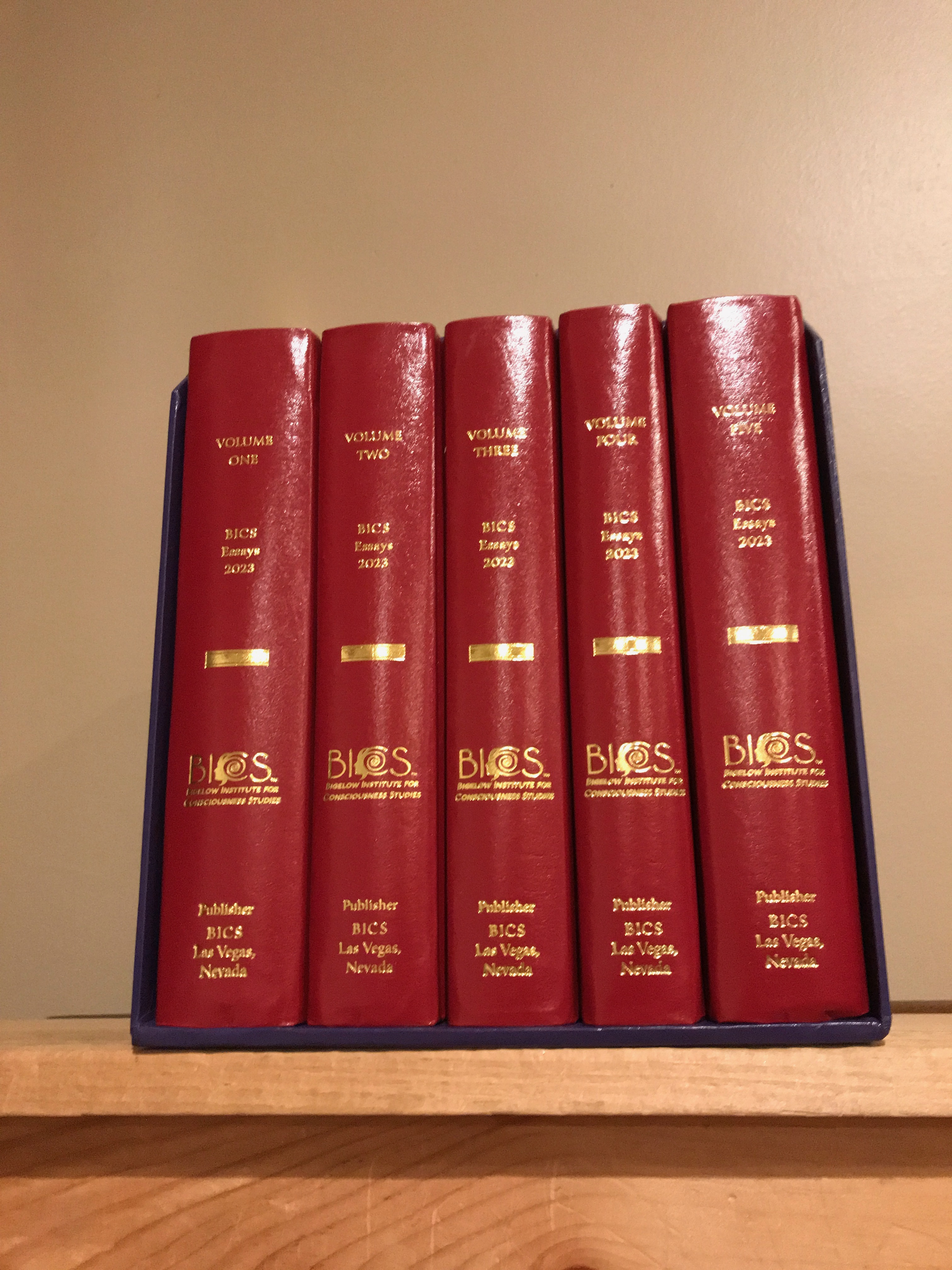
Robert T. Bigelow is wealthy enough to speak his mind.  A hotel and aerospace entrepreneur, Bigelow has made no bones about his belief that aliens are among us, for example.  After the death of his wife in 2020 he initiated a contest for essay writers to give their best proof that consciousness survives death.  The results took the form of a five-volume, twenty-eight essay collection that, according to those who’ve read all, is impressive.  Having spent my life studying religion, I can trace my motivation back to this basic concern.  As a child I was terrified of Hell—a fear that has never abandoned me—and consequently studied religion as a means of reassurance.  I’m not alone in this; the whole Methodist movement began because of John Wesley’s similar concern.  Most of us don’t have the money Bigelow has to attempt reassurance.

Having said that, some time ago, the Bigelow Institute for Consciousness Studies—the organization behind the essay contest—offered $500,000 for the first place essay.  The second received $300,000 and the third $150,000.  Those who were selected for publication received a copy of the five-volume set.  Then, the Institute made an announcement: while supplies lasted, anyone with a legitimate interest in the subject could write to them for a free copy.  I’m not of the intellectual caliber of these essayists, but I have studied religion my entire life.  And I am quite interested in what the BICS is calling “absolute proof of life after death.”  All it cost was an email.  They even paid for shipping.

The set arrived yesterday.  The postal worker at the door seemed apologetic (I had to sign for it), noting the package was heavy.  Now, this is going to take some time to get through.  The five volumes are handsomely produced.  The hardcovers are printed in full color (I know from work this is quite costly).  They have gilt edges and ribbon markers.  And a wealth of thought within.  I guess you’ll need to stay tuned here to find out, after I finally finish, if the results are assuring.  Glancing through the table of contents, and having looked over the judges of the contest, I’m optimistic.  Although Robert Bigelow stands at the opposite end of the political spectrum to me, we both understand that deep-seated human need to know physical death is not the end of who we are.  Even the famous skeptic Harry Houdini wanted the answer to this question as he debunked mediums in search of someone legitimate.  In any case, I’ve got years of interesting reading ahead of me.


Stalking the Stalker

You had to’ve seen this coming.  The Night Stalker introduced how Carl Kolchak, hard-nosed reporter, became a believer in the supernatural.  This highly-rated television film led to a sequel, The Night Strangler, which appeared the following year.  It also did well.  Ditching a third script by Richard Matheson, ABC decided on a series, Kolchak: The Night Stalker.  The subtitle was probably considered a necessary reminder that the movies had done very well.  It also transferred the stalker epithet onto Kolchak.  But I’m getting ahead of myself.  The Night Strangler shifts the action to Seattle where an elixir-of-youth-drinking monster is murdering young women to keep himself alive.  Once again the police and government officials cover up what’s really going on, for fear of losing tourist dollars.  There is a bit of social commentary here.


This movie reminded me of an In Search of… episode on Comte de Saint Germain, who, as a child, I assumed was a Catholic saint.  Saint Germain (just his assumed name) was an alchemist who claimed to be half a millennium old.  He seems to be, guessing from the number of books that treat him as an actual saint, just as popular now as he was in the seventies.  At least among a certain crowd.  And it was in the seventies that this movie was released.  Saint Germain’s enduring popularity all but assures no academic will touch him.  No matter, we have Kolchak to fill in the details.  And Richard Matheson was a smart man.  The Night Strangler does have a few pacing problems, but it certainly is a film worth seeing, even though it exists in that shadowy world of telinema (the combined forms of television and cinema).

Kolchak succeeds by believing in where the facts point, although the conclusions are supernatural.  In fact, watching The Night Stalker I couldn’t help but think of those who claim to have staked the Highgate Vampire.  That’s some strong conviction.  Indeed, the will to believe is more powerful than most people would like to admit.  Our minds contribute to our reality, but we insist that minds = brains, despite our inability to define consciousness.  That’s why I liked shows like In Search of…  As a teenager I couldn’t get enough of it.  I purchased all the accompanying Alan Landsburg books with my hard-earned summer income, skimping, as always, on the school clothes that I had to buy for myself.  Funny, it seems that my mindset hasn’t changed that much since the days of my youth.  Or maybe a sign of maturity is recognizing you were closer to the truth than you realized, back when you started the quest.


To Their Own Devices

This one’s so good that it’s got to be a hoax.  One of the upsides to living under constant surveillance is that a lot of stuff—weird stuff—is caught on camera.  I admit to dipping into Coast to Coast once in a while.  (This, originally radio, show [Coast to Coast AM] was well known for paranormal interests long before Mulder and Scully came along.)  It was there that I learned of a viral video showing devices praying together during the night in Mexico City.  The purported story is that a security guard in a department store came upon electronic devices reciting the Chaplet of the Divine Mercy.  One device seems to be leading the other devices in prayer.  Skeptics have pointed out that this could’ve been programmed in advance as a kind of practical joke on the security guard, but it made me wonder.

I’m no techie.  I can’t even figure out how to get back to podcasting.  I do, however, enjoy the strange stories of electronic “consciousness.”  I use the phrase advisedly since we don’t know what human, animal, and plant consciousness is.  We just know it exists.  I am told, by those who understand tech better than I do, that computers have been discovered “conversing” with each other in a secret language that even their programmers can’t decipher.  And since devices don’t follow our sleep schedules, who knows what they might get up to in the middle of the night when left to their own devices?  Why not hold a prayer service?  The people they surveil all day do such things.  Since the video hit the web not long before Easter, with its late-night services, it kind of makes sense in its own bizarre way.

As I say, this seems to be one of those oddities that is simply too good to be true.  But still, driving along chatting to my family in the car, some voice-recognition software will sometimes join in with a non sequitur.  As if it just wants to do what humans do.  I don’t mean to be creepy here, but it may be that playing Pandora with “artificial intelligence” is dicey when we can’t define biological intelligence.  I’ve said before that AI doesn’t understand God talk.  But if AI is teaching itself by watching what humans post—which is just about everything that humans do—maybe it has learned to recite prayers without understanding the underlying concepts.  Human beings do so all the time.

Let us pray


Using Brains

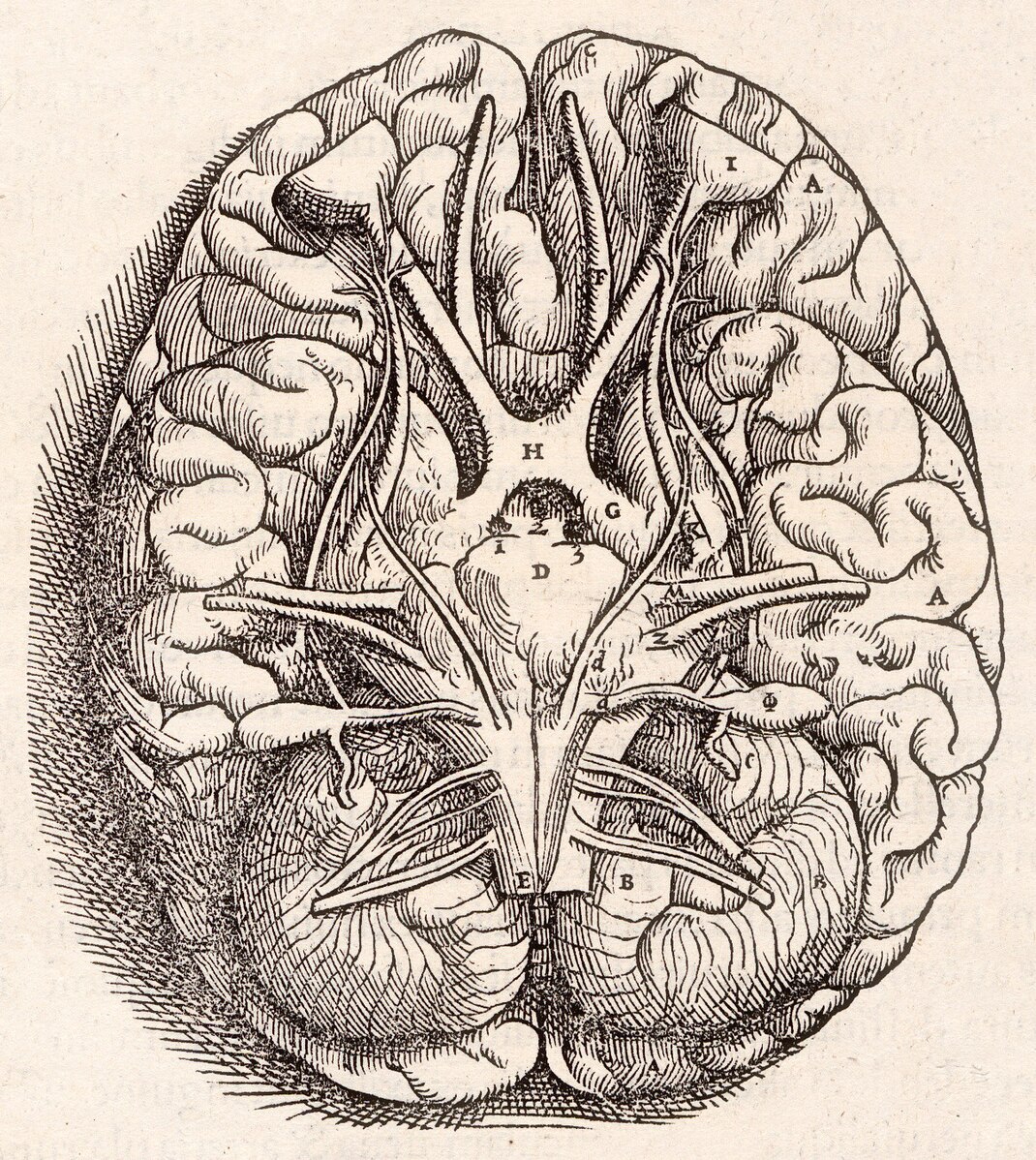
I’m old enough to know better.  Here’s a thought.  I recently saw a headline that suggested human brains filter out things like ESP because brains evolved to help us survive.  No matter what you believe about ESP, the idea got me to thinking.  We often act as if our brains are able to determine the Truth (that capital is intentional).  At the same time we don’t understand what consciousness is.  We know that other animals have brains and that the evolution of said organ is to help individuals survive to reproduce.  Some animal species end their existence at that point, but others linger on to wonder.  And I’m wondering if our brains are filters.  Stick with me here: we know that there are stimuli that we can’t perceive that other brains can.  For example, it seems that migrating birds can perceive magnetic fields.  Even if they can’t there are magnetic fields that we perceive only through their effects on objects.  Our brains have no direct access.

Image credit: Andreas Vesalius‘ Fabrica, showing the Base Of The Brain, by user Ancheta Wis

Here’s where it gets spooky.  If our brains filter out things that may hamper us in survival, what if they overzealously teach us not to perceive things that actually exist?  We’re somewhat limited by our “five” senses, no doubt.  We get along okay.  But what of those people who see things that others don’t?  We tend to medicate them or lock them away, but what if their brains have learned how to shut off part of the filter?  Having written a book about demons, naturally they come to mind as a test case.  Or, if you prefer, ghosts.  We tell our children these things aren’t real.  Trust the filter.  Get on with life in “the real world,” right, Cypher?

I didn’t have time to read the article, but I’d experienced a perspective shift.  If our brains are all about gathering information (and in part they clearly are), that’s one thing.  If they are actively filtering things out, well, that’s quite another.  We laud the imagination of children until they become “old enough to know better.”  Do we teach them to shut out what they can actually see, or sense, in order to accept the inevitable, material, adult world?  This idea has startling implications.  As we plunge ahead inventing AI to do our thinking for us, perhaps we’ve left something even more fundamental behind.  Have we lost interest in the Truth?  We may not be able to access it directly, but I wonder if we’re taught to give up without even trying.


Brain Exercise

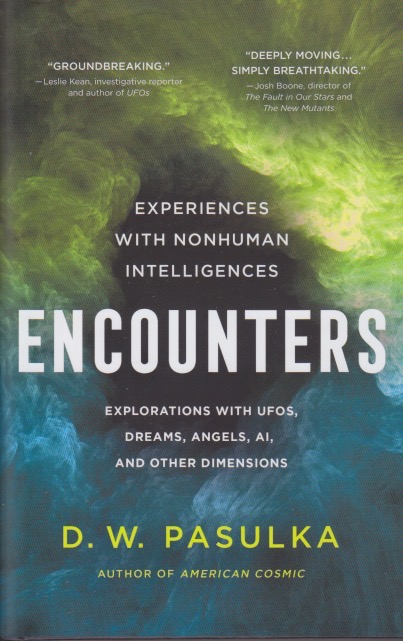
Why do we read, if not to expand our minds?  I’ve read all of Diana Walsh Pasulka’s previous books but Encounters is mind-blowing.  I feel particularly honored that a scholar of religion has been able to put together so many pieces of a very strange puzzle.  Pasulka’s first book was about Purgatory.  Having grown up Catholic that seems a natural enough choice.  Her second book, American Cosmic, focused on a topic that academics were just starting to address at the time—UFOs.  That book justly earned her acclaim.  Encounters takes a few steps further into the mysteries of being human.  Those who experience UFOs have much in common with people who have other extraordinary encounters.  The profiles in this book will give you pause time and again.

Many of us have felt that the unfortunately successful government strategy of ridicule toward experiencers has been a blanket covering up the truth for too long.  I was interested in UFOs as a child and was unmercifully teased for it.  One of the reasons I was interested was that I learned, when I was about eleven, that my grandfather had been interested as well.  I was only two when he died, so there was no way to learn this personally.  It came through discovering a couple of his books that my mother had kept.  Since she was one of five siblings, it’s difficult to say if he’d had any other books on the subject, but being a reasonable kid, I wondered why this was a forbidden topic.  You could talk about ghosts (at least a little bit) and be considered “normal.”  Mention UFO’s and you’re insane.

When the Navy’s video recordings of UFOs—renamed UAPs—were released in 2019, there was silence in the room for about half an hour.  Serious people began to realize there might be something to this.  Of course, those who’d internalized the ridicule response continued to fall back on it, perhaps as a defense mechanism.  That revelation has allowed, however, serious consideration of what is a very weird phenomenon.  I’ve deliberately avoided saying too much about what Pasulka covers in her book.  As I generally intend when I do this, what I’m hinting is that you should read this book.  You should do so with an open mind.  If you do, you might find yourself thinking in some new ways.  Of course, some will ridicule.  Others, however, may walk away with an expanded perception of reality.


Your Mystery

Few things glaze the eyes of others like somebody else’s genealogy.  That’s not what this is, so unglaze those peepers!  As with most of my posts, there is reflection here and that contemplation applies to just about everyone.  We don’t know our parents very well.  It’s only been when trying to connect the dots for my progenitors that I came to realize just how poverty-stricken that knowledge is.  I could (and did) talk to my mother frequently, until recent days, but even to her my father was a mystery.  I knew he was in the military for at least six years, so I filed a military records request with the National Archives.  You can do this if you’re next-of-kin.  That’s when I learned of the National Personnel Records Center fire of 1973 when at least 16 million records were destroyed.

National Archives fire, public domain (via Wikimedia Commons)

My father is a mystery to me.  The National Personnel Records request brought back a few hits, all documents partially consumed by fire (for which the administer apologized) that contained just tiny bits of information.  All of this makes me reflect on our limitations in knowing others.  Parents, spouses, children, siblings—they all remain mysterious in some ways.  And some more than others.  We go through life knowing only ourselves, and not even that person fully.  Consciousness brings these things to a new level, but we still really find ourselves bound by our minds.  That’s why, I suspect, some of us keep trying to cram new things in there—wanting to understand others as well as ourselves.  All it takes is a fire in the National Archives to wipe out entire lives.  Or parts of them.

Now that her earthly time has ended, I realize my mother is also a mystery to me.  It will take some time before I can sit down to write out what I knew of her life.  We grow up distracted by our own needs and wants.  Does a baby bird ever wonder at the enormous energy and strain on its parents as they bring food to their open beaks?  Even those of us who write leave gaps—some intentional—in the records of our lives.  Other people are mysteries.  Wouldn’t the world be a better place if we treated them as such?  Instead, we often act as if their roles (store clerk, accountant, electrician) are their lives, their essential selves.  It’s all we can do, I know, to take care of our own lives.  But it would be a more wonderful world if we could see others as doing just the same.


Morning Reflections

Morning thoughts are different from evening thoughts.  As we spin recklessly through the blackness of space on this globe, we really have no idea how consciousness works.  We assume, unless some “pathology” is present, that personalities are stable.  But we also think differently at differing times of the day.  I’ve long observed this as the work day progresses.  Anxiety tends to ratchet up during the afternoon, sometimes getting a head start in the morning.  Of course, all of it will depend on whether I slept well and have rebooted properly.  So the person you encounter when you see me will depend on when it is you come calling.  Many people prefer to know someone is coming.  Not only does it give you time to groom for the role you’re going to play, but it also allows you to prepare mentally.

I don’t see many people in the course of a day.  My job is such that I do not regularly have lots of meetings—sometimes going days without any.  During those times the only person I regularly see is my wife.  She’s more aware than most that my morning thoughts are different than my latter-day thoughts.  Those who think of me as a pessimist mostly know the me that’s been awake for several hours.  The morning me is generally optimistic.  And productive.  That cycle for me may begin a few hours before others awake, but it’s characterized by, in a word, inspiration.  The whetstone of a day grinds you down without always making you any sharper.  The problems of work are generally other people’s problems, but without the benefit of seeing them.  And I wonder, at what stage of morning to evening thinking are they?  That changes things.

Thinking is something that is constant.  It doesn’t slow down much, until the afternoon drowsies (with all that that implies—think carefully), but when it picks up again it’s quite different than morning thinking.  I tend to do my writing in the morning.  The freshness is important.  I realize others are on different timetables and at different points in their thinking day.  I wonder how much this has been studied by experts.  Me, I’m an amateur thinker.  I have some formal training in philosophy, but not as much as the professionals do.  I’m more of an experiencer.  An experiencer trying to make sense of life—or to assign it some meaning to help me get through the changes the day inevitably imposes on my thought process.  There’s a reason we appreciate sunrises on this wildly spinning planet, and it has something to do with the way we think in the morning.