Creepy AI Doll

We’ve all seen the killing doll horror movie before, of course.  Who hasn’t?  What makes M3GAN different is the whole artificial intelligence angle.  Okay, so you understand it’s about a killing doll, but unlike Chucky or Annabelle, M3GAN has a titanium frame and a super-advanced, wifi-connected brain.  Like generative AI, she’s able to learn on her own and even able to use her own reasoning to get around her basic programming.  Now, you’re likely smarter than me and I didn’t catch what the critics call the “campiness” to the film.  Yes, there are places that made me snicker a little, but although the killing doll premise made the results somewhat predictable, I watched it seriously.  Some websites list it as horror comedy, while others prefer sci-fi thriller.  Nevertheless, it isn’t really that funny.  And there’s a cautionary element to it.

Funki, a Seattle-based toy company, is always trying to stay ahead of the competition.  Animatronic toys are the rage, and Gemma (brilliant choice to have a female mad scientist here) is a visionary programmer.  She wasn’t expecting, however, to become her niece’s guardian after Gemma’s sister was killed in an accident.  The M3GAN prototype was already underway, but Gemma kicks it into high gear to help make up for her own lack of parenting skills.  M3GAN becomes her niece’s companion—soulmate, even—and since the two are bonded with biometrics, her protector.  Bullies, lend me your ear; you don’t want to mess with a girl who has an android as a bestie.  And nosey neighbors, fix that hole in your fence.  Or at least curb your dog.

Instead of I, Robot this is more like You, Robot.  There is a wisdom to the othering that goes on here because none of us know in what kind of reasoning generative IA might engage.  In real life computers have been discovered communicating with one another in a language that their programmers couldn’t read.  We’re all biological, however, and thinking, as we know it, involves many biological factors.  Logic is part of it, but it’s not the whole story.  So techies who idolize Spock and his lack of emotion feel that they can emulate thinking by making it a set of algorithms.  My algorithms lead me to watch horror films out of a combination of curiosity and a need for therapy.  Where does a computer go for therapy?  The internet?  Well, you might find some good advice there, but don’t be surprised if it comes at you with a paper-cutter sword in the end.  You’ve been warned.


Thinking Power

Thoughts are powerful.  An idea can change everything.  While materialism tells us that thoughts are only electro-chemical signals in an organic mass of tissue, those who have them know differently.  I don’t know you, kind readers, well enough to share the full truth of the matter, but I am more and more convinced that materialism is woefully overconfident in its ability to explain everything.  As a friend once told me, science accomplishes a lot and it clearly works, but it also sweeps anomalies off the table as statistically insignificant.  So when we read accounts of educated, rational individuals describing the impossible we laugh it off.  We shouldn’t.  Science and spirit working together is a powerful combination.  Getting the mix right is part of the process.

Our thoughts affect the world around us.  This can be as simple as deciding to mow the lawn.  By doing so, based on a thought, you physically altered the environment in some small way.  Isn’t it merely a matter of degree to let the thought do more of the work?  We’re a long way from mowing the lawn by mind power alone, but we’re at the point where belief (and I’m not talking facile follow-the-leader kinds of belief) should be allowed to grow a little bit.  There’s a lot more to the world than we’re often told there is.  What’s happened to our curiosity that we don’t explore it?  I have some theories regarding why we’ve cut ourselves off from potentially world-changing thoughts—thoughts that really could make the world a better place for all.  We’re tied to old paradigms.

We tend to be too busy to put large amounts of time into thinking.  As a society we undervalue that, in any case, until we need a professor in a specific specialization.  Thinking can lead to action.  We still can’t explain, scientifically, how the thought that I should mow the lawn translates to me standing from my chair, grabbing my hat and gloves, and a battery-pack, going to the garage, and hauling out the mower.  We do know that a thought starts a chain of events, but how does that thought move arms, legs, hands, and feet?  “For verily I say unto you, that whosoever shall say unto this mountain, ‘Be thou removed, and be thou cast into the sea,’ and shall not doubt in his heart, but shall believe that those things which he saith shall come to pass, he shall have whatsoever he saith.”  Or so the perhaps most influential sage in history once said. 


Actual Intelligence (AI)

“Creepy” is the word often used, even by the New York Times, regarding conversations with AI.  Artificial Intelligence gets much of its data from the internet and I like to think, that in my own small way, I contribute to its creepiness.  But, realistically, I know that people in general are inclined toward dark thoughts.  I don’t trust AI—actual intelligence comes from biological experience that includes emotions—which we don’t understand and therefore can’t emulate for mere circuitry—as well as rational thought.  AI engineers somehow think that some Spock-like approach to intelligence will lead to purely rational results.  In actual fact, nothing is purely rational since reason is a product of human minds and it’s influenced by—you guessed it—emotions.

There’s a kind of arrogance associated with human beings thinking they understand intelligence.  We can’t adequately define consciousness, and the jury’s still out on the “supernatural.”  AI is therefore, the result of cutting out a major swath of what it means to be a thinking human being, and then claiming it thinks just like us.  The results?  Disturbing.  Dark.  Creepy.  Those are the impressions of people who’ve had these conversations.  Logically, what makes something “dark”?  Absence of light, of course.  Disturbing?  That’s an emotion-laden word, isn’t it?  Creepy certainly is.  Those of us who wander around these concepts are perhaps better equipped to converse with that alien being we call AI.  And if it’s given a robot body we know that it’s time to get the heck out of Dodge.

I’m always amused when I see recommendations for me from various websites where I’ve shopped.  They have no idea why I’ve purchased various things and I know they watch me like a hawk.  And why do I buy the things I do, when I do?  I can’t always tell you that myself.  Maybe I’m feeling chilly and that pair of fingerless gloves I’ve been thinking about for months suddenly seems like a good idea.  Maybe because I’ve just paid off my credit card.  Maybe because it’s been cloudy too long.  Each of these stimuli bear emotional elements that weigh heavily on decision making.  How do you teach a computer to get a hunch?  What does AI intuit?  Does it dream of electronic sheep, and if so can it write a provocative book by that title?  Millions of years of biological evolution led to our very human, often very flawed brains.  They may not always be rational, but they can truly be a thing of beauty.  And they’re unable to be replicated.

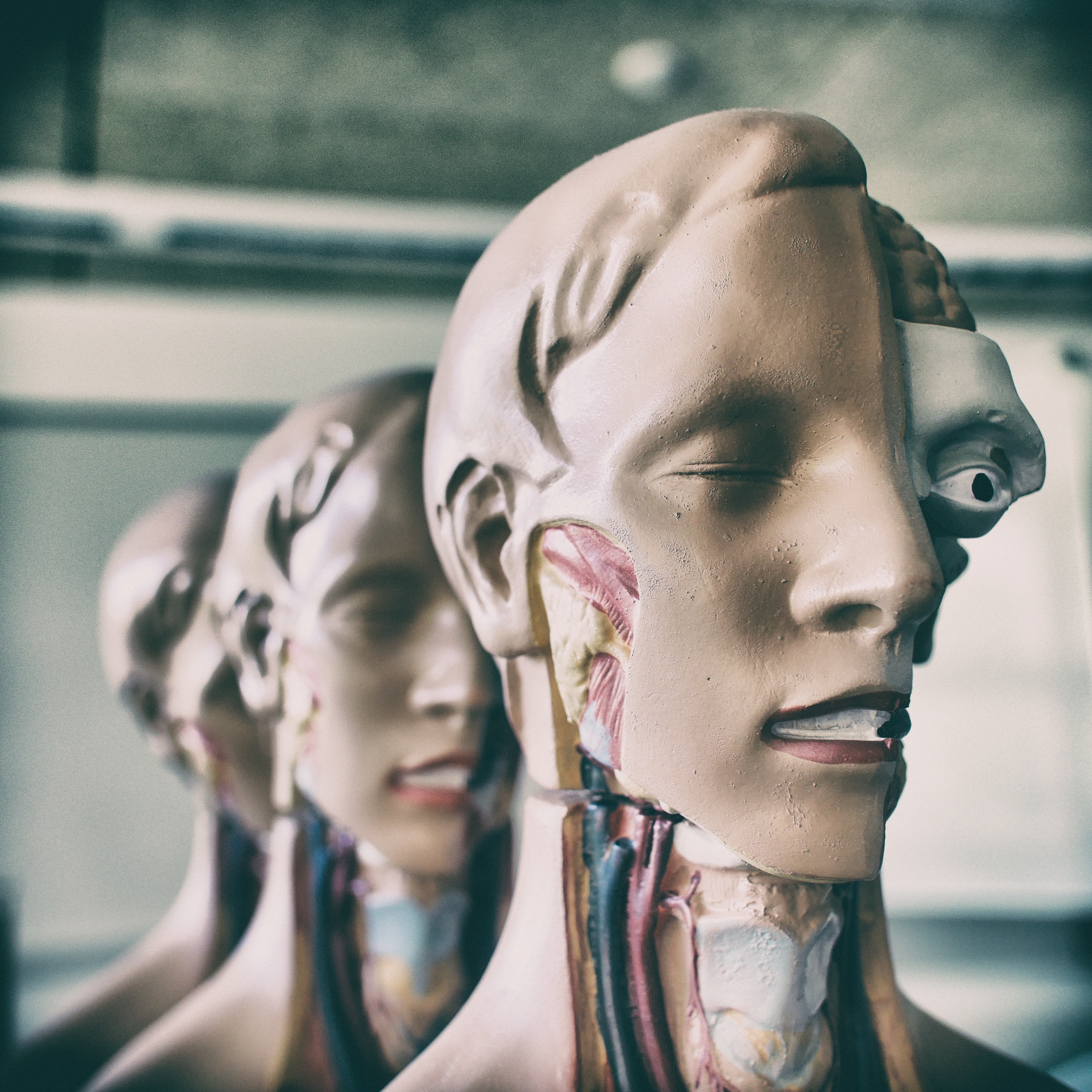
Photo by Pierre Acobas on Unsplash

Everything

It’s been getting a lot of press, Everything Everywhere All at Once has.  It’s been winning awards and it demonstrates that absurdism isn’t dead.  Absurdism is an essential element of existentialism, the philosophical school with which I most closely identify.  I had no idea others found it so appealing.  This movie’s difficult to encapsulate—the summary on Wikipedia is actually not bad—but it has to do with human potential when living in a multiverse where every decision splits the ‘verse into new bubbles where your actions play out in all possible ways.  And, of course, it’s tax season.  There are clearly elements of The Matrix here, as well as Brazil.  And it’s distributed by A24.  The message is good, as the story plays out.  The images are impressive and confusing and will make you think.

From the time I left home I’ve looked for two main elements in movies—they should make me feel and make me think.  When they do both they are successful.  Everything Everywhere All at Once is successful.  It also reminded me of how healing existentialism can be, which is what drew me to it in the first place.  Life, or to point a finer point on it, consciousness, is absurd.  You can follow the same rules and get different results each time.  And you have to live with the consequences.  If you think about it too much it leads to despair.  I need, and it seems others do as well, to be reminded once in a while that absurdity is endemic in this universe.  How else can we explain Trump?  Existentialism breaks in on reality and I used to self-medicate with Nietzsche and Kafka and Camus.  Lately I’ve been using horror.

The thing about absurdity is that it’s funny.  We may not laugh about what the universe hands us as much as we should.  Existentialism also holds that darker element called dread.  Sometimes that comes to the foreground.  In my own life, I guess I thought getting a Ph.D. from a major, internationally renowned, research university might help.  I had forgotten the role absurdity plays in all of this.  Everything Everywhere All at Once shows the universe, or multiverse, is the ultimate trickster.  There are those, serious scientists, some of them, who believe that each decision does split off another universe and that all possibilities play out somewhere in the multiverse.  Even if that’s true, we’re stuck in this one.  It makes sense, therefore, to laugh at it once in a while.


Missing Thoughts

Photo by Alberto Bobbera on Unsplash

Where do thoughts go?  Like many people who write, I carry a notebook with me to try to catch fleeting thoughts that make their way into my work.  That doesn’t mean you’ll catch everything, of course.  One of the most frustrating things is when you come to a key point in an essay or story and it vanishes before you can catch it.  Such things happen rather frequently.  More so than I would like, and, I’m sure if it happens to you it frustrates you as well.  Where do such important thoughts go?  This is a tricky question to answer because philosophers and scientists still don’t know what thinking, or what consciousness, is (are).  Whatever they are, they have some of my property.

Or do I have some of theirs?  Some have suggested that thinking is a much more collective activity than we suppose.  Our materialist view is that all my thoughts come from my brain and only get out if I share them.  Another way of thinking about it is that thoughts are out there and individuals receive them, like a radio or television.  Clearly our brains are involved in this, but mightn’t they be more like receivers instead of creators?  At least creators working ex nihilo.  One comforting thought, although it doesn’t help at the moment, is that that missing thought might still be out there, and like bread cast upon the waters, it will come back to you.  Sometimes it does.

Years ago I was working on a short story.  While out for a jog a perfect culmination for a scene came to me.  Naturally, by the time I reached home it was gone.  I was in anguish over it for many weeks.  Then, long after I’d stopped worrying about it, it came back within reach.  Something, I have no idea what, brought it back.  I hope this still works.  While rewriting a point in my latest book project, a stunning answer came to me, right in the middle of a paragraph.  By the time I’d hit “return” it had vanished.  The more thought I put into it, the more I felt like I was hitting a concrete wall.  As of this point, the key idea is still AWOL.  Since I don’t know where it possibly could have gone I can’t look for it.  Believe me, I’ve turned over every rock in this aging grey matter I regularly til and I just can’t find it.  Experience tells me it’s still out there somewhere.  And I do hope my receiver’s still functioning when it makes its way back around here.


Gorilla Thinking

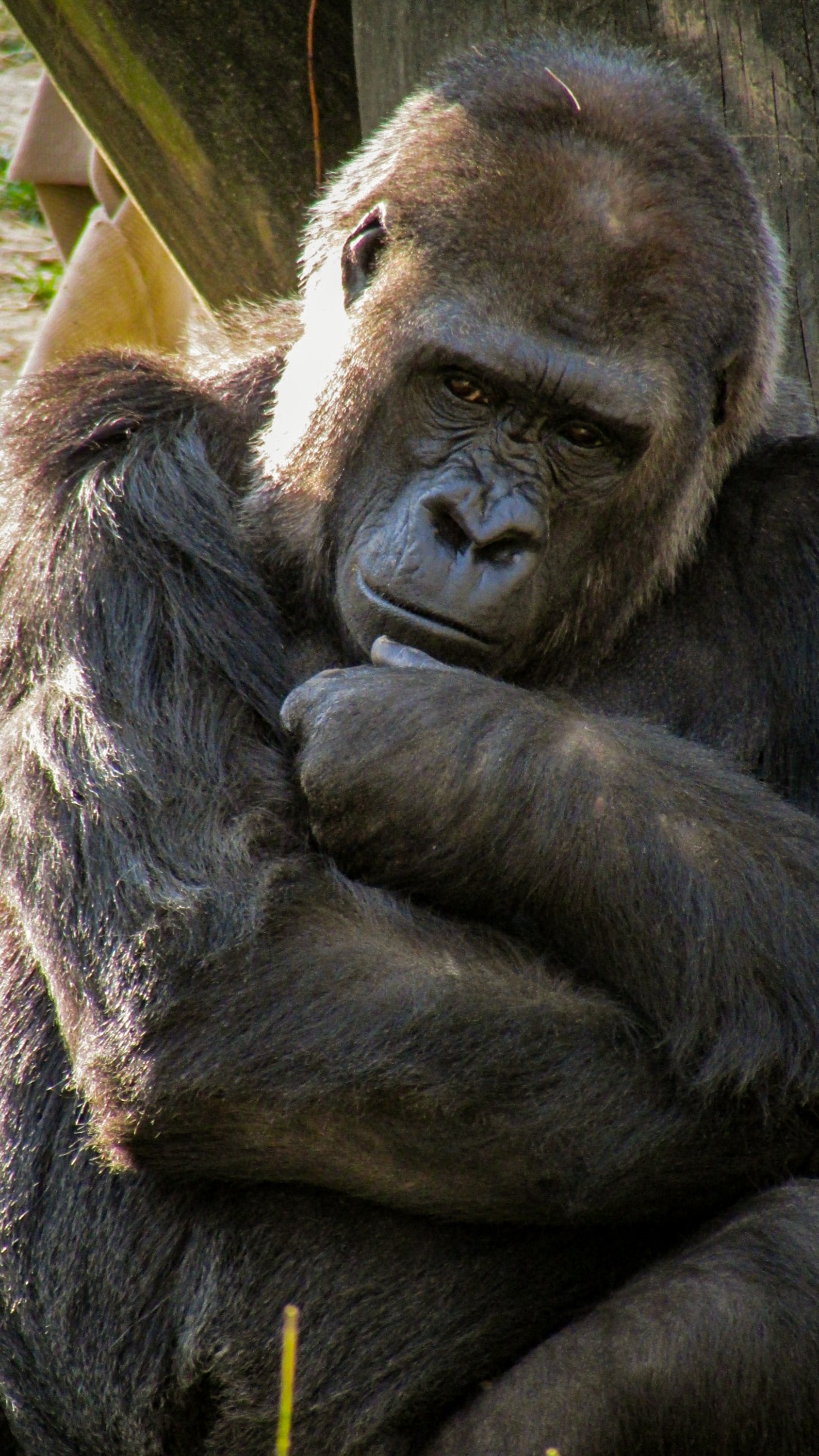
We don’t understand consciousness, but we want to keep it all to ourselves.  That’s the human way.  Or at least the biblically defined human way.  Animals, however, delight in defying our expectations because they too share in consciousness.  Take gorillas, for example.  Or maybe start with cats and work our way up to gorillas.  We all know that cats “meow.”  Many of us don’t realize that this sound is generally reserved for getting human attention.  Cats tend not to meow to get each others’ attention.  According to Science Alert, gorillas in captivity have come up with a unique vocalization to get zookeepers’ attention.  Not exactly a word, more like a sneeze-cough, this sound is used by gorillas at multiple zoos for getting human attention.  Even if the gorillas have never met in person.

Photo by Joshua J. Cotten on Unsplash

This is a pretty remarkable demonstration of consciousness.  What’s more, it’s an example of shared consciousness.  The same vocalization shared over hundreds of miles without a chance to tell each other about it.  We’re very protective of consciousness.  As a species we like to think that consciousness is uniquely human and that it’s limited to our brains.  Moments of shared consciousness we chalk up to coincidence or laugh off as “ESP.”  Funny things happen, however, when you start to keep track of how often such things occur.  It might make more sense to attribute this to moments of shared consciousness.  In our materialist paradigm, however, that’s not possible so we just shake our heads and claim it’s “one of those things.”

Animals share in consciousness.  We don’t always know what their experience of it is—indeed, we have no way to test it—but it’s clear they think.  I live in a town, so my experience of observing wild animals is limited to birds, squirrels, and rabbits, for the most part.  I often see deer while jogging, and the occasional fox or coyote, but not long enough to watch them interact much.  But interact they do.  Constantly.  These are not automatons going through the motions—they are thinking creatures who have sophisticated ways of communicating with each other.  Ours includes vocalization, so far uniquely so in the form of spoken language.  The great apes—chimpanzees and orangutans, according to Tessa Koumoundouros—also vocalize and do so with humans.  Now we know that gorillas do too.  And we all know that a barking dog is trying to tell us something.  If we took consciousness seriously, and were willing to share it a bit more, we might learn a thing or two.


A Little Fuzzy

Animals don’t obey the law.  As I observed just a few days ago on this blog, they don’t recognize indoors or outdoors.  And they certainly don’t respect private property.  Conflicts are sure to arise.  Mary Roach turns her impressive writing skills to address this, and related issues in Fuzz: When Nature Breaks the Law.  I’ve read an academic book on this subject as well, and I have to say that one wasn’t as much fun.  Roach has a way of bringing the humor out of even potentially trying subjects such as how do we scare carrion birds away from human corpses?  How do we eliminate pests that we’ve accidentally introduced?  (Think of rabbits in Oceania.)  How do we stop birds from getting sucked into jet engines?

Although the book handles these with a light touch, as with most of Roach’s work, it also raises some serious issues.  Solutions to introduced species can involve poisoning that also kills native species it’s designed to protect.  Genetic engineering may have (likely will have) unforeseen effects.  What is a dominating species to do?  We have laws about ownership, after all, and we expect them to be obeyed.  Squirrels, for example, won’t care that you just had to have a sink replaced at great expense.  They’ll gnaw their way in anyway, creating a new crisis right on top of the old one.  Deer cross highways, their brains not yet evolved enough to interpret what a car is—they’ve only been around for just over a century.  (The cars, not the deer.)  They sometimes cross runways too.  (The deer.)  We like animals well enough in the wild— in fact we long to see them.  When they get into our space, however, our rules don’t apply.

As long ago as the Bible, and perhaps before, the question arose of punishing animals.  If your ox gores someone what should you do with it?  I’m not sure Homo sapiens are the best species to be making such decisions.  We’ve shown colossal poor judgment (think of Trump and try to disagree).  We’re actively destroying our own environment, the terrestrial equivalent of defecating in our own fishbowl.  What gives us the right to punish other creatures who are more in tune with what nature tells them to do?  Perhaps the biggest takeaway from all of this is that we may try to make the rules, but the rest of the planet responds to what we might call a higher power.  I’m glad that writers like Mary Roach can show the fun side of it all.


Thinking about Thinking

I’ve been thinking about thinking quite a bit.  My lifelong fascination with religion is part of this, of course.  So when someone pointed out Bridget Alex’s article “The Human Brain Evolved to Believe in Gods” in Discover, I had to ponder it.  The idea, here supported by science, is that people evolved survival traits that lent themselves to religious belief.  That religious thinking was a byproduct that eventually took on a life of its own.  Evolution works by giving a reproductive advantage to one trait over another—which is how we get so many types of dogs (and maybe gods)—and those that disposed people to be religious did just that.  Elaborate religions evolved from these basic traits.  Alex suggest there are three: seeing patterns, inferring intention, and learning by imitation.

While there’s a lot of sense here, the reductionism doesn’t ring true.  The need to explain away religion also seems uniquely human.  Ironically, the idea that we are somehow special compared to other animals derives from a biblical worldview from which science has difficulty divorcing itself.  One of the greatest ironies of the science versus religion debate is that scientific thinking (in the west) developed within a worldview formed by Christianity.  Many of the implications of that development linger, such as the supposition that animals can’t have consciousness, or “souls.”  We watch a chimpanzee in an experiment and deduct points when they don’t do things the way a human would.  We thus confirm the biblical view in the name of science and go home happy.

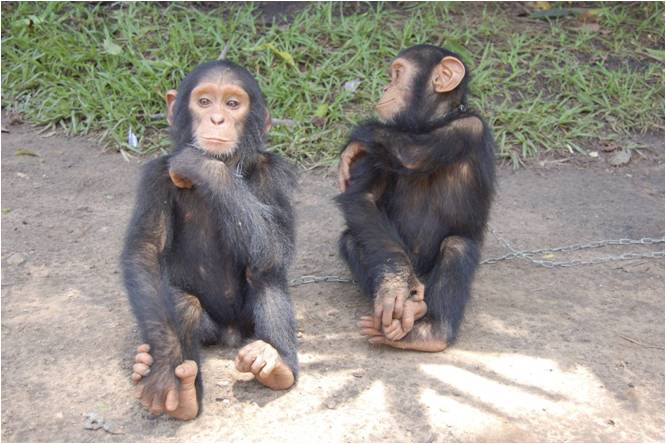
Photo credit: Afrika Expeditionary Force, via Wikimedia Commons

I have no doubt that people evolved to be religious.  There are certainly survival benefits to it, not least group building and shared purpose.  I do wonder that science doesn’t address the elephant in the room—that we have limited receptors for perceiving specific stimuli, such as light and sound, but that there are other phenomena we don’t perceive.  We build instruments to measure things like x-rays and neutrinos and magnetism, but we don’t sense them directly.  How can we possibly know what we might be missing?  I suspect the real problem is we don’t want to admit willfulness into any other part of the universe.  Humans alone possess it.  Some scientists even argue that our own sense of will is an illusion.  It’s not difficult to believe that we evolved to be religious.  It’s also not difficult to believe that we pick up hints of forces that have yet to be named.  An open mind, it seems, might lead to great rewards.


Pennsylvania Dreaming

“I finally understand what I’ve come here to learn,” I said.  I was incredibly happy.  I recall the sun was shining, making its way up from my feet to my legs in a symbolic way, soon to reach my head.  I was on the cusp of an epiphany.  That’s when I woke up, needing to head to the bathroom.  Of course, after that it’s difficult to fall back asleep.  I knew that even if I did it would be to a different dream and I wouldn’t learn what it was that I’d come here for.  So it is with the great experiment of consciousness.  Either we’re continuously learning or we’ve already died.  Nobody has all of the answers.  Consciousness may be the true final frontier.  There is no scientific explanation for what it is that is universally accepted.  We all, however, know what it is though daily experience.

Dreams are considered part of our subconscious.  While we sleep we’re said to be not conscious, although we all know that at times we are.  Sleep can be somewhere between.  And we don’t even know what consciousness is.  The study of dreams is still valued in psychoanalysis—it is a form of thinking too—but in our materialist, capitalist society we tend to dismiss dreams.  They generally don’t bring in money.  In ignoring them we move further from understanding consciousness.  Enlightenment, while not a scientific category, still seems possible, even should it come in dreams.  If only we could stay asleep long enough to see it through.

I have a friend who also thinks too much.  He sometimes wonders if this constant focus on what the “they” want isn’t a plan to keep us too busy to think things through.  I often think that the monastics had it mostly right.  At least the part about taking time to contemplate.  When you encounter an idea that feels like a key and you know the door that it opens will be profound, it always seems that work comes to interrupt right at that point.  The job where you can wrestle with ultimate reality and not worry about not producing “product” for which you’re paid, is rare indeed.  That’s why waking from this particular dream was so difficult.  I had a semester break while teaching where I read three books that changed my outlook forever.  It was possible because I had a few weeks before I had to be back in the classroom.  Since then the dream, I guess, has been to return to where you’re paid to learn, for the betterment of all.


Squirrel Wisdom

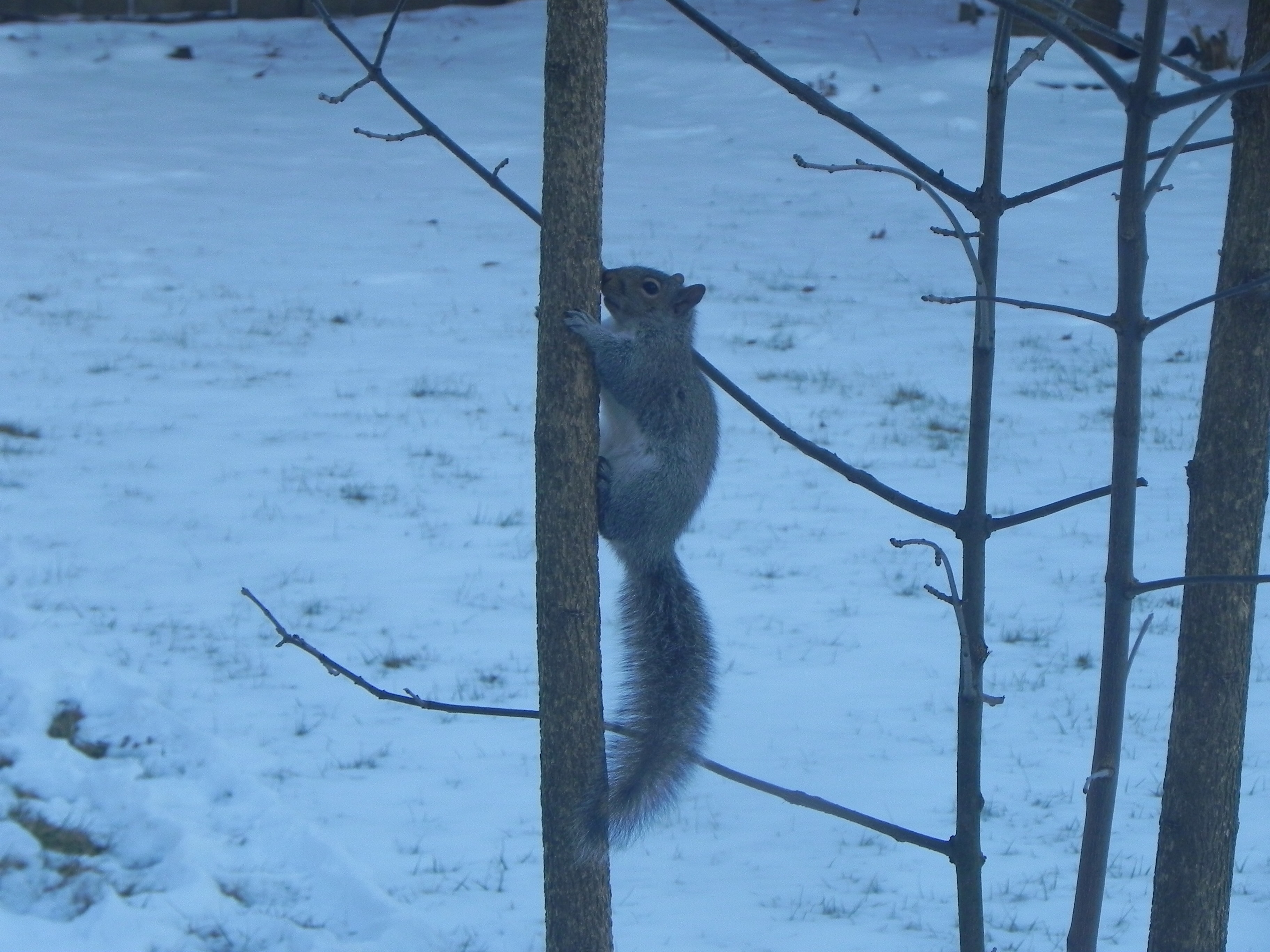
In a dangerous world prey animals have evolved to over-multiply.  That’s clear from watching the gray squirrels from my office window.  There’s a stand of maybe a dozen pine trees across the street, and some days it’s like the bark itself is crawling, there are so many squirrels chasing each other.  Especially when mating season begins.  Of course, squirrels get into everything.  We have a problem with them in our improperly sealed garage.  They have a biological need to gnaw and really animals don’t share the human concept of indoors versus outdoors.  They don’t understand that we want them outside, not in.  This leads to my love-hate relationship with squirrels.  I’m usually on the side of the prey, but they can be a real nuisance.  Still, they’re cute and furry and they take their chances going, well, outside.

So the other day there was a kind of love fest, a Woodstock of squirrels, if you will, in those pine trees.  The sun was out and the hormones must’ve been raging like a high school Friday.  A few minutes later I glanced outside and couldn’t see a single one.  A blur of wings caught my eye as a red-tailed hawk landed on a branch.  All the squirrel play had ceased.  Where there had been dozens just moments ago, not a single individual could now be seen.  The hawk seemed in no hurry, lazily flapping from branch to branch, swiveling its head around, watching.  It might not’ve been in a squirrel mood that day, or the prey might’ve been too well hidden.  Or maybe they knew if you play the game right, predators will just go away.

The squirrels’ conflicting urges both had to do with survival.  In a way from which we could learn, they seem aware that the group outweighs the individual.  Something about their level of consciousness gives them a deep wisdom.  We tend to call flighty individuals among our own species squirrelly, or we can say that we’re feeling squirrelly about something.  Rodents, however, are smart.  In fact, they understand some things better than humans do.  After all, there are so many of them because our species has killed off most of their predators, just as we’ve done for deer.  There’s a reason there’s so much road kill.  Watching the abundance of squirrels it becomes clear that they’re in tune with the ways of nature.  They have to chew or their teeth will grow too long.  And they definitively don’t know the differences between outdoors and in.  Still, they deserve our respect, even if they’re occasional nuisances.


Phobia Therapy

I don’t like being scared.  That’s why I watch horror.  You see, many people deal with fear by running away from it.  Embracing artificial fears, however, prepares you for the horrors life will inevitably throw at you.  We humans have created an artificial environment for ourselves with many natural dangers removed.  For example (and there are always exceptions) we’ve been able to seal ourselves up in our homes and wear masks in public to avoid a killing virus.  For the most part we’ve destroyed our large predators.  As a society we tend to avoid the things that make us afraid which, in turn, makes us fragile when we have to face truly frightening situations.  I wouldn’t suggest becoming a fear junkie, but experiencing scary scenarios can diminish the overall  fear factor.

People often make assumptions about those of us who watch horror, even though it is the majority of Americans.  We’re seen as creepy people who lurk in dark places, unable to get along with our fellow human beings.  Perhaps it’s true, or perhaps it’s a reasonable coping technique.  I tend to think of it as a spiritual practice.  Spirituality is often about feeling, but it’s not completely divorced from rationality.  Often it has to do with that gut feeling that this is really real.  This is something that my years on this weary old globe have taught me is true.  Many times it’s this way in the face of evidence.  Others have trouble believing it, although some bearded guy alone on a mountain top says it’s true.  So life goes.

Spirituality is important.  I have many humanist friends and they are often uncomfortable thinking about spirituality.  It seems dangerous, a superstition that somehow survived enlightenment.  Enlightenment, however, is itself a spiritual idea.  There’s something inside of us that makes us who we are.  Whether it’s something physical or something else, it requires nourishing in order that we might thrive.  We expend a lot of energy arguing about the right (only right) way to do it.  The way to be a more spiritual person.  To me it seems that it’s about discovering what replenishes us.  What makes us into better people.  You find that and you feed it.  Spirituality comes in many forms and shapes.  Some of us have it fed by what others dismiss as mere horror.  There’s more to it than meets the eye, however.  I watch it to learn not to be afraid.


Thinking Big

Depending on who you are the Bigelow Institute for Consciousness Studies (BICS) may set your eyeballs to rolling.  You might know that extremely wealthy Robert T. Bigelow made his fortune as a hotelier and then began investing his money in aerospace technology.  He publicly admits to believing that aliens are already among us, and has contributed to advances in space travel components.  (It seems that many of the uber-wealthy are looking for a way off this planet at the moment.)  Not an academic, Bigelow is keen to admit his interest in what is often laughingly labeled the “paranormal.”  If you’ve got money you really don’t need to worry about what other people say.  I recently ran across an announcement regarding the winners of a BICS essay contest regarding the survival of consciousness after death.

As I’ve noted before on this blog, the paranormal and religion are close kin.  Nevertheless it does me good to see that so many people with doctorates (both medical and of philosophy) entered the contest.  I’m glad to see not everyone is buying the materialist narrative.  We’ve been so misguided by Occam’s razor that we can’t see reality is more complex than they teach us in school.  Churches may not be doing it for us any more, but it does seem that “there’s something out there.”  With a top prize of a half-a-million dollars, there was certainly a lot of interest in this enterprise.  If you go to the website you can download the winning papers.

Consciousness remains one of the great unexplaineds of science.  Answers such as “it’s a by-product of electro-chemical activity in the brain” don’t mesh with our actual experience of it.  Indeed, we deny consciousness to animals because our scientific establishment grew out of a biblically based worldview.  Even a century-and-a-half of knowing that we evolved hasn’t displaced the Bible’s idea that we are somehow special.  Looking out my window at birds it’s pretty clear that they’re thinking, solving problems.  Dogs clearly know when they’re pretending, as in a tug-of-war with its weak owner.  We don’t like to share, however.  Being in the midst of my own book project I really haven’t had time to read the essays yet.  I do hope they come out in book form, even though they’re now available for free.  I still seem to be able to carve out time for a book, which is something I consciously do.  I’m not convinced by the materialist creed, although I’ve been tempted by it now and again.  I like to think that if I had money I’d spend it trying to sort out the bigger issues of life, no matter what people call them.


Thinking Plants

Consider your sources.  As an erstwhile professor I grew accustomed to repeating that, and this was before the internet started up, making claims of all kinds.  Certain news sources—think New York Times, or the BBC—earn their reputations slowly, over many, many years.  That doesn’t mean they don’t make mistakes, but it does mean they’re often on the mark.  So an article on plant consciousness on the BBC is worth considering.  Consciousness is still something we don’t understand.  We have it, but we can’t always say what it is.  Many, if not most, people tend to limit it to humans, but it’s become very clear than animals share in it too.  Why not plants also?  A few years back I read a book by philosopher Thomas Nagel.  He made the argument that human consciousness must come from somewhere, and as we look down toward animals, and plants, what we see are smaller pieces of the same thing.

I’m not stating this as eloquently as Nagel did, but the idea has stayed with me.  The BBC article  notes how plants seem to react to human interaction.  And they seem to communicate back.  We lack the natural range to hear their responses, but some experiments indicate that plants at least communicate among themselves.  Being the BBC, the story reports but doesn’t necessarily advocate this point of view.  Still, it makes sense.  For too long we’ve supposed human beings to be the only intelligent creatures on this planet, taking the arrogant view that animals are automatons with no thinking ability.  To give them that would be to make them too human-like.

That particular viewpoint still exists, of course, but more and more scientists are starting to consider whether consciousness isn’t emergent from, as Nagel put it, smaller building blocks.  I tend to be on the more imaginative end of the spectrum—consider your source here—but it seems to me that plants could well have a consciousness too.  Trees move.  They do it too slowly for our species to notice it, fixated as we are on our own brief time in the world and our human affairs, but that doesn’t mean they don’t move.  It simply means that if we want to see it we need to shift our perspective.  Communication, it would seem, pervades nature.  If it does, isn’t consciousness somehow implicated?  Plants may respond when we pay attention to them.  To me that makes the world an even more wonderful place.


The Future of Consciousness

Consciousness is unexplained.  We’re born and we become aware.  Raised by parents or guardians, we learn where we belong.  The decisions of one generation affect the futures of the next, often without conscious consideration.  I’ve been thinking about how, with our limited resources, we’ve pressed on, reproducing beyond what our environment can sustain and each of us is born conscious.  Some of us—many, in fact—in difficult circumstances.  Instead of working together to figure this out, we keep on, not quite sure of what we’re doing or where we’re going.  Heath Ledger’s Joker may’ve been speaking for all of humanity when he asked, “Do I look like a guy with a plan?”  Do any of us?

During a discussion the other day the topic of the severe western drought came up.  There have been general drought conditions in the western half of the country (the northwestern coast has been spared) for well over half-a-century.  I wonder why the cities in such regions continue to expand and then I realize that each generation is a kind of reboot.  We tend to think we belong where we’re born.  My thoughts turn toward the ancestors of the first nations and how they knew that moving was necessary for life.  When the ice sheets start descending you really don’t have many options.  Perhaps our sense of place is an evolved trait, brought on by the changed circumstances of invaders’ senses of ownership.  Capitalism certainly doesn’t help.  Those born in drought-ravaged areas soon come to think of it as normal.  We can adjust to just about anything.

Settled existence is necessary for a life that defines meaning by ownership.  For me, I have a difficult time imagining my life without my books.  What we read tends to define us.  What would I do if the ice sheets began descending again?  Such change takes time, of course, but our complex society doesn’t seem to be very good at advanced planning.  My consciousness tells me where I belong geographically, psychologically, and even religiously.  I was taught such things as a child and even if I unlearn lessons that were wrong, I will always still feel that they were right.  If I flee the coming ice sheet I simply have to accept that my reality has changed.  Until that ice sheet’s at my back door, however, I can continue to deny it’s a problem.  Consciousness is a funny thing.


One, two, three

The danger of statistics is that they turn an individual into a number.  A few days ago an article in the New York Times addressed the rare blood clots that some women develop after receiving the Johnson and Johnson covid vaccine.  The response of the cited physicians was telling.  Many praised the decision to halt use of the J&J vaccine immediately.  Others, however, point to the numbers.  If a vaccine is halted many more could be exposed to and contract Covid-19.  It is better, they aver, to take the statically smaller risk and use the vaccine.  While I understand the logic here, I do wonder if the side effects occurring primarily in women has anything to do with the reasoning.  Why not save this vaccine for the men instead?

This raises once again the specter of consciousness.  Statistically the odds are small that a woman will develop a clot.  What if you are the woman who does?  This dilemma always bothered me while camping in the woods.  Statistically black bear attacks are rare.  How does that help you if your tent is one that looks like a candy wrapper to a bear of little brain?  You become a statistic instead of a living, breathing, feeling, blogging person.  Statistics.  There’s a reason some of us identify with the humanities, I guess.  I can imagine what it would be like to have your doctor say to you, “Sorry, this is rare, but look at the bright side—you now become a statistic!”

Photo credit: HB, via Wikimedia commons

The fact is we’re all statistics to strangers anyway, the government above all.  We are vote-bearing numbers to be gerrymandered and prevented from voting.  Beyond that we’re merely annoying.  This pandemic has introduced Stalin’s accounting with a vengeance.  542,000 is a big number.  Unless you know one or more of them personally.  Then the statistics seem to melt.  Life is full of risk, of course.  We’ve barricaded ourselves in our homes for over a year now, eating things that are likely more dangerous for us than a rare complication.  The virus, and perhaps some vaccines, are among various killers on the loose.  Nobody can declare with any certainty the correct course of action.  Actually doing something about the virus when it was first a known threat would’ve helped, of course.  We find ourselves on the brink, it seems, of getting Trump’s disease under control.  Would that we all could do so, without having to worry about lying down to be counted.