The New Neighbors

Apartment dwellers often ponder new neighbors. If anything gives the lie to being in control of your own destiny, renting your domicile does. Still using the old, aristocratic terms landlord or landlady, we know that we are under someone else’s authority. “As long as you’re under my roof,” my bully of a step-father liked to huff, “you’ll obey my rules.” When you rent, you can’t choose your neighbors. Those who own the property have final say. If they play the stereo too loud (“game” is probably the modern equivalent, but I was born before Pong even came alone) and won’t listen to your plea for a more monastic setting, you throw yourself on the mercy of your lord or lady. We got new neighbors this week. Not just us, but the whole galaxy. Seven new earth-like planets—surely ruled by Trump-like dictators—have been discovered. Let’s hope they’re early to bed, early to rise types.

During the Bush administration I often fantasized about the aliens landing on the White House lawn. I thought, with a president so obviously lacking intelligence, what would our new neighbors think of us? Would they complain to the landlord? You’d think that after that long trip across cold, vast interstellar space they’d maybe have the right to expect to find the brightest and the best in charge, right? Mission accomplished. The sign says so right there. Or to put it in a modern key, “Earth first, Earth first.” If they’ve got their intergalactic television on, I hope it’s switched to a different channel.
15207890820_d855b341e3_z

Contact, the novel by Carl Sagan, suggested the first contact from the aliens would be of Adolf Hitler. Among the first poisoned radiation this planet flung off into space was the fascist propaganda of 1930s Germany. Earthlings, not yet tempered by the Trump brand, were shocked. Surely this is a sign of hostility! Unless, of course, you control both the legislative and executive branches. Then you can just decide not to show up at the town hall and tell everyone you’ve got more important things to do. So, what will our new neighbors think? Do they just want the bodies of their compatriots from Roswell back, or is it a more serious discussion to be held behind closed doors? After all, African slaves were merely chattels in a negotiation between a more powerful culture and unhuman indigenous dullards with nothing better to do. On the spaceship back to their extraterrestrial slave mines, I do hope they have the common decency to keep the music down to a reasonable level.
Contacting Faith

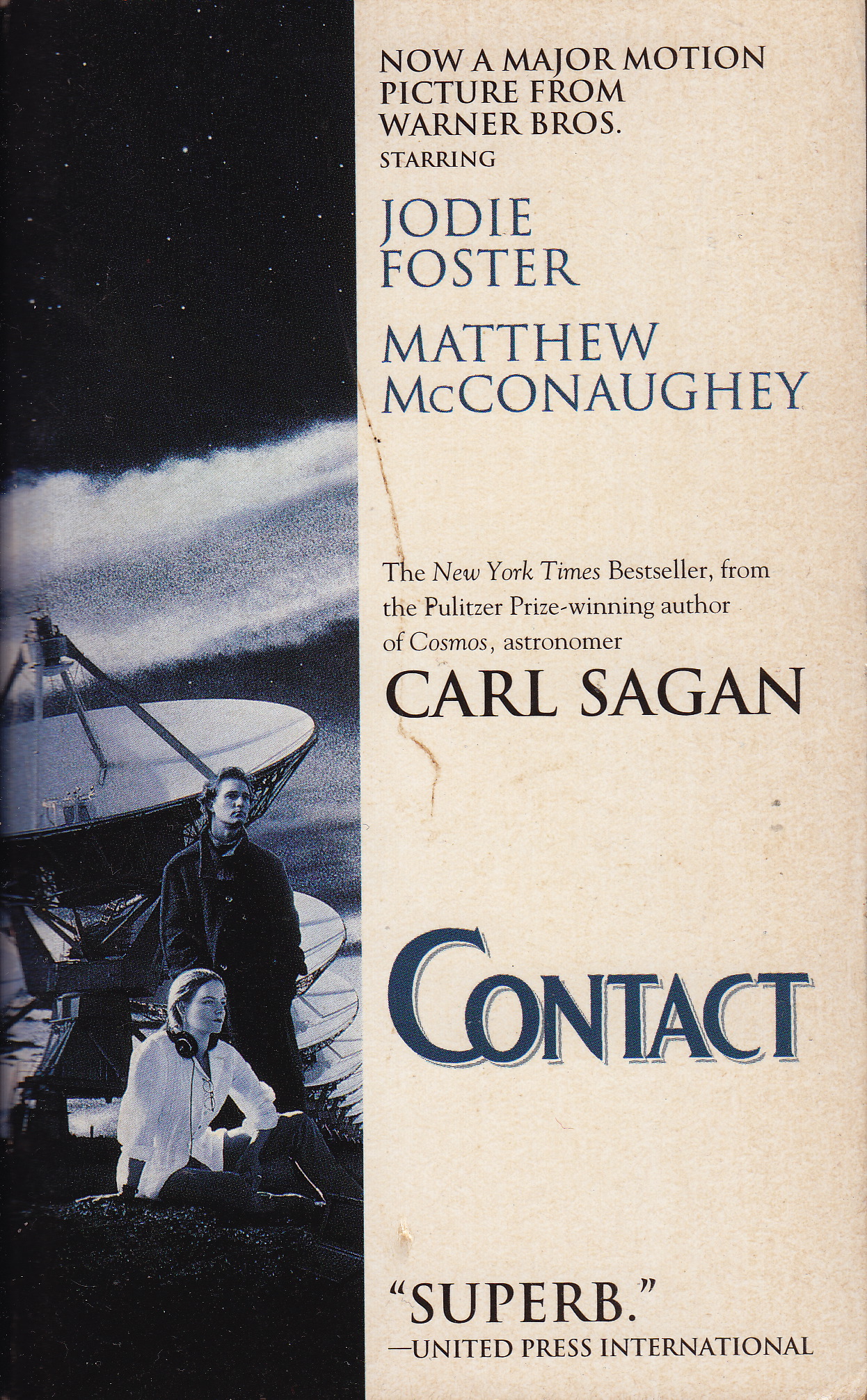
Contact_0001Sometime after the movie Contact came out, I saw it while on a flight to somewhere here or there. As with most movies on airplanes, it didn’t receive my full attention and I seem to recall not hearing a lot of the sound. Having always been intrigued by the possibility of aliens, however, I told myself I’d watch it again. Several months ago I did just that, but as Carl Sagan hoped, much of the story had become somewhat dated. I finally finished reading the novel, and this was a case of the book being better than the movie (as is frequently the case). A number of things surprised me about the story, the primary one being just how prominent religion is in the plot. In the movie some crazy preacher sabotages the first machine just as it’s nearing completion, and even though Ellie Arroway is long connected to Palmer Joss, their relationship doesn’t seem to dominate the script the way it does the book.

Almost immediately upon reading about adult Ellie, it became clear that religion was a major interest that Carl Sagan had. While the chiliasts receive many scathing comments throughout the novel, thoughtful Christian thinkers, such as Palmer, find a way of being taken seriously by Ellie, despite her own personal unbelief. Unable to understand how someone could not accept the evidence before their eyes, she wants to belittle religion but can’t when serious thinkers like Palmer remind her that they have a sophisticated worldview as well. The story represents a long struggle between alternative outlooks. While as a novel it doesn’t always flow, it pulls the reader along, partly based on the intriguing character of Sagan himself.

Carl Sagan believed in life on other planets. He was less sanguine about the possibility of either ancient astronauts or current-day visitors from space, but he kept an open mind. While he was the respected author of numerous scientific papers, other astronomers didn’t always know what to make of such a popularizer. Of course I never knew him, but I have to wonder if his true beliefs didn’t appear in his fiction rather than in his factual writing. At times I found the novel slow and plodding, and as the machine gives ambiguous results, I wondered where the rest of the story could go. Sagan profoundly brings the end back to belief. Without evidence, Ellie finds herself in the place of the religious who believe on the basis of experience and faith alone. And she finds her best friend is a clergyman. Contact, with its God-like aliens, is really a story of finding oneself a place in an infinite universe. To do that well, Sagan seems to have believed, requires both science and religion.


Reach Out and

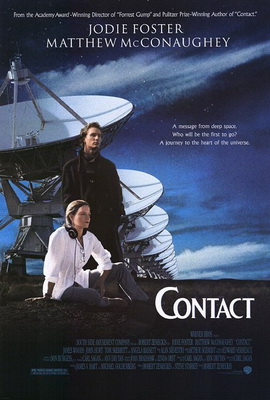
Contact_ver2Carl Sagan, one of the great proponents of the idea that earthlings have never been visited by aliens, wrote a novel entitled Contact. I haven’t finished reading it yet, but many years ago, on a long plane ride, I caught part of the movie version—most of it without the sound on, as I recall. While the ideas have been brewing for about a decade, I’ve been meaning to get around to watching the film. It is a bit of a slow-starter, but I finally sat down to watch it, with sound. While the movie ultimately remains agnostic—with a Twilight Zonish twist at the end—about whether the contact is truly alien or not, one aspect leaves no room for doubt: the movie is really about the relationship between religion and science. Eleanor Arroway cannot raise faith in anything but science, especially since her father’s premature death. Although she has a brief affair with Palmer Joss, a theological journalist, she just can’t believe what her senses don’t confirm.

Once the alien signal is announced, the response of the populace is overwhelmingly religious. One sect in particular seems to channel its faith into the hatred of science, and even Palmer, now an advisor to the president, questions whether science alone can really help humanity to progress. He is the one who nails shut the coffin of Dr. Arroway’s hopes of going to Vega to see the aliens. The reason: she doesn’t believe in God, and therefore is not qualified to represent the human race. Ah, the cruel irony of it all. When she finally does get a chance to visit space, the results are both Freudian and religious. She finds her father in a place like heaven, but her beloved science makes no record of her journey. At a congressional hearing she is made to admit that she believes in what happened without proof. Science is now standing on faith while the religious look smugly on.

Despite the pacing, Contact is an enjoyable movie. In many ways it hasn’t aged much since its 1997 release. Science and religion are still at loggerheads in some camps, and we are no closer to the stars than we were a decade and three-quarters ago. Reading books on the nexus of religion and science, one often gets the impression that the two are inevitably foes. Much of it goes back to a principle that recurs throughout Contact—Occam’s razor. The idea that the simplest explanation is the best does not seem to serve science (or religion) well. Although it works most of the time, it is because, as a friend recently said, we are willing to sweep the stuff that doesn’t fit off the table. Contact showed Occam’s razor with its indiscriminate cutting. Both the religious and the scientific end up bloody when it’s all over (metaphorically speaking, of course). It seems what religion and science really need is indeed contact.