Meet the Neighbors

I was called “moon boy” and was otherwise taunted in ways I care not to share. As a child I openly spoke about my fascination of life in space and was ridiculed in the way children specialize in executing humility. So it was with great appreciation, but not much surprise, that I read that water had been discovered on Mars. Where there’s water, there’s likely life. I won’t say “I told you so.” Life, although I know I’m being premature—I’m a moon boy after all—has been one of the many tools in the God-of-the-gaps bag. God-of-the-gaps thinking is where a religion, in the light of scientific explanation, backs and fills by saying only God could do x, y, or z. The weather used to be a gap, but meteorology and fluid dynamics have started to explain many of the things that happen in the atmosphere. But life—life! Life was something only God could do, and it was only here on earth. Mind the gap.
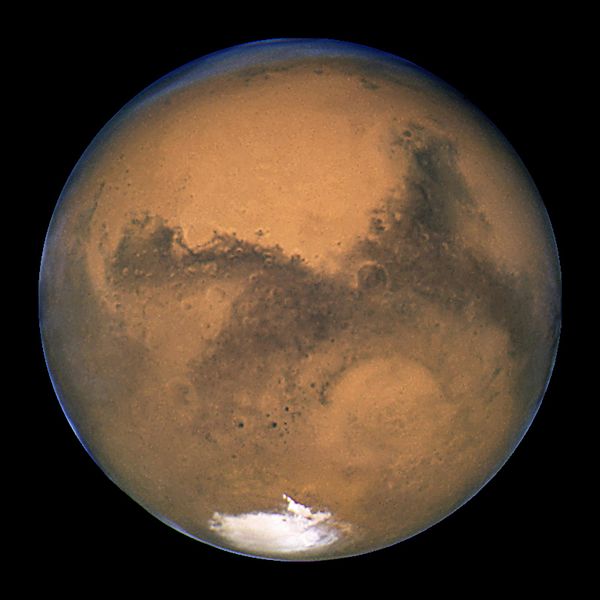
Mars_23_aug_2003_hubble

No, we’ve not yet discovered life on Mars. Those who spend every hour of their waking days combing at incredible magnification the photographs coming from Mars have suggested life forms. Some of them, I must admit, have been very intriguing. The official stance, however, has been that Mars is too cold for life because, as any trekkie knows, life has to be as we know it. I would venture to say that life will be announced on Mars before too long. Astronomers and astro-biologists are a cautious lot, but I think that life is probably a lot more common than we’ve been led to believe. And I have to believe that we’re not the most intelligent species possible. How else can we explain what’s happening in the run up to the Republican Convention? E.T. may not live on Mars, but somebody else might.

Often I ponder how strange our geocentrism is. Copernicus and Galileo more or less proved that we’re not the center of the universe. Reluctantly the church let go of that fiction, but scientists, in some measure, have held onto it. We are the only planet with life. Life on our planet is the most advanced that it is anywhere. And because we know that nothing travels faster than light there’s no possibility that life elsewhere has ever found its way here. To claim otherwise is to face a scientific inquisition. Water on Mars? Yes! This is a new chapter not in the history of the universe, but in appropriate humility in the face of the unknown. Take it from the moon boy—there’s a lot more yet to be discovered.
Oxford’s Hire

In 1478 the first book printed in Oxford heralded the eventual founding of Oxford University Press. Just two years earlier Vlad III, the Impaler, had been assassinated. In 1478 the Tribunal of the Holy Office of the Inquisition was established in Spain. Just over a century earlier, the Black Death decimated the population of Europe. Things looked a bit dark at that time. Nicolaus Copernicus, however, was five years old in 1478 and the Enlightenment was just around the corner. The printing press had been, well, hot off the press for just a couple of decades at the time. The University of Oxford had been around for nearly four centuries already, making it one of the oldest and most prestigious centers of learning in the world. Oxford University Press early on began the business of printing Bibles and shedding light on a world where things were somewhat dim. Progress often brings misery with it, but the idea that a literate public stood a better chance of improvement bore an optimism that has occasionally been realized, even in free market times. I’m very glad for Oxford University Press.

These are among my thoughts as I prepare for my first day as Associate Editor for Bibles and Biblical Studies at Oxford University Press. It is a heady sensation. Bibles were among OUP’s first printing projects. As part of an increasingly secular society in an increasingly religious world, I’m aware of the power the Bible has had and still has. Love it or hate it, it has shaped this thing we call modern culture in ways both profound and facile. The opportunity to work in this division is sobering. A little unnerving, even.

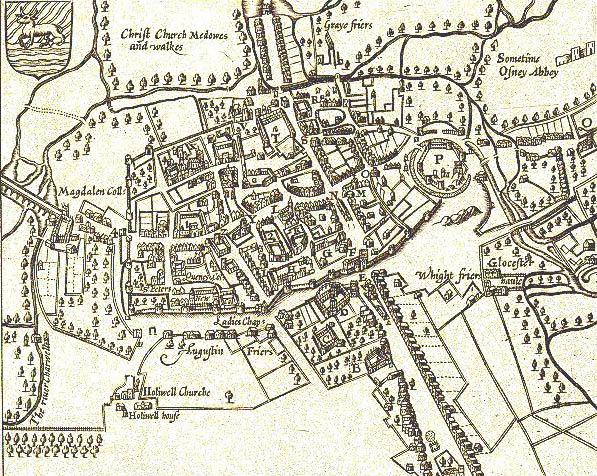
John_Speed's_map_of_Oxford,_1605.

Ironically, my career has largely been Anglo-oriented. Perhaps it is because those based in England appreciate the solidity of a degree from Edinburgh University, although this is only speculation. Nashotah House was a profoundly anglophile institution, at least once upon a time it was. The founder of Gorgias Press had studied in both Oxford and Cambridge. Routledge is a British-based publishing house. Ironically, British culture is not as prone to Bible-reading as that of the United States. My jobs, which have largely focused on the Bible, have been British-oriented. I try to add it all up but get lost in the midst of the numbers. Call it first day jitters. Twenty-five years ago at this time I was preparing to get married and to move to Scotland. Little did I suspect that a quarter-century later I would be coming back to an ancient university of the United Kingdom again.


Unbelievable Voyage

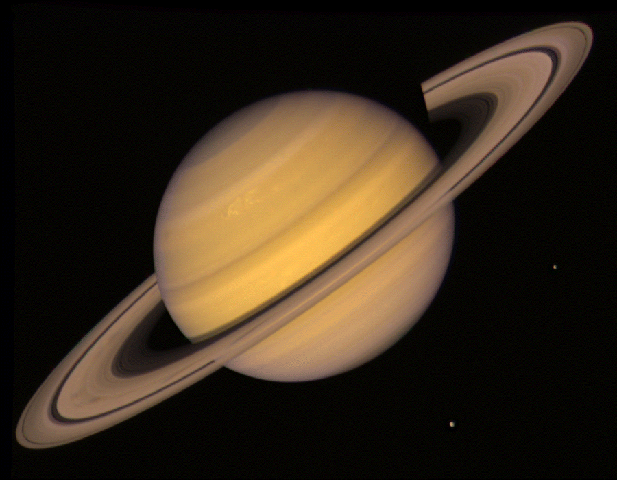
In Sunday’s paper a story from the Los Angeles Times reported that Voyager 1, now 35 years old (and a technological grandfather, considering how quickly technology develops), is poised to leave the solar system. It is the first mechanical device, at least designed and launched from earth, that will do so. The spacecraft, billions of miles away, sends signals that take 17 hours to reach earth. It is boldly going where no man [sic] has gone before. The vastness of open space was one of the initial challenges to the traditional theology that had developed in an unbroken sequence from the time of the Bible down to the days of Copernicus and Galileo. Nobody was sure what was out there, but certainly Heaven had to be somewhere and God was clearly above us, so, in a marriage of convenience, God reigned in the unexplored sky. Voyager 1 bears a gold-plated plaque that attempts to describe who and where we are. Sent into the neighborhood where God used to live, Voyager was announcing that we were ready for celestial guests.

Many scientists don’t take seriously the idea that we’ve already been visited. The internet, however, has become a great clearinghouse for those intrigued by extraterrestrial life. I found a website this weekend that had located at least three different life-forms in just one of the Mars rover Curiosity’s pictures. We are lonely without heavily denizens. Stephen Hawking famously warned, a couple years back, that if they’re there, they’re probably not friendly. His paradigm, however, was based on earth psychology. Most of us know how far to trust that!

The fact is, we’ve been beaming our existence into space since the invention of the radio. Our electronic signals are, according to physics, pretty close to eternal. Electromagnetic waves just keep going and going, putting all manner of Energizer bunnies to shame. Long before Voyager 1 reaches the cusp of the solar system, our light and sound show has been announcing that this is where the godless party is and has been for over a century. Voyager 1 is far less than a needle in the cosmic haystack. It is more akin to a molecule or an atom. Will it find God out there? I highly doubt it. Nevertheless, when I went out to get the newspaper before dawn this morning, I spent an extra few moments looking at the stars and wondering.