Raven about this Book

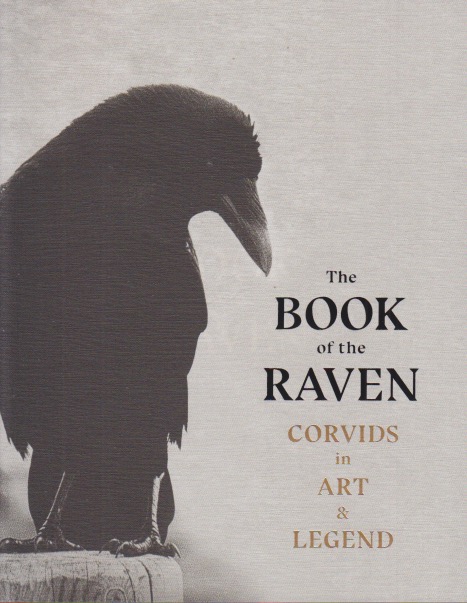
Some books are meant to be looked at.  Being busy most of the time, even on weekends, I’m guilty of not enjoying art enough.  The Book of the Raven: Corvids in Art and Legend is a work of art.  In it Caroline Roberts and Angus Hyland have compiled paintings, photographs, and prints that feature ravens, crows, magpies, and jays, interspersed with facts, poems, excerpts, and bits of lore.  It’s not a comprehensive book, nor is it intended to be.  It is, however, a deeply moving book for a certain kind of person.  It was an accidental find in a visit to The Book & Puppet Company in Easton.  When we’re in town we like to support the independent bookstores.  (I was saddened to discover that Delaware River Books, one of the two used bookstores in town, had recently closed.)

Corvids are, on a scale, about as intelligent as we are.  They think, solve problems, make tools, and recognize human faces.  They remember acts of kindness and reciprocate.  They recognize their dead and they also play.  They’re very much like us.  The book includes, of course, Poe’s “The Raven,” but also other poems that draw inspiration from these smart, magnificent birds.  The artwork is arresting.  One of the great sins of modern life is its busyness that robs us of the time for appreciating art.  And reading.  Learning how to thrive in a world that has become purely about profit and ownership.  Art is intended to be shared.  An artist produces so that others might see.  A author writes so that others might read.  And corvids exist to bring wonder into our lives.

I find the strident call of jays comforting.  I often hear them even on my winter walks.  There are murders of crows in the neighborhood from time to time.  They gather on roofs and in the trees across the street.  Recently I spied a large black bird while on my daily constitutional.  It had left a tree full of crows and was flying straight down the path toward me.  As it flew overhead I had a good look at its tail in flight—one of the best ways to tell a raven from a crow.  It was indeed a raven, and even common ravens are rare in this area.  We live on the edge of their habitat.   I was honored by its momentary attention.  I wished I had more time, perhaps to follow that magnificent corvid and to learn from it.  Instead, I will ponder The Book of the Raven with wonder.

Our Pigeons, Ourselves

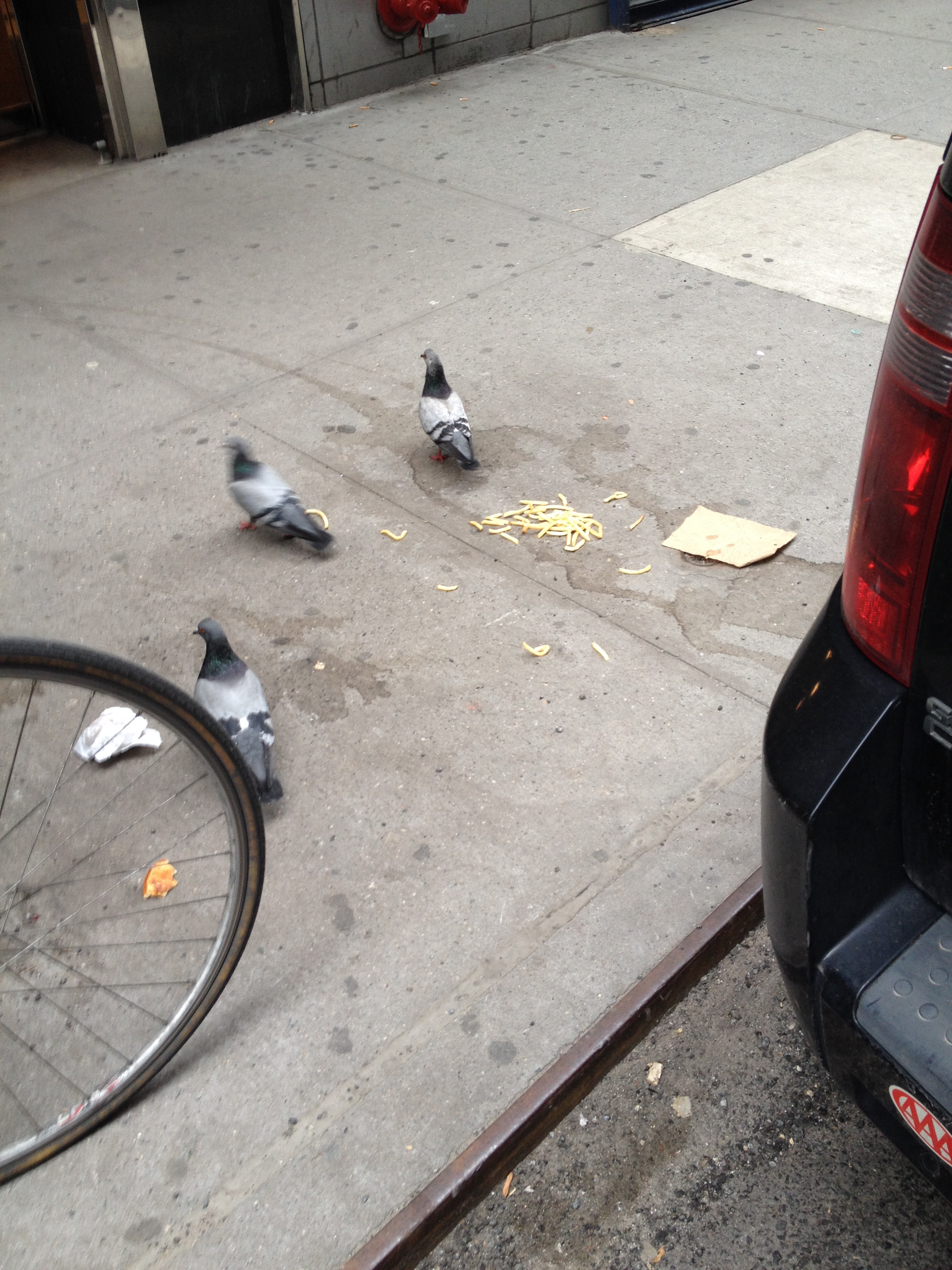
You don’t have to be in New York City long to begin to see yourself as an expert on pigeons. The ubiquitous avians are ruthlessly castigated as “flying rats” and “filthy birds,” primarily because they like people food and poop everywhere. I have it on the authority of Gomi and Stinchecum that everybody poops. From what I’ve seen walking through the city early on the morning after a holiday, not everyone is discriminate about where—and I’m not talking only about the pigeons. Still, I can’t help thinking that pigeons are unfairly maligned. They are pretty birds, when examined individually. They have iridescent throat feathers and a pleasing, portly gait—almost jaunty. They manage well, despite hardships. Often I see one hobbling about missing a foot or otherwise physically challenged, and yet ebullient in their pullastrine way.

IMG_1287

Yesterday as the NJ Transit behemoth in which I was riding rounded the helix into the Port Authority Bus Terminal, I saw two depressed pigeons. Unlike the jolly bobbing and pecking they usually seem to enjoy, this pair was simply standing. On the ground before them was a dead pigeon. Now I don’t know the backstory here, but the two standing around didn’t look like murderers to me. It seemed that they’d come upon a fallen comrade and were, in their own way, offering respects. In the ongoing debate separating ourselves from other animals, I often wonder if we have by-passed many of the basics. I do know that many animals find dead of their own species distressing. This is well documented. Why not pigeons?

Pigeons—related to doves, which, according to some religious traditions have sacred qualities, eh, Mary?—are seldom classed as the brightest of birds. I’ve written about the intelligence of corvids before, but pigeons have uniquely adapted themselves to our polluting ways. I grew up in a small town where pigeons weren’t especially abundant. They gather in large numbers where many people congregate and drop their litter. And, based on my recent experience, contemplate the mysteries of death. Peregrine falcons lurk overhead, doling out death at over 200 miles an hour. All the pigeons want to do, it seems to me, is to get a free lunch in an uncertain world where those whose presence has conjured them despise them. Unlike their sacred cousins, they are, like us, utterly pedestrian. Maybe they too appreciate the simple value of life.


Crowing Up

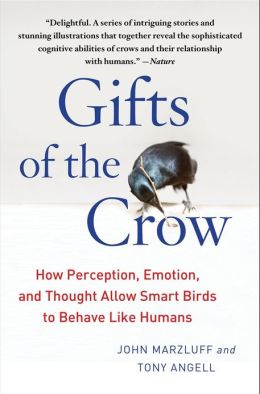
GiftsOfTheCrow Whether we climb up or down the evolutionary scale, one factor remains constant—our human sense of superiority. Despite the castigation of biblical-era thinking in the eyes of many scientists, few are willing to relinquish that Genesis-bestowed sense of being the pinnacle of nature. We know the universe is vast, but we assume we’re the best and brightest in it. Climbing down the ladder a bit, we like to distance ourselves from our fellow creatures because of our superior mental capacity. That is why I am so engrossed by scientists who explore animal intelligence. We find we are not so different after all. Gifts of the Crow: How Perception, Emotion, and Thought Allow Smart Birds to Behave Like Humans, by John Marzluff and Tony Angell is such a book.

If you’re like most people in this electronic age, you probably haven’t given much thought to corvids. Corvids are the members of the crow family: ravens, jays, magpies, and, of course, crows. Scientists have long known that these birds are exceptionally intelligent, and Marzluff and Angell have written a spell-binding little book that shows a remarkable level of intellect among the birds. Documented cases of tool making and use, conscientious interaction, and perhaps even language, have occurred among the corvids. We try to shoo them from our crops with “scarecrows” and we poison them en masse when they become “pests,” but when we take the time to understand them, we find that we may be far darker than the crows.

Not that Gifts of the Crow is all that easy-going. There is plenty of brain physiognomy and quite a bit about brain chemistry here as well. Knowing that not all of us are scientists, though, Marzluff and Angell include a generous portion of narrative description of what corvids have been observed to accomplish. For three days in a row I climbed off the bus stunned, scanning the skies for crows, just to see for myself. In this suburban jungle outside the New York City metropolitan area, crows aren’t so abundant as they were when I lived in the Midwest. They will, however, serve to remind me, when I see one, that our privileged place in nature has more to do with our thumbs than with our intelligence. When I saw a solitary crow atop a tree during a neighborhood stroll after finishing the book, I stopped, smiled, and bowed. Nature belongs to each and every creature, and there sat one intelligent enough to appreciate it.