Colorful Space

Lovecraftian horror translates to film unevenly.  Even when it’s successful, as in Color Out of Space, it really isn’t that close to reading Lovecraft.  “The Colour Out of Space” is among my favorite Lovecraft stories.  To me, it feels perhaps his closest to Poe, and Poe is my personal muse.  I knew that it couldn’t be made cinematic without changing things a bit, and that it would be pretty gnarly.  I was correct on both counts.  In very broad brush strokes, the movie follows the story: a colorful meteorite on an isolated farm begins changing the crops and the people who live there.  Instead of crumbling, however, they are struck by the color and become other.  The mother and her youngest son, for example, are fused together creating one of the most cringe-worthy scenes I’ve watched in a long while.  The movie emphasizes family, even when things go horribly awry.

Defying Lovecraft’s well-known avoidance of focus on female characters, the movie’s focal point in Lavinia accords with Poe’s concern for threats against beautiful women.  She’s the teenage daughter of the family and the film opens with a scene where she uses Wicca to try to heal her mother of cancer.  The love between Nathan (Nicolas Cage) and his wife is movingly shown.  The movie was recommended to me during a conversation about Nicolas Cage in horror.  Maybe it’s because he’s in so many movies in total, I’d never really considered him a scream king, but he’s nailed the role quite capably, with the notable exception of The Wicker ManColor Out of Space is pretty extreme body horror but the movie is artistically done.  You almost don’t mind feeling violated in that way because of the visual appeal of the non-horror focused parts.

The acting is uniformly strong.  In a nod to Lovecraftian fans, Lavinia uses the Necronomicon as the basis for her Wiccan rites.  Some of the scenes seem to reference Evolution and others eXistenZ.  Transforming the action from Lovecraft’s setting in the early twentieth century to the early twenty-first is done pretty well.  The family is isolated when the meteorite prevents electronics, including cars, from working.  The movie does offer some alien creatures, unlike Lovecraft’s basic story.  And these creatures point to a planet with tentacly beings that naturally tie this story into the Cthulhu mythos.  Lovecraft’s own story doesn’t make this move, but of course, the Cthulhu mythos only really developed among his fans.  In all, Color Out of Space exceeded my expectations, even though it was a box office flop. 

Slimy Monsters

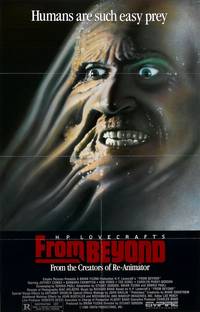
Stuart Gordon apparently had in mind to do an H. P. Lovecraft cycle, as Roger Corman did with Poe.  I first saw Dagon—clearly his best—and some time later picked up Re-AnimatorFrom Beyond was his second Lovecraft movie and it doesn’t have the visual appeal of Dagon, but it is certainly a passable gross-out for those who enjoy slimy monsters.  Gordon was pretty obviously of greater libido than Lovecraft ever was.  From Beyond puts sex in the spotlight’s periphery without making it absolutely central to the story.  A Dr. Pretorius has built a “resonator” that allows him to see extra-dimensional beings.  It does this by stimulating the pineal gland.  His assistant Dr. Tillinghast, is present when a creature from, well, beyond, kills Pretorius by wrenching off his head.  Tillinghast is suspected in his murder but is being held in an asylum rather than a traditional jail.

Dr. McMichaels, the love interest in the film, believes that Tillinghast is sane and that he actually did witness these beings from beyond.  As a scientist, she wants to see if the resonator really works.  It does, but in addition to providing the ability to experience the other realm, it also boosts the sex drive of those under its influence.  She decides, against the warning of Dr. Tillinghast, to try the resonator once more, but this time the other-dimensional Pretorius has become strong enough to prevent her from shutting the machine down.  Tillinghast is transformed into a modified human with an extension from his forehead and as she tries to explain what she witnessed, McMichaels is classified as insane.  She and Tillinghast escape the asylum and McMichaels manages to blow up the machine, ultimately going insane for real.

Lovecraft strenuously avoided sex in his written work, limiting the number of women characters who appear.  I suspect he would not have been pleased with this treatment of his story.  Gordon went on to make one more Lovecraft movie beyond Dagon, a television movie of Dreams in the Witch House (which I haven’t seen).  Of the three theatrical releases, I find Dagon the most convincing since the mood is serious and it seems to capture much of the feel of Lovecraft’s “Shadow over Innsmouth,” one of his best stories.  Lovecraft himself apparently didn’t care that much for that particular tale.  And he was critical of the conversion of stories into movies.  It’s a good thing that one doesn’t have to see eye-to-eye with Lovecraft to appreciate his works.  And some of them transfer to film reasonably well.  Especially if you’re in the mood for slimy monsters.


Lovecraftian Advice

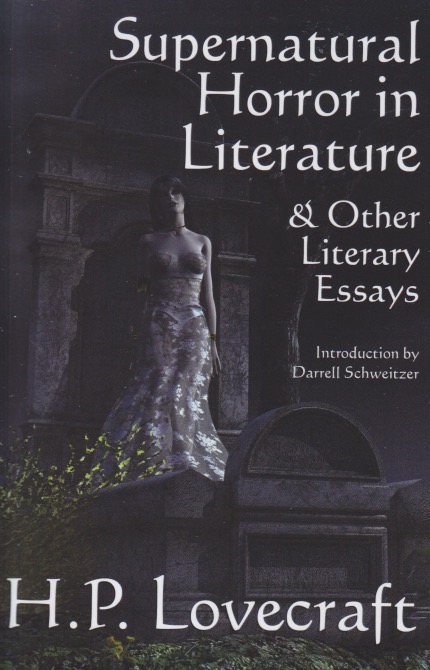
It seemed natural enough to follow up Stephen King’s On Writing with H. P. Lovecraft’s famous essay “Supernatural Horror in Literature.”  This piece, widely quoted, is available online but it is lengthy and I wanted the convenience of not reading it on a screen.  What can I say?  I like to turn pages.  I found a print copy, along with two other, shorter Lovecraft essays in Supernatural Horror in Literature & Other Literary Essays.  This was published by Wildside Press, which added a brief introduction by the speculative writer Darrell Schweitzer.  The text of the main essay was obviously computer-read—a couple reading errors remain—but it is clear enough to read.  Like Poe before him, and King following, Lovecraft put down some of his thoughts on the craft of writing.  Interestingly, Lovecraft is seldom considered as a producer of belles-lettres, but he is world famous as a horror writer now.

The essay itself is worth reading.  Mostly it is a summary of what Lovecraft felt was worthy weird fiction.  I tend to agree with much of what he says here, as would be evident were anyone to read my own fiction writing.  I can’t say that I learned this at Lovecraft’s knee.  I only discovered who he was when I was teaching at the University of Wisconsin Oshkosh.  I did not have literary friends growing up; my reading tastes were determined by myself, largely based on what was available at Goodwill any given week.  Nobody I knew read Lovecraft and although his books may have been in that bin, he wasn’t really someone I’d have known to keep an eye out for.  As a child I didn’t think of myself as a horror reader.  I liked monsters, and vampires were among the most immediately recognizable.  My brother, if I recall, got me started on Poe.

When I began writing fiction, probably around twelve or thirteen, it was weird fiction.  One of my other influences was Ray Bradbury.  I agree with Lovecraft that, to be interesting, fiction often requires a speculative element.  I do read realism, of course, but I really enjoy tales with a bit of supernatural.  It’s useful to read Lovecraft’s ideas about influential writers.  I’ve got my homework cut out for me.  I can certainly recommend this edition for anyone who wants to read this lengthy essay in print form.  The one thing that struck me as weird was the cover design.  It features a woman wearing a strapless dress in a cemetery.  Lovecraft famously didn’t really have women as one of his main themes, and his women characters are among his most inaccurately drawn.  Still, it’s best not to judge a book by its cover.


Suitable Genre

As I muse over genres, it seems that “low-budget Lovecraftian horror” might be an—ahem—suitable one.  This is perhaps because Lovecraft has trouble being taken seriously as a literary writer and his stories are so easily parodied.  I watched Suitable Flesh unaware that it was a Lovecraftian (low-budget) movie.  I’ve seen quite a few of these over the years and they can be pretty fun.  This one was somewhat enjoyable.  Based on Lovecraft’s “The Thing on the Doorstep,” it’s a body-swapping, possession fest that involves two psychiatrists who have been friends forever but who both become victim of a nameless possessing entity.  It took some adjusting to believe Heather Graham in her lead role here—she doesn’t strike me as the Lovecraftian type.  She does seem to enjoy her role, nevertheless.

Lovecraft famously didn’t write many women.  He was xenophobic and a racist.  He didn’t much enjoy being married.  Modern films (and even novels) based on his works tend to redress this situation, sometimes creating a little disconnect with the white-male Lovecraftian universe.  Still, the story is fun.  Dr. Elizabeth Derby (Graham’s character) encounters a young man whom she supposes is schizophrenic.  In actuality, his body is being taken over by an entity that had possessed his father.  While possessed, the patient begins an affair with Dr. Derby and that leads to her also being a target of possession.  Although not considered a comedy it does seem that part of the story has an inherent humor about it.  Some consider it camp.  Lovecraft’s mood is difficult to translate to film.

Although cinema existed during Lovecraft’s lifespan, his writing wasn’t influenced by the possibility of film conversion.  The monsters are too enormous and the concepts too broad.  The real fear here, apart from the gross-out effects, is that of losing your identity.  The whole centers around a psychiatric ward where the supernatural events aren’t really accepted by the science that reigns.  People end up dying because the supernatural is inadmissible.  In this aspect, it shares some of the overarching concepts of some great horror.  The Exorcist, for example, derives a great deal of its energy from the fact that modern people have great difficulty in accepting that a demon could actually exist and science doesn’t seem to be working.  There are plenty of other examples of this.  Lovecraft’s stories bring us close to this realm, although Lovecraft himself was an atheist.  Maybe that’s one of the reasons his works are difficult to translate to film.  Or maybe something larger is going on.


Filming the Void

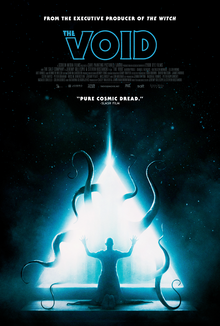
Once you move away from major studios, it turns out that Lovecraftian horror is rather prevalent.  Seeing that The Void was rated higher than many offerings on FreeVee, well, why not.  It was compared to the intellectual works of Benson and Morehead, but to me it matches more closely with Older Gods.  Like many movies in this genre, The Void isn’t easy to follow and having commercial interruptions doesn’t help.  (In movies made for television, directors know to offer cues at specified times to allow for a break.  I’m not sure that those at FreeVee, or Tubi, or Plex, or their ilk, or even Hulu, know how to do this well.)  So there are these mysterious cultists—somehow “new religionists” just doesn’t seem to cut it—who apparently want to bring about the apotheosis of their leader in a rural setting. 

Meanwhile a local sheriff finds a young man fleeing from a couple of guys who are killing people and takes him to the hospital.  This hospital, however, is being closed down and there’s only a skeleton crew there to handle emergencies until it can be decommissioned.  Once the guys trying to kill the young man arrive, the hospital is surrounded by the cultists.  By the way, there will be spoilers—just saying.  It never is adequately explained how these killing guys know who these cultists are, unless it happened so fast that I missed it.  In any case, all trapped in the hospital there’s the problem with a monster that has tentacles (Lovecraftian) that takes over the body of a nurse, then a tries to get a state policeman.  Lots of axes and gunfire, and the numbers in the hospital are reducing.

It turns out that the kindly old doctor is the leader of the cult and he’s trying to raise the old gods so that he can bring his daughter back to life.  The sheriff, who’s been the protagonist all along, knocks said doctor into the eponymous void, leaving only two people alive in the hospital.  It’s not really explained where the cultists, who made it into the hospital, went.  Nevertheless, this is a good example of horror and religion (which is ironically Lovecraftian).  The doctor’s unconventional religion is the cause behind the hospital mayhem, and, apparently the killings being conducted by the interlopers are attempts to stop it.  As a horror film it’s effective, if a bit disjointed.  It seems that there’s still a lot to unpack from films that try to bring Lovecraft’s ideas onto the silver screen, major studio or not.