
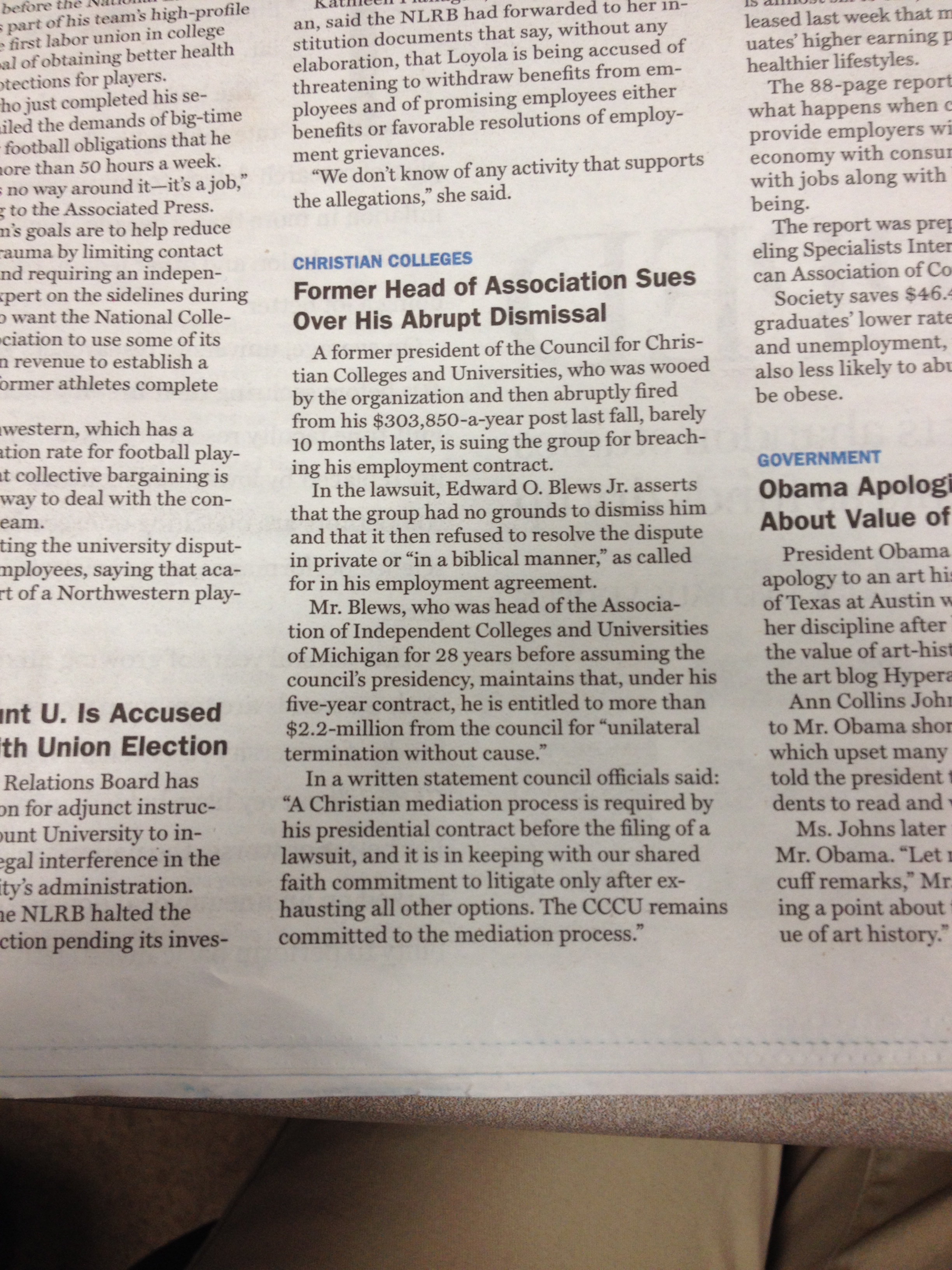
There’s strength in numbers. This is a biblical concept as well as a folk saying (although it is worded differently in the Good Book). The power of conviction grows in a group, and that’s a reason that governments fear mobs, particularly angry ones. As biblical fundamentalism began to develop at the turn of the last century, those who opposed modernity found like-minded believers and gathered themselves together to stand on the same side of multiple causes. Not only fundamentalists, but all different religious outlooks—evangelical groups especially. The more “mainstream” and liberal groups, lacking the conviction of feeling like they’ve been left behind as society moves ahead, have felt less need to organize together. This is something the Democratic Party has felt ever since the Religious Right wed the Republican Party. It is an interesting dynamic. Banding together makes you feel like you’re not alone. So it was that the Council for Christian Colleges and Universities was founded. Higher education, which began in the church, had gone directions that made evangelical groups uncomfortable, so their institutions formed a coalition.
A story in the current Christian Century two Anabaptist member schools have caused waves of protest because they have decided that it is permissible to hire same-sex married faculty. Eastern Mennonite University and Goshen College, sponsored by groups known for their primitivism, have surprised the CCCU with their surprisingly open stance. When is the last time the Mennonites made the news? In response, according to the Century, Union University, an evangelical school in Tennessee, has threatened to withdraw from the Council if this infringement is permitted. This is a perfect example of the dilemma faced by those who support higher education, but hold it to evangelical standards.
Homosexuality, over the past few decades, has become recognized as a basic form of human sexuality. As the stigma has begun to evaporate in the light of scientific, psychological, and sociological studies, the consensus has begun to shift in the wider world. With the Supreme Court decision in June (the first decision autosuggested as one Googles “supreme court”) rightfully following the evidence, any government barriers to same-sex marriages was pulled out from under the evangelical camp, and thus the CCCU. Eastern Mennonite University and Goshen College have decided this presents no problem to their educational mission. Some members of the CCCU, it seems, disagree. The Century blurb asks if this is the beginning of the end of the Council. Probably not. Prejudice finds any hidden corner or recess that it can in which to hide and grow, like any fungus. Groups that identify by what they hate are loath to change, no matter how bright the sunshine. Rain encourages the mushrooms into the open, but the sunlight afterwards creates rainbows.

 Steve A. Wiggins