Fair Country?

One of the lesser known Bruce Springsteen songs is “County Fair.” I hadn’t heard the song until I purchased The Essential Bruce Springsteen some years back when you actually had to buy a disc to get the music. Not a rock-n-roll anthem, it is a quiet, poignant song about the existential pleasures of a county fair. My daughter has been a 4-H member for six years and we’ve annually attended our county fair-the largest free fair east of the Mississippi, it is said-each of those years. In a good year 10,000 people will wander through, looking at farm animals that seem so foreign in our urban lives and which most people only recognize covered in gravy or some glaze. They see the exotic animals and pets so cute that they should be illegal. Like a fledgling college campus there are Arts and Sciences tents. Model planes, model trains, and model automobiles. To a sophisticated adult this might seem like pretty mind-numbing stuff, but I never fail to leave feeling inspired. I play “County Fair” religiously before heading out the door. Yesterday saw the close of the sixty-fifth Somerset County 4-H Fair, and despite the periodic showers, people seemed to be enjoying themselves.

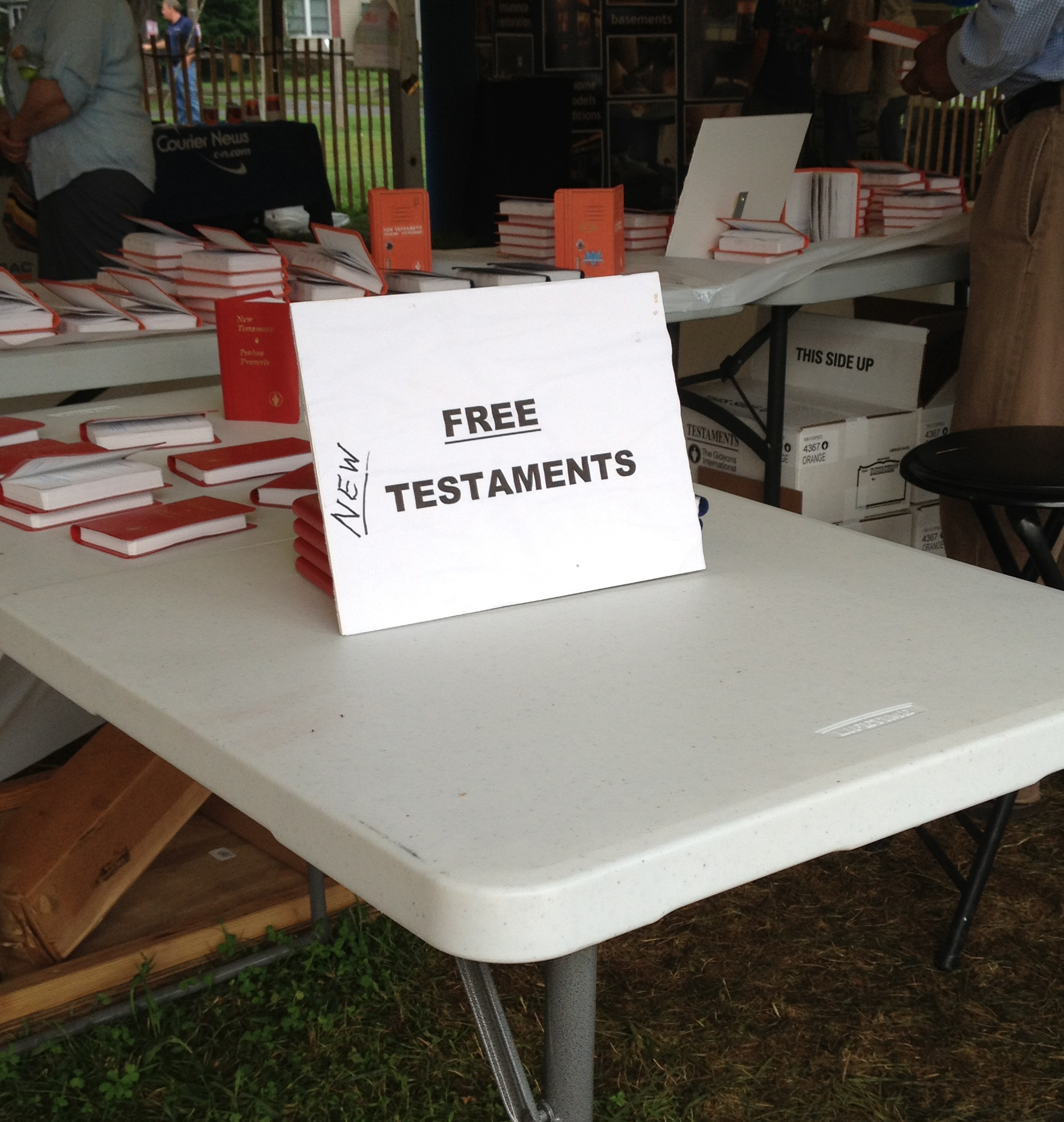
Under the commercial tent stands the Gideons’ table. Each year the fair is literally littered with free Bibles. I noticed with interest that the sign, which had originally read “Free Testaments” had been redacted to “Free New Testaments.” I tried to imagine the conversations, or confrontations that led to such a change. I can’t say for certain, but I suspect Hebrew Bible professors are not among the higher demographics of fair attendees. Most of the colleagues I know would never confront a poor Gideonite about ambiguously handing out New Testaments. I did, however, experience a kind of existential downgrade here. Christians used to declare, doctrinally at least, that the “testaments” were equal. Sure, when you’re standing on the George Washington Bridge trying to decide whether or not to jump, there’s some parts of the older testament that you’d probably be better off not reading. Nevertheless, doesn’t the rule book say the two are part of a whole?
IMG_0922

Nationally, as I well know, there are fewer “Old Testament” jobs than “New Testament.” But that slick little book the Gideons hand out feels a lot more streamlined than the bulky full edition. And I also realize that walking around a relaxing event like a county fair, seeking the most innocent kinds of fun imaginable, that a Bible in your hip pocket is probably overkill. There seems to be no devil lurking here among the sheep and the goats. Feet damp from the rain, under a cloudy, August nighttime sky, sitting in the car my daughter reflects on how this is her last fair as a 4-H member. I wish there were some twinkling stars overhead to make this a storybook ending. But all I’ve got is a truncated Bible in my pocket, and it is missing my favorite part.
Trashing the Bible

For the past month any free time I’ve had apart from class preparation has gone toward helping my daughter get ready for a presentation at the 4-H County Fair. Now, the morning after the close of the fair, when prize dairy cattle and model rockets and treasured family pets have all been transported back home, I am left with that sense of purposelessness that follows a period of intense preparation. Four minutes of public exposure translated into hours, days of often emotional planning, trouble-shooting, and dreaming. Although I grew up in a small town, farm life is as foreign to me as Cambodian politics. When I’m at the fair, however, spending long hours wandering amid animals, and go-carts, and community college recruiters, somehow being outdoors feels like being truly human. Perhaps it helps that the local 4-H is part of the Rutgers Cooperative Extension. My regnant, reluctant employer channels enormous resources into helping the youth of the state transform into the future.

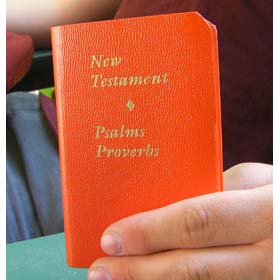
One of the vendors at the fair was the Gideons. Each year they have a table piled high with cheap New Testaments bound in flimsy plastic made to resemble jaunty orange leather, and the unwary soon find themselves with the Gospels and Paul tucked away in their bulging samples bags. It is curious that the Hebrew Bible, apart from the Psalms, is so dispensable in the cause of conversion or enlightenment. The motivation of the Gideon movement, ironically, draws on the book of Judges for its very label. An occupational hazard, I already have more Bibles than any decent human should, nevertheless, the Gideons always wish me to take on one more, if only a truncated version.

While wandering back to my daughter’s club tent after a trip to the bustling food tent, I passed one of the numerous trash receptacles mandated by any such large gathering of people in a disposable culture. Glancing in for a place to toss my greasy napkin, I spied a Gideon Bible, its optimistic orange cover partially smudged by cotton candy and other ambiguous substances. The tableau gave me a moment of reflection amid the noise, energy, and enticing aromas of church and firehouse cuisine. To someone, the Bible was that extra bit of unwanted, cheap, fair promotional junk. Although not a Bible-worshiper, the image left me just a little sad. Those weeks of intense preparation for my daughter’s presentation are brief compared to the decades I’ve spent trying unsuccessfully to cobble a teaching career out of the Bible. Sometimes symbolism can be cruel and ironic all at the same time.


This Fair’s for the Goats

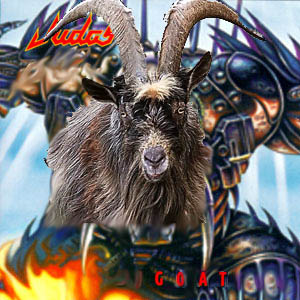
“County fair, county fair, Everybody in town’ll be there, So come on, hey we’re goin’ down there …” Thus begins the chorus of Bruce Springsteen’s little-known song “County Fair.” (It is one of the bonus tracks on The Essential Bruce Springsteen.) The haunting melody of what might otherwise be a carefree summer song is enhanced by the fact that my wife has been staffing a couple of 4-H County Fair booths over the past weeks and I don’t get to see much of her with the long hours. While at a recent fair she pointed something out to me that, not having much experience on a farm, I had never known. Abattoirs employ goats in a specialized animal herding role. The animals in a stockyard, usually sheep or cattle, get familiar with the goat and learn to follow it. The goat is trained to lead them to their deaths while it is spared. The industry term for this animal is a Judas Goat.

It's a goat's life

Slaughter House Rock

Although the origin of the name is obvious, the practice strikes me as insidious, if justifiably biblical. Training an ignorant animal to lead more gullible animals to their premature demise — it sounds a little too much like Pat Robertson to me! Is this sending in a goat to do a man’s job? Then to saddle the poor creature with the title of Judas, as if the poor thing planned it! Yet another reason to be glad I’m a vegetarian!

The Bible is pervasive in and paradigmatic for our culture. I might even term it endemic. As many children grow up without the biblical force-feeding that many of those in my generation had, these images and metaphors may eventually go extinct. Or perhaps there will always be a goat to lead them back to a Bibliophile culture. The county fair itself might be instructive. Originally instituted in Roman times as periods of relaxation from labor (rather pointless for those of us not gainfully employed), fairs evolved into opportunities for individuals and companies to display their wares and goods. From a practical point of view there is little you can see at the fair that you can’t find quicker or cleaner on the internet. But the internet lacks that human element. Perhaps we are really all just glad to go with the crowd sometimes without even asking where the goat is leading us.