Not Relic

Someone somewhere sometime recommended The Relic to me.  I can’t recollect who, where, or when, so I’m not sure in which direction to point the blame.  (Or maybe they recommended Relic…)  Weekend afternoons are drowsy times, and rather than sleep, I prefer to watch movies.  Those on my wish-watch list don’t often coincide with what’s on the streaming services available to me, so I try to recall those recommended to me at some point.  I mean, The Relic sounds like it should be good: a Meso-American god that’s part lizard, part beetle, and part mammal rampaging through a major museum?  Well, what’s not to like?  Monsters are usually fun.  This one requires hormones from the hypothalamus to survive, so it beheads people to get at their brains.
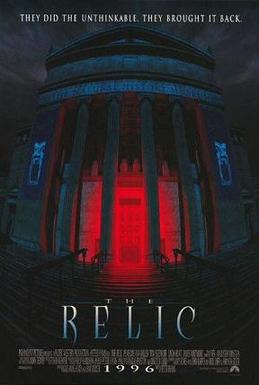
Now, if you’re not a fan this will sound goofy to you.  The thing is, in the right hands such a film could be very good.  I hear that the novel upon which it’s based is.  Unfortunately the script and the acting don’t really hold up.  The sciencey explanation doesn’t make sense—the evolution from eating certain leaves is too rapid, outpacing even the monsters in Evolution.  And when we learn that the mammal DNA comes from a human, it raises the question of whether indigestion was mistaken for evolution.  Of course, the monster—shown a little too early—is a chimera.  Since it’s part bug and part gecko it can walk up walls, which is admittedly pretty cool.  But the holes in the plot don’t ever really get filled so it’s a lot of running through tunnels in the dark with flashlights.

When I read the description that it involved a god-monster I thought I’d figured out why it’d been recommended.  Religion and horror share gods and monsters, so I thought maybe something would’ve been made of this.  The scenes where the carving of Kothoga is being prepped make no sense—you use carving tools to excavate fossils, not statues—and we learn nothing of this intriguing deity beyond that it was released to eat your enemies brains and when it ran out of brains, it dies.  Of course, it can eat leaves as well.  Ironically and paradoxically, the film makes me want to read the novel to get a fuller explanation.  The combination of gods and monsters is rich territory to explore and when those making a movie credit the audience with enough intelligence to make this work, it might be enough to keep you awake on a drowsy weekend afternoon.  Or it might keep you awake even if they don’t.

Flavor of Childhood

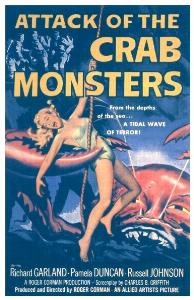
Giant, telepathic crabs whose molecular structure make them impervious to bullets, explosives, and fire, and that know how to use dynamite and who plan to take over the human world?  A group of scientists trapped on an irradiated Pacific island that is slowly sinking into the ocean?  This must be Attack of the Crab Monsters!  I was born during what is generally considered the dearth  period of the American horror industry.  Roger Corman, however, was working hard outside of the studio system to cater to that new demographic—teens with spending money.  Drive-in theaters were big and for about $100,000 you could shoot a double-feature and bring in ten times that much.  If you shoot quickly enough you can produce several of these in a year and not have to worry about the big studios.

It’s been fashionable to laugh Corman off, but he knows how to live the teenage dream.  Monster movies were part of the childhood of many of us during this “dearth.”  Yes, sophisticated frights were yet to come, but these creature features were full of creativity and escapism.  And so many unanswered questions.  How did those giant crabs chop all the radio wires to bits with those indelicate giant claws?  If they could smash through the outside wall of a house, why couldn’t they break through a light-weight door once inside?  And why, knowing that bullets and grenades can’t possibly hurt them, do scientists keep firing away?  What was that oil subplot all about anyway?  And how do you end a film with the lines “He gave his life,” followed up by “I know”?  This is stuff, like Strawberry Quik, I couldn’t get enough of as a kid.

No, this wasn’t intelligent horror—it was often laughable—but it made an impression.  As an adult I can’t recall which of these movies I’ve seen before and I suspect it would take a lifetime to watch all the films Corman directed or produced.  Along with his contemporary indie director/producer William Castle, Corman may be inordinately responsible for my tastes as an adult.  I’ve grown more sophisticated (I hope) in some ways, but I’m at a pay grade where free on Amazon Prime often decides a weekend’s entertainment.  Besides, these movies struggle to top out an hour’s running time.  You can still get a lot done in a day and still have time for a monster crab, giant leech, or wasp woman.  With enough radiation, and imagination, anything can happen.


Horror Show

The horror film history narrative runs something like this: although there had been some scary movies in the silent era, the term “horror” was first used to describe Universal’s 1931 release of Dracula and Frankenstein.  Some other studios got in on the action and creature features were a staple of US cinema until the fifties when they began to peter out.  By that point a UK horror industry took off, largely due to Hammer Studios.  While these Hammer offerings often remade the standard creature features, they also branched out into less commonly explored areas such as films set in contemporary times focused on the occult.  This phase faded in the sixties just as “modern horror” was taking off with classics like The Night of the Living Dead and Rosemary’s Baby.  Modern horror quickly grew.  Further divisions can of course be made, and the modern period has gone through several transformations as well.  It’s a rich coffer.

There’s a real problem with this, however, for those who might’ve missed a decade or two somewhere in there.  Many of the UK films are still not available in the US for anything like a fair price.  Part of the reason for this is copyright law, but another is apparently the ignoring of demand.  I saw maybe one Hammer film (on TV) growing up.  Saturday afternoon fair was more often American B movies like Zontar the Thing from Venus.  I’ve got a hankering to watch some of those Hammer films, but even in the 2020s they’re difficult to find.  Even with the internet.  Often the DVDs are (because of differing copyright laws) coded so they can’t be viewed in North America.  You can buy a player to see them, but when you think of the inevitability of streaming it hardly seems worth the cost.

Streaming might be the solution, but much of the Hammer oeuvre doesn’t stream in the US, at least not that I’ve found.  If I’m wrong please let me know in the comments!  You see, I spend time reading about horror and when you do this recommendations often arise.  Some Hammer classics are as expensive as the academic books that discuss them.  Is it possible to be a horror connoisseur?   And can you truly be a connoisseur without sampling what’s on offer overseas?  We tend to forget that the world is culturally divided by copyright laws.  If nobody’s watching the movie anymore what’s the harm in making it free?  If people do want to see it, why not sell it to them at industry standard price?  Even trying to watch horror, it seems, has become a horror show.

Photo by Michael Mouritz on Unsplash