Creeping Again

The morality of Creepshow 2 is pretty straightforward.  Of course, this is early Stephen King.  Sometimes it’s good to keep things simple.  Horror anthologies sometimes work and sometimes they don’t.  This one falls somewhere in the middle.  Of course, George Romario didn’t direct, although he wrote the screenplay.  And King didn’t write the screenplay, as in the first installment, but he shows up for a bit part.  Campy and funny, as the first film established, there are a few scary moments, but you get the sense that the bad guys deserve what they get.  There are only three regular segments, apart from the cartoon framing, each with a “do something bad, get punished” theme.  “Old Chief Wood’nhead” seems to start out insensitively to First Nations people, but it features an avenging statue “cigar store Indian” whole doles out justice.  It’s the most disturbing of the three segments since the robbers show no human compassion at all.  Of course, the chief gets them.
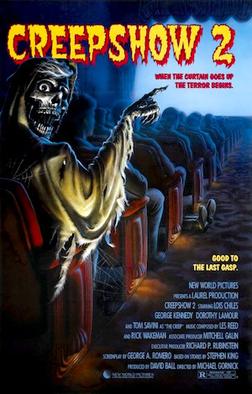
“The Raft” features less obviously bad protagonists.  Four teens drive out to an isolated lake with a swimming platform (the eponymous raft) in the center.  They all get high on their way there, and it’s clear the guys want to get their girls to the raft to have sex with them.  A mysterious floating blob surrounds the raft and eats them one by one.  You start to think Randy might survive for being good but when left alone with Laverne (his best friend’s girl) he begins to seduce her while she’s asleep.  None of them survive.  The last segment, “The Hitch-hiker,” follows a woman who’s having an affair.  Late getting home, she hits a, well, hitch-hiker and ends up as his victim.

The Creepshow franchise is, of course, comedy horror.  This film does end with a moralizing message that comic books don’t lead to juvenile delinquency, but rather other factors do.  This feels like an important message in days of increasing efforts to ban books.  Easy solutions by unthinking adults never solve the “problems” they hope to address.  Often what it comes down to is an aesthetic difference rather than true morality.  Morals don’t fit across the board, especially if you don’t think through your own motivations.  Of course, it’s nice to have a movie where such deep thinking isn’t really required.  Kids being eaten alive for being kids may be a bit harsh, but the others in this pleasant little diversion really just get what’s coming to them, and right soon.

Funny Scares

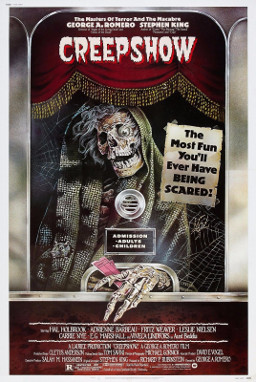
Camp has its own aesthetic.  I’m not talking about the kind with tents and sleeping bags, but that has its own aesthetic too.  No, I mean campiness in pop culture.  Creepshow, which was released in 1982, has maintained its value as camp and you pretty much still have to pay to see it (at least it’s free not on any streaming services I use).  For an episodic film it’s not bad, and since it’s comedy horror it won’t keep anyone up at night.  And of course both Stephen King (who wrote the script) and his son Joe (future horror writer as well), appear in the movie.  The elder King in a charmingly overacted segment based on one of his short stories clearly influenced by H. P. Lovecraft.  Put this all together with direction by George Romero and a cast including Leslie Nielsen and you’re in for a fun afternoon or evening.  (Or morning.  I won’t judge.)

It’s definitely a period piece.  The attitudes are those of the late seventies and early eighties.  That fact underscores, for me, how media affects everything.  Cultural outlooks change periodically and the more we know about what other people think, the more quickly they change.  Of course, since this is camp you can’t take it seriously.  And yet you somehow do.  The first vignette is, appropriately, holiday horror.  It has to do with Father’s Day which is, I suspect, a holiday to which most men acquiesce rather than anticipate.  This story is about a dad who takes it too seriously and a daughter who takes it too far.  Until…

The plots of all the stories are comic booky, and they contain many of King’s early themes.  “Something to Tide You over” is probably the most disturbing of the tales, at least by implication.  It reflects some of King’s fears as presented in some of his short stories but the method of execution is particularly distressing.  The comic book ending, however, shows it’s all for fun.  The prologue/epilogue reflects, I expect, the experience of many of us growing up.  I remember having comic books to which my mother objected because they were “too scary” for young boys (in our context).  I even recall her trying, and perhaps succeeding, to take them away and put them in the trash.  This is a situation as old as media for children.  The brothers Grimm knew just as well as King does that kids like scary stories.  Some grow out of that.  And others of us find a couple hours to watch Creepshow as an adult.  At least those of us who enjoy camp.