
David Cronenberg’s name suggests a certain kind of body horror as unique as it is unsettling. Crimes of the Future (2022) immediately reminded me of Existenz, which I watched many years ago. Crimes of the Future is more difficult to understand, however, in part because it is shot dark and quite a lot of the dialogue is indistinct. I happen to be reading a hard-to-follow book and my overwhelmed brain was hoping for a more straightforward narrative. In any case, in the eponymous future, human evolution is such that it has to be regulated. A performance artist couple puts on shows of surgery since he (Tenser) is constantly growing new organs. They’re harvested as part of the performance. Humans have evolved out of pain by this point, so surgery is done as art.
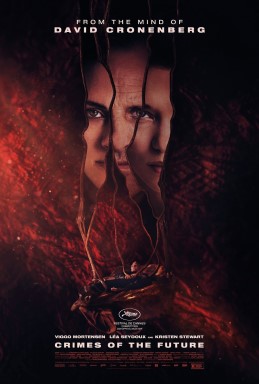
Meanwhile, a group has evolved to the point that they can eat plastic and toxic waste. They demonstrate that physical modifications can be inherited, which puts them on the government’s wanted list. Tenser and his partner, Caprice, own an automated autopsy table (who doesn’t?) that performs the autopsy while letting others watch. The radical group wants to use this device to autopsy, as art, the child born with the ability to eat plastic (he’s killed at the beginning of the movie). Also in the mix are a couple of crooked bureaucrats and a detective who seems sincere, but who has been working with an insider among the criminal group. Eventually the autopsy occurs but it seems the boy’s insides had been surgically altered. The leader of the radical group is assassinated and Tenser eats a toxic waste bar and dies.
If you’re saying “How’s that make sense?” you’re not alone. Body horror isn’t my favorite. Many of Cronenberg’s favorite themes are present here, but the film lacks a strong narrative. Or at least one that I could follow. Art house cinema often requires quite a bit of work from the viewer. The atmosphere of this film, like Existenz, isn’t really horror, but it breezes into that territory. Just when the horror—the surgeries—appears the social commentary kicks in. That’s often true of body horror, a genre Cronenberg is credited with developing. But I watch for the story as well as the mood. Some movies are more about the images, I know. And the future orientation makes some classify the film as science fiction. It has more of a Blade Runner, dystopian feeling atmosphere, but without replicants. Crimes of the Future, it seems, may require a better detective than yours truly to solve them.
 Steve A. Wiggins