What Message?

The search for autumnal horror movies is a never-ending one.  Can it really be that auteurs just don’t—drenched in the California sun—get that October feeling?  There’s something in the turning of the leaves and the appearance of pumpkins that changes everything.  And it works every year.  So it was that I thought of The Messengers.  I’d watched this years ago but found it somewhat unremarkable.  I seemed to recollect that, being based on a farm, it was autumnal in character, so I decided to try it again.  I remembered once more why I hadn’t watched it for years.  It’s a serviceable movie, but it is really set in summer (short sleeves the whole way through) and although August farm visits put me in the fall mood, this one is incoherent enough to prevent that feeling from catching on.
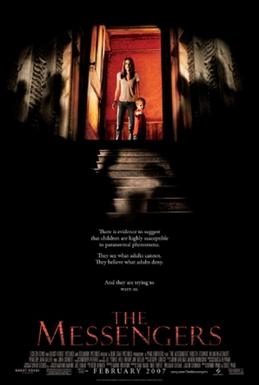
Jess is a girl with a past.  Driving under the influence, in Chicago, she was in a crash that rendered her baby brother mute.  In response her parents decide to move to a sunflower farm in North Dakota.  There the crows (actually ravens) attack them.  A stranger arrives and offers to help out.  Of course the house is haunted because of some past murders, but when the crows attack the hired help, it spurs him into a relapse—he’d lived here before and had killed his family, and so he decides to kill this new one too.  Being PG-13, they survive and the house swallows up the murderer from the past.  It’s never quite clear what the crows (the presumed messengers) really want to convey.  Are they trying to warn the family?  Are they trying to awake a killer’s memory?  What do they want?

This is an early Kristen Stewart movie—she’ll go on to more sophisticated horror films.  William B. Davis, with only cameo appearances, offers echoes of The X-Files.  Casting the generally congenial John Corbett as a killer is a bit of a stretch, however.  More intriguing, in this more global world, are the directors—the Pang brothers.  Known for their east Asian movies, including award-winning horror, they took on this American-themed, shot in Canada, project.  It had the backing of a few production companies and a reasonable budget.  Still, it struggles to be memorable.  I seem to recall that the prequel might’ve been a bit better.  But was it autumn-based?  I can’t recall and it’s that time of year when seeing falling leaves and a pumpkin or two make for essential viewing.

Crowing Up

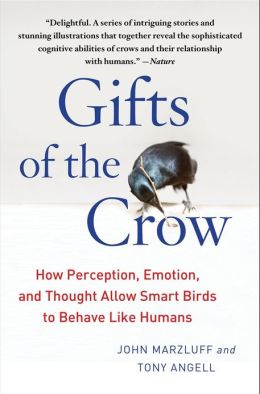
GiftsOfTheCrow Whether we climb up or down the evolutionary scale, one factor remains constant—our human sense of superiority. Despite the castigation of biblical-era thinking in the eyes of many scientists, few are willing to relinquish that Genesis-bestowed sense of being the pinnacle of nature. We know the universe is vast, but we assume we’re the best and brightest in it. Climbing down the ladder a bit, we like to distance ourselves from our fellow creatures because of our superior mental capacity. That is why I am so engrossed by scientists who explore animal intelligence. We find we are not so different after all. Gifts of the Crow: How Perception, Emotion, and Thought Allow Smart Birds to Behave Like Humans, by John Marzluff and Tony Angell is such a book.

If you’re like most people in this electronic age, you probably haven’t given much thought to corvids. Corvids are the members of the crow family: ravens, jays, magpies, and, of course, crows. Scientists have long known that these birds are exceptionally intelligent, and Marzluff and Angell have written a spell-binding little book that shows a remarkable level of intellect among the birds. Documented cases of tool making and use, conscientious interaction, and perhaps even language, have occurred among the corvids. We try to shoo them from our crops with “scarecrows” and we poison them en masse when they become “pests,” but when we take the time to understand them, we find that we may be far darker than the crows.

Not that Gifts of the Crow is all that easy-going. There is plenty of brain physiognomy and quite a bit about brain chemistry here as well. Knowing that not all of us are scientists, though, Marzluff and Angell include a generous portion of narrative description of what corvids have been observed to accomplish. For three days in a row I climbed off the bus stunned, scanning the skies for crows, just to see for myself. In this suburban jungle outside the New York City metropolitan area, crows aren’t so abundant as they were when I lived in the Midwest. They will, however, serve to remind me, when I see one, that our privileged place in nature has more to do with our thumbs than with our intelligence. When I saw a solitary crow atop a tree during a neighborhood stroll after finishing the book, I stopped, smiled, and bowed. Nature belongs to each and every creature, and there sat one intelligent enough to appreciate it.