Shopping for Fear

So I decided to visit a Halloween store. These have been showing up with metronomic regularity in September for several years now and are usually good for a cheap thrill. My personal preference for Halloween is more somber than garish, but the affirmation that other people enjoy a safe scare has a way of drawing me in. Those who read this blog on a regular basis know that I frequently point out commonalities between fear and religion. They both seem to hover around the same orbit in the brain, and, in some accidentals are very similar. Horror films therefore often indulge in religious imagery, and monsters do not infrequently partake of the divine. So it is no surprise to see my thesis borne out in shops intending to capitalize on fear.

I will freely admit that there may be cultural references that I’m missing here. A movie that I’ve neglected, or some television show or graphic novel may be informing some of the images in ways I can’t comprehend. Nevertheless, we all know of the power of the crucifix when it comes to vampires. I wasn’t aware that the cross had horrific effects on other species of monsters as well. Take this guy here. I’m not sure what he’s supposed to be—perhaps a zombie? It seems a little too corporeal to be a demon. The teeth just don’t look right for a vampire. In any case, he seems to have an extreme reaction to religion, with the cross melting right into his skull. Is there a conversion message hidden here somewhere? Of course it could be just a chinzy attempt to scare a real religiophobe. The cross has become the backup weapon against all supernatural evil.
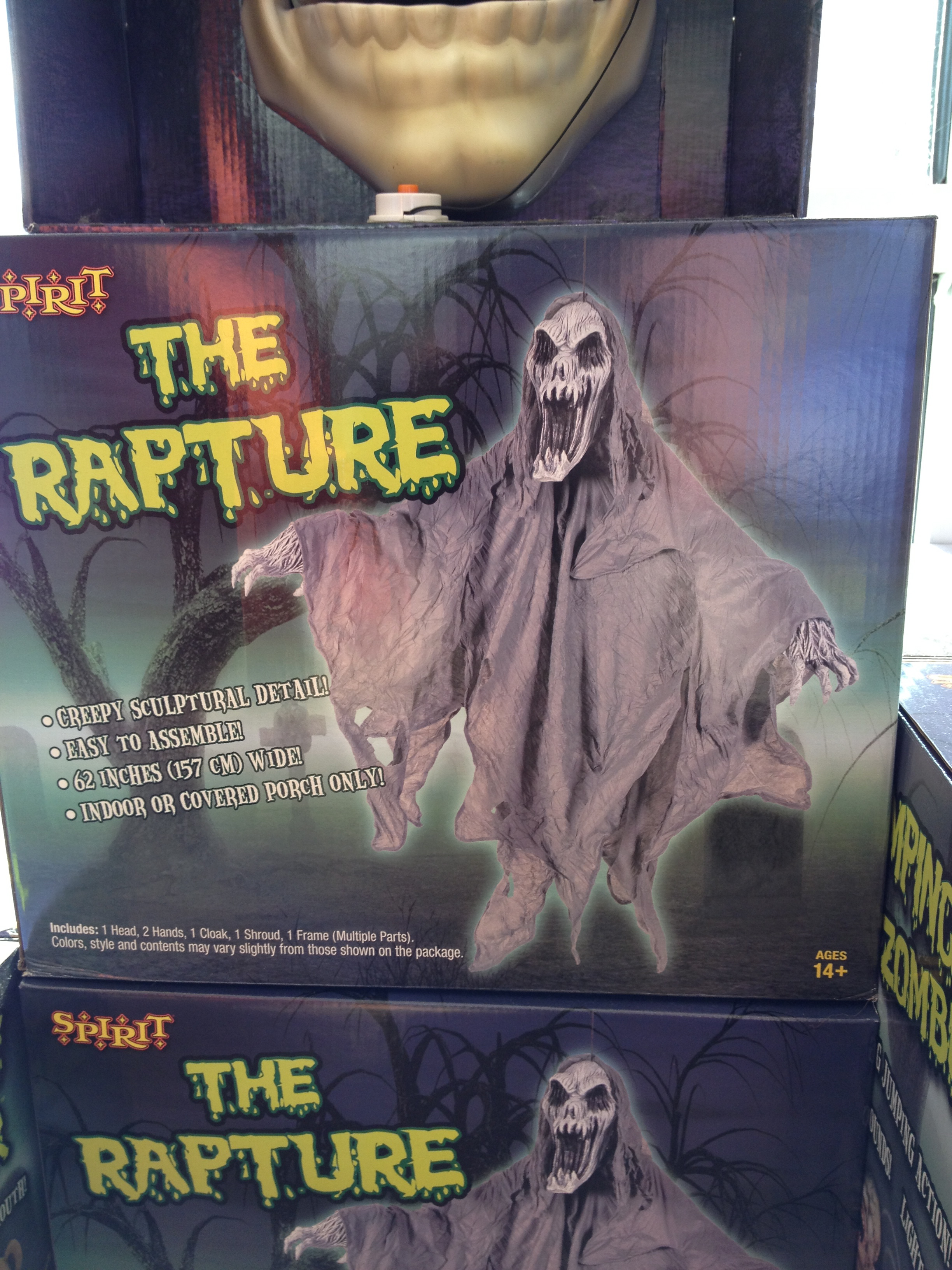
The use of a grim-reaperish ghoul rising from the grave to illustrate The Rapture was a new one on me. Last I heard only the squeaky clean and friends of the Tea Party got to go on the Rapture. (Well, the latter category might explain it.) The idea of the Rapture, as it was fabricated late in the nineteenth century, involved the chance for all the good Christians to escape before things really got rough down here for us normal folk. I would’ve thought that scary guys like this joining the heavenly crusade might take a little bit of the joy out of the occasion. Or maybe they’re being left here to haunt the rest of us. In either case it is clear that consumers respond to religious sounding language and symbolism when looking for a scare. Obviously there is plenty in the store with no religious significance at all, but finding hints of religion scattered in with the plastic scares does show a kind of Frankenstein’s monster of human sentiments and emotions. It’s only appropriate when the nights are now longer than the days.
Monsters Are Due on Elm Street

November 1984. George Orwell’s dark vision had not fully emerged, but the veneer had worn off of the fairy-tale world promoted by the evangelical, free-market professors at Grove City College. As a blue-collar kid in a blue-blood institution, I was out of place. The campus was buzzing, however, about a new movie—A Nightmare on Elm Street—for which I finally plucked up the courage to ask a cute coed for a date. I’d never seen a slasher movie before, having sampled mostly traditional monster-flick fare as a child. I felt a sense of accomplishment since some of my college friends had to leave the theater for fear. On the big screen, with no previous knowledge of the plot, the film worked for me on many levels. Last night I decided to watch it again.

My first reaction was a sense of surprise at how much of the movie I still recalled with pristine clarity. For having been nearly thirty years ago, such clarity is a rare phenomenon for many details of life, often reserved for memories of early girlfriends. A second reaction was noticing how religion featured in the film. The girls skipping rope chant, “One, two, Freddy’s coming for you / Three, four, better lock your door / Five, six, grab your crucifix.” Indeed, the crucifix features in several scenes as an ineffectual weapon against Freddie Krueger. The days of defying vampires are over when your own subconscious turns on you. In one of the early chase sequences, Freddie, raising his infamous glove, says, “This is God!” Religion and its overarching concerns with death and suffering come together with horror in that one moment. The traditional power structures of religion have lost their power to defend the troubled teenagers. The only one well adjusted is, ironically, Johnny Depp’s Glen. Even he falls victim to the revenge sought by Krueger.

Surprisingly, the scene I had most trouble recalling was the end. I recollected the bright, hazy sunshine, but couldn’t remember how Wes Craven released his audience from the drama. Of course, there is no end. Freddie came back in countless sequels, none of which I ever watched. Although I wouldn’t know it at the time, Robert Englund based the screen presence of Freddie on Klaus Kinski’s Nosferatu in Werner Herzog’s classic remake of that silent gem. Freddie is the vampire that defies religious cures. Movie villains are among the most adept practitioners of resurrection on the silver screen. The occasional E.T., Neo, or Spock will come back from the dead, but those who repeatedly return are the denizens of our nightmares. As Orwell’s vision continues to unfold in subtle ways, 1984 looks like an age of innocence before the ineffectual god worshipped by the establishment became self-image, writ large, on Elm Street.


Not So White

Over the past two decades, an interest in presenting fairy tales more akin to the spirit of the brothers Grimm has blossomed into its own industry. For those of us who were reared on Fractured Fairy Tales, this is a welcome development. Among the more creative approaches to this genre is the 1997 movie, Snow White: A Tale of Terror. Hampered by lack of theatrical release in the United States, this gothic attempt at telling the story in its original, dark form has gone largely unnoticed. I recently viewed the movie for the first time myself, and although the basic storyline is somewhat trite the Grimmesque features redeem it at many points. (Who doesn’t secretly want to see the pretty-boy prince charming thrown out of a castle tower window?) Perhaps the most unexpected addition to the Disneyfied tale we all know is the religious component to the movie.

“Snow White”—never named so in the movie—has been raised by a pious father who wears a cross and insists that she say her prayers and read her Scriptures. Being a local lord, he suppresses ruffians who populate the woods, including a band of not-so-merry men who incorporate some that were tortured for refusing to go on crusade. When the not entirely wicked step-mother needs Lord Hoffman’s blood to raise their stillborn son to life, she lashes him to a crucifix, saying to the corpus that occupies the other side, “now you shall have company.” (Did I mention this is a horror film?) Along with the unexpected twists that those conditioned to happy endings find so disturbing, the film actually contains a subtlety on matters of religion that is frequently missed. It also resists corny dialogue that so often plagues films where the storyline cannot bear any substantial weight.

While it will never be my favorite movie, this particular film was an effective adult retelling of a familiar tale with more depth than the common story might suggest. The Germanic folklore collected by the Grimm brothers often reveals a depth of insight into humanity that is bleached out by Disney’s bright colors and cheerful smiles. It is more true to the human experience. The scene that remains seared in my mind is where one of the seven miners (only one is a dwarf—another is actually a friar) is revealed to have been disfigured by crusaders off to liberate the Holy Land. Refusing to participate, he had to watch his family burned at the stake and had a red-hot iron cross pressed to one side of his face. (Did I mention this is a horror film?) As in the days of Grimm and continuing into our own, the church continues to scar many even as it attempts to heal others.