Cryptid Caper

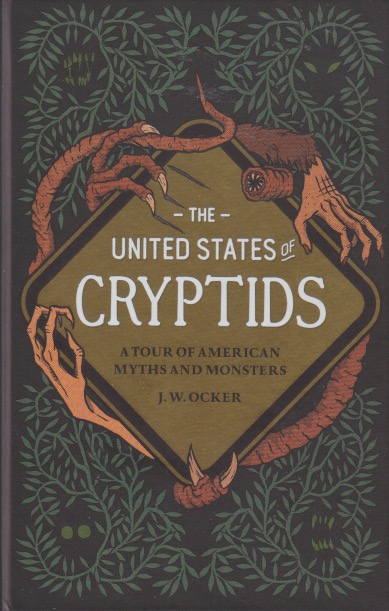
I don’t recall how it got on my fiction reading list—I probably saw it on Goodreads—but I picked it up because it was short.  And surprisingly, multiple copies were in Barnes and Noble.  Since James Daunt bought the chain out it has definitely improved.  In any case, Hunter Shea’s To the Devil, a Cryptid looked like it might be a fun romp, and if it turned out that I didn’t like it, well, it was short.  Ads in the back keyed me in that this was a part of a series of horror novels about cryptids.  Besides, I like to support publishers that aren’t part of the big five.  I’d just finished reading a five-hundred-pager, so something under two was very welcome.  The title seems to riff off the horror flick To the Devil a Daughter.  As much as I try to keep up on my cryptids, I was unfamiliar with the Goat Man.  And I did like it, by the way.

So, the real Goat Man is mostly associated with Maryland, but in Texas, where the novel is set, there is the Lake Worth Monster.  This seems a good fit for the cryptid part (whether intentional or not I don’t know).  A bunch of kids messing around with Satanism decide to sacrifice a goat in the woods where a Goat Man cryptid is said to live.  Something goes wrong and the goat fuses with a guy trying to break up the ceremony and mayhem ensues.  Lots of bodies torn apart in this version of the Lone Star State.  Still, the story is fun.  I’ve been writing cryptid fiction for years, and this may be a targeted demographic, but that doesn’t prevent this from being a good horror novel.  Particularly interesting is the resolution.  I’ll try not to give too many spoilers, but the next paragraph reveals something.

How do you stop a demonic, bulletproof Goat Man?  You call in a priest to do an exorcism.  The truly remarkable part of this is that the priest is treated sympathetically.  None of the characters are religious.  And of the two main young people who survive, you really don’t expect them to be found in church.  The story isn’t intended to be believable, of course.  The Goat Man is an urban legend.  Urban legends are often difficult to tease apart from actual cryptids sometimes.  Cryptids remind us that there’s still more to be discovered in the world.  And I may have just discovered a series of stories that work for a quick fix.


No Demons

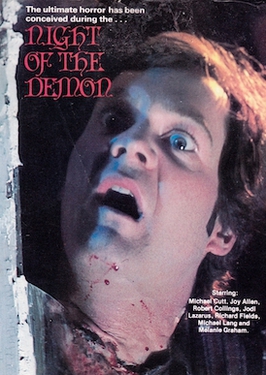
There’s a connoisseurship about it.  Making bad films, that is.  It’s a wonder that Night of the Demon—I should specify 1980 as the year—hasn’t really become a cult film of any standing.  You can tell the maker tried hard to shoot a reasonable film, but with a nearly Ed Woodsian level of incompetence.  It lacks Woods’ artistry, however.  For those just getting on the Bigfoot kick in the new millennium, it might help to know that Sasquatch was big in the seventies.  Yes, the first real efforts to sort this thing out came about when the psychedelic seventies were underway.  The documentary The Mysterious Monsters came out in 1976.  The first serious efforts to explain Bigfoot as not just a hoax began.  And James C. Wasson, Jim L. Ball, and Mike Williams took a shot at making a horror film of the hairy guy.

The acting is about the worst you’d care to see, and the script is abysmal.  The effects are anything but special, and the flashback scenes incongruous.  But it does have significance for religion and horror.  It goes like this: a professor and some students go to investigate a series of Sasquatch-related murders.  They’re led to “Crazy Wanda,” who lives alone in a remote cabin.  Wanda, when finally persuaded to talk, reveals that her crazed preacher of a father killed her Bigfoot-hybrid baby.  His followers still perform demonic rituals in the woods, worshipping the Sasquatch.  Wanda had burned her father to death in retaliation for killing her child—she kinda likes Bigfoot, it turns out.  The professor and students, naturally, fall victim to the beast.

Only the professor survives.  He’s assumed to be criminally insane and suspected of murdering his own students.  It’s almost painful to watch a movie where everyone is trying so hard to do it well, but just can’t seem to manage it.  The plot line about the cultists is immediately dropped after an intended rape ritual is interrupted by the professor.  Wanda’s preacher father, who seems to fit into no particular form of Christianity, has no motivation beyond avoiding Hell for himself.  At one point he seemingly admits killing her mother.  There’s even a scene where Bigfoot kills two Girl Scouts.  With all of this going for it, you might think it would’ve picked up a following.  It has some fans, I’m sure, but I’m not certain that it’s well enough known to make it onto lists of worst movies of all time.  More’s the pity since it would absolutely deserve it.


Paranormal Prophets

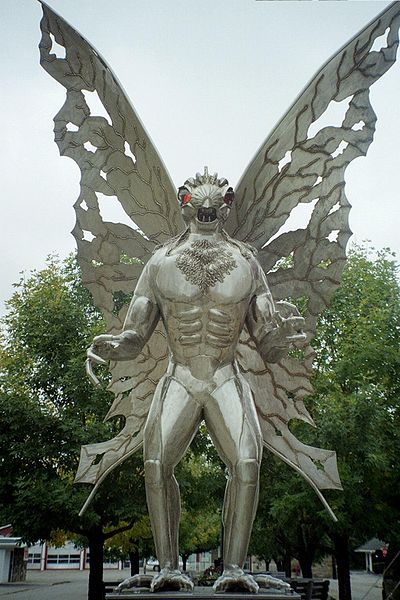
At the suggestion of a friend, I watched The Mothman Prophecies last night. Very loosely an updated version of the collapse of the Silver Bridge in Point Pleasant, West Virginia, the movie both satisfied my monster movie habit and my interest in things biblical. As a monster flick, it was satisfying in maintaining tension, never clearly showing the creature. As a representation of prophecy, it falls into the camp of Nostradamus.

Reports of the “mothman” began in 1966 and continued over the next year. It was reputedly seen near the Silver Bridge, the artery that connects Point Pleasant with Gallipolis, Ohio. After the tragic collapse of the bridge, resulting in nearly 50 deaths, the paranormal prophet was never seen in the area again. While in West Virginia last year, a friend introduced me to a couple from Point Pleasant who stopped into her store. They looked a little embarrassed when the mothman came up in conversation.

Point Pleasant's mothman statue from WikiCommons

Prophecy, in the vernacular, refers to predicting the future. Although some biblical prophets correctly intimate future happenings, mostly the image of prophets in the Bible is that of effective speakers. Prophets are individuals who participate in the reality of the world by adding their powerful words to the mix. If their words regard a future event – fairly rare in the Bible – they affect the outcome because their words have influence in the world. It is a supernatural view of the spoken (or written) word, to be sure, but it is a long cry from predictive ability. It is a matter of perspective.

Interestingly in the movie, Alexander Leek, the specialist on mothmen (apparently there are many), suggests that they see farther because they are higher in the sky than humans. In other words, it is indeed a matter of perspective. Certainly the mothman must go down as one of the oddest cryptids sighted. I give them no credence as prophets, but I will think twice before driving over bridges from now on.


Cryptid Be Thy Name

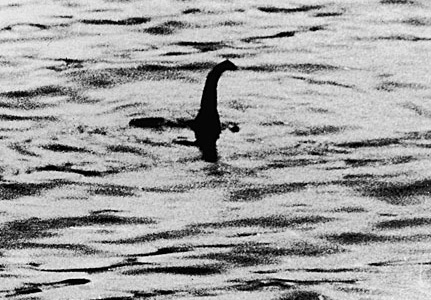
While poking around the internet last night to take my mind off the heat and humidity surrounding me, I stumbled across an article entitled “The Religious Struggle over Cryptozoology” on a site called Science and Religion Today. The piece was written by Joe Laycock, a doctoral candidate at one of my alma maters, Boston University. Having just finished Bruce Hood’s Supersense, there was a pleasing euphony in the coincidence. Cryptozoology is the study of unknown animals, and is not necessarily based on the supernatural (although it may fall within Hood’s definition of it). Laycock notes that two religious elements in society have latched onto this study: New Agers and Creationists. Creationists, it seems, see in certain cryptids, such as the Loch Ness Monster, hold-overs from the Mesolithic Era that prove the Mesolithic Era never existed. God can still make dinosaurs today, therefore the Bible (which doesn’t mention dinosaurs at all) must be true.

The draw of the unknown

One of the most welcome parts of Hood’s thesis was its consonance with Stephen Asma’s On Monsters, a book I’ve posted on before. Both authors explore how the human psyche reacts against what it perceives to be “strange mixes,” beings that cross-over between readily defined categories. Hood addresses this by tackling the concept of “essence” while Asma notes a dread accompanied by a sense of wonder. Hood demonstrates that from a scientific point of view, there is no such thing as the “essence” of a person, object, or living thing. Such ideas are the cling-ons from the era of souls and radically distinct species and genders. Closer observation has taught us that many such things are more of a continuum than a series of sharply defined types. Religions prefer to have fixed categories. Religious ethics often depend on them.

Laycock suggests that both New Ageism and Creationism “can be read as a religious response to the cultural authority of science.” Religions fear that which can be empirically demonstrated since it throws the god-of-the-gaps into the dryer and he comes out smaller each time. This is so, despite the fact that Creationists crave scientific respectability. While teaching my course on Myth and Mystery at the University of Wisconsin Oshkosh, I dwelt on cryptids for a few sessions. They are indeed often surrounded with a religious mystique. I wouldn’t necessarily dismiss the possibility of undiscovered species, many new ones are described by science every year. Nor would I say that they are supernatural. Nature has ways of surprising us still, and as Asma clearly demonstrates, we still have a need for monsters.