
Religion and horror have long been bedfellows. And quite companionable ones at that. I’ve written a longer piece that I’ve not yet managed to wedge into a book about how the earliest Universal monster movies all involve religion in some way. Maybe some day it will come out into the light. In the meantime, I submit, for your consideration, The Cult of the Cobra. This 1955 horror film was one of a series of movies about shapeshifting. We’ve recently seen The Leopard Man on this blog, and before that Cat People. Cult of the Cobra, set in amorphous “Asia” to start, involves the invented religion of the Lamians. A group of US Airmen pay a Lamian to watch a woman transform into a cobra in an “Asian” ritual. They’re revealed by trying to take a photograph—they’d been warned that if they were discovered the cobra would hunt them down and kill them.
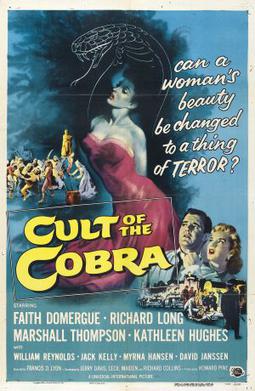
Convinced this is all superstition, despite one of them dying the next night from a cobra bite, they return to New York City and civilian life. The cobra woman follows them to carry out her mission. She’s killed, however, before getting the last two. What’s so interesting here is the discussion of belief that takes place throughout the movie. Americans can’t believe in some “cult”—it’s clear from the start that anything not western is cult—but none of them show any inclination to church, or crosses, or even references to God or the Bible. The only religion shown is that of the Lamians. The cobra woman falls in love with one of the Airmen and tries to explain that she’s coming to doubt something she’s believed all her life. She’s caught between religious duty and the experience of falling in love.
The movie failed to impress critics and was largely dismissed as a knock-off of Cat People. There’s too quick a judgment here, however. One of Universal’s earlier monsters had encountered a non-western religion but became much more famous for it. The Mummy was based on “ancient Egyptian” religion. Indeed, the whole story is premised on it. The Cult of the Cobra, however, engages with the religion. As jingoistic as it is, it nevertheless tries to represent “the cult” as a religion taken seriously by an exotic group of believers. “Lamians” seems to have been borrowed from Greek mythology, however, where lamia were demon-like devourers of children. I write about them in Nightmares with the Bible. This isn’t a great movie by any stretch, but it shouldn’t be dismissed either. It’s an important piece of the puzzle of how religion and horror interact in film.
 Steve A. Wiggins