Celestial Happenings

Science fiction used to be the mainstay of my reading. Unlike a true fan, I was never exclusively devoted to it—my tastes are far too eclectic to be contained by any genre. Nevertheless, at a used book sale, on a whim, I picked up Frederik Pohl’s The Day the Martians Came. It had a cool looking spaceship on the cover, and I recognized his name from my childhood reading. I prepared myself for an adventure. Instead I found a disillusioned tale of humans and their foibles, many of them religious. Many tales, in fact. Indeed, I wasn’t surprised to find out that this was originally a set of discrete short stories later laced together into a novel. The point, it seems, would be appropriate to Qohelet. Human beings run around doing their pointless things and failing to communicate with one another. That much was true to life.

The Martians, who are more evolved and intelligent than humans, but who appear to be mere docile animals, are discovered near Christmas. Much is made of the fact that humans still celebrate Christmas on Mars. And, if you can cut through all of the snark, there’s also a message that we like to live out our prejudices whenever possible. So the humans, excited about Martians being transported back to earth, try to take advantage of each other any way they can. Some of the most complex of the stories involve religious leaders who dismiss science and assert mystical knowledge of these extraterrestrials. These leaders, of course, are only after the money of the gullible. They’re playing the popularity circuit, or running cults, and the clueless are drawn to them. And so the book isn’t really about Martians at all, but about human folly. Mainly religion.

Science fiction means different things to different people. In a used bookstore I noticed Neil Gaiman under science fiction. As much as I enjoy his work, I’d classify it as general literature instead. Genres are there to help us find related material. The name Frederik Pohl and the word “Martians” in the title suggest science fiction, but the book itself doesn’t really meet the criteria. At least for me. Perhaps it’s because we’ve landed rovers on Mars and are now talking about a human expedition. Mars has become somewhat less exotic. Religion, meanwhile, continues to churn and muddy the waters. Not always as cynical as the leaders seem to be in this book, nevertheless they are part of the discussion since once we get off this planet we’re going to have foreign deities with which to deal. Whether we respond with snark or science fiction is entirely up to us.
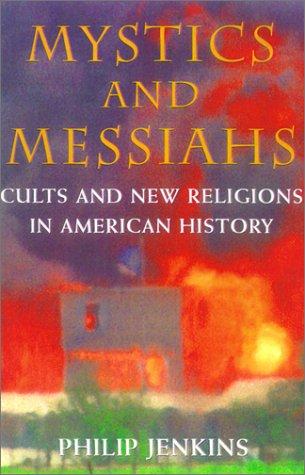

Mystic Messiahs

It is difficult to know where to begin when discussing Philip Jenkins’ Mystics and Messiahs: Cults and New Religions in American History. As a student of religion I early found myself drawn to the question of where religions begin. In the case of many religions we have an identifiable founder. Frequently that founder ends up being a god him (or more rarely) herself. In order for any putatively revealed religion to attain any credibility, the ultimate source must come from on high; God himself. So it is that we look askance at any religion that has appeared in the last couple of centuries, when, as we knew at the time, the earth was no longer the center of the universe and science had taught us to know better than to accept the old-timey stories of a god in the clouds. We can accept the ancient, time-honored stories, venerated as they are by centuries. If someone today tells us that God has spoken to him or her, we refer them to psychiatrists first, and then to the mind-altering drugs.

Jenkins, writing in the shadow of the tragedy of the Branch Davidians at Waco and the ritual suicide among the members of Heaven’s Gate (one of the members’ sons was one time a student of mine in seminary), tries to demonstrate that such groups are part of the fabric of religion. What is new in such movements is not the fact that they suddenly come into existence, or that society reacts violently to them, but that we now have a concept of “cult” to label them. Jenkins convincingly illustrates that fear of new religions stretches back for centuries. Even in the seventeenth century people experimented with new religions. When they survive, they become “churches.” Consider the Mormons, the Seventh-Day Adventists, and the Pentecostals. They all began as “cults” and are today considered just another variety of Christianity. Most adherents to religions do not inquire too closely as to the origins of their brand. Historically we know that the three denominations mentioned above are well under two hundred years old.

In a fascinating twist, Jenkins describes how the Zeitgeist of the early twentieth century was ripe for such developments. One of the sources, ironically, was the fiction of H. P. Lovecraft. His weird stories often invoked cult-like groups devoted to unusual practices that sometimes turned deadly. Also during that same time period, Christian Fundamentalism began as an effort to sort out what was “fundamental” to Christianity that set it apart from the cults (including Pentecostalism, now one of the most dominant Fundamentalist sects). As Jenkins points out, when these new sects become mainstream, they vehemently seek to destroy all new comers. Christianity began as a cult in the eyes of both Jews and Romans.

Religions are inherently conservative. As we will see in the approaching election, the religious background of a candidate plays a major role in public acceptability. We enjoy freedom of religion in the United States, but only to a point. Jenkins should be required reading for every religious believer. Tolerance would be the only proper and reasonable response.


Christian Movementarians

After a distressing day of job-hunting yesterday, I turned to the Simpsons for solace. Often the most intelligent program on American television, as well as being the longest running series, the Simpsons frequently hits religion with a few good-natured and well deserved whacks. Last night I watched The Joy of Sect from season nine. It has been a few years since I’ve seen the episode, and I was pleasantly surprised how it correlates with the overall theme of this blog.

Although the episode ends with a normalcy returning to Springfield after the appearance of a cult called the Movementarians, the parallels between the cult and Rev. Lovejoy’s church are numerous and poignant. This perhaps hits too close to reality for many religious believers — what separates a “cult” from a “church” is more a matter of perspective than a matter of practice or accident.

Even early Christianity had considerable connection to and similarity with Gnosticism. When religions collide, they must emphasize their distinctiveness to survive. Like biological organisms, those that meet the needs of their societies (“the fittest”) survive, while others go extinct. It seems to me that the main cause of religious violence is the need to claim exclusive access to the truth. People are not comfortable believing a religion that might be proven wrong. Like the Simpsons they wish everything will return to normal at the end of the day.

The very definition of normal