Alien History

If aliens sat down to read earth history, they’d get the impression that we’re a very warlike species.  While, no doubt, this is true for a large part of history, I’d suggest that at least since 1900 it hasn’t been so much that the species is warlike, but that its leaders are.  As long as we have “shallow bastards” (to use Frank Turner’s phrase from “1933”) leading us, is it any wonder?  Even with current world leadership given a pass, looking back over the big ones of the last century, it was mentally unstable leaders with fragile egos that led to wars.  I’m sure some national resentment across borders certainly exists, but would people just go and kill those in the next town over, in the “modern” world, if their leaders didn’t tell them to?  Think of World War II, brought on by a madman.  Yes, Germany had grievances, but war wasn’t the only way to solve them.  And killing Jews did nothing to help anybody.

Or World War One.  The assassination of an Archduke need not have led to nations clashing with excessively deadly force.  Men with inflated egos and personal ambitions seem to have played a large role.  To any aliens reading this, some of us would like to take exception to this warlike generalization.  Human society is complex, and the jury is still out on whether democracy can really work when the electorate doesn’t bother to educate itself.  Or allow itself to be educated.  Still, my sense of my species is that we’ve managed to civilize ourselves out of being warlike, but we do have strong emotions that we need to learn to control.  Watching Washington flirt with war every day because of incompetence, well, dear aliens, we’re not all like that.

Image credit: NASA (public domain)

The world into which I was born seemed to be okay as far as national boundaries went.  Younger generations are raised to realize that colonialism was an evil, exploitive outlook.  There are those alive, unfortunately many of them in public office, who want to go back to acquiring more land.  And countries, sometimes artificially created (generally by Europeans), continue to break apart.  South Sudan became a country only in 2011, but Sudan appears to have been artificially held together by pressure from other nations.  I still don’t see why globalism and lack of war can’t coexist.  If nations had thinking persons in charge rather than macho men eager to show how big they are (aliens, this is a human fascination, I’ll grant you), we might well be able to live in peace.  If you want to take them back to your planet, you are most welcome to do so.


Zoning In

Born Jewish, and Unitarian by choice, Rod Serling believed in the inherent worth and dignity of all human beings.  Like many people, even Serling believed that season four of The Twilight Zone, which went to an hour format from the usual half, didn’t really work.  Nevertheless, the fourth episode of that season,“He’s Alive,” really should be required watching of every person in the United States.  This episode was written by Serling and it focuses on a young American fascist who’s having trouble gaining a following.  A shadowy figure then reads to him from what sounds exactly like Trump’s playbook, and soon decent people are raging along with him about foreigners and those who are different.  When the shadowy figure is finally revealed, we’re not surprised to learn it is Hitler.

The young man obeys without question, and soon it looks like he could be elected.  He has one of his best friends killed as a martyr to the cause.  He murders an old Jewish man who has cared for him since his youth.  He declares himself made of steel, with no feelings.  And when he ends up dead (everyone knows how Hitler’s career culminated), the spirit of Hitler rises from his body as Serling warns that wherever hatred exists, Hitler still lives.  Now this episode aired in 1963 but it could’ve been 2016, or 2024.  Prescient people, like Rod Serling, knew that mob thinking could be easily exploited.  Even in the first segment after the introduction the instructions are laid out.  Play on people’s fear of those who are different.  No matter how good things may be, people will be unsatisfied.  Add any power-hungry individual and you’ve got the recipe for a fascist overtaking.

The episode made me wonder if we could ever become a just society.  Ironically, that which calls itself “Christianity” these days stands in the way.  In its day, The Twilight Zone was amazingly influential.  It had a great impact on what was to follow and it’s still regularly referred to, even by those who’ve never seen an episode.  If only we’d pay attention to its message.  I’ve been making my way through the entire series, slowly, over the years.  Now and again an episode will really hit home.  I have to admit that I was physically squirming during “He’s Alive.”  It’s not that it is the greatest episode of the series, but its message is extremely timely.  The requirement for a better world is simple, but seemingly impossible to reach.  Treat others as you wish to be treated.


Peace

Mother’s Day should be a time for peace.  In these days when misogyny is in style, it’s an especially important holiday.  The one holiday to explicitly honor women, it’s always been an occasion for reflection for me.  We have 364 days of warring and hatred, and one dedicated to the givers of unconditional love.  I can imagine a different world.  One in which women don’t have to become alt-right to gain positions of authority.  Where compassion and humane treatment would be world priorities.  I can imagine.  Although fathers are necessary too, we have no shortage of men pushing forward their personal agendas.  None of them would be where they are without mothers.  And women are the ones who give us care.  I can imagine a world where Mother’s Day wouldn’t have to feel so politicized, almost polemical.

With all eyes on Pope Leo, I can’t help but think how many treat Mother’s Day like an indulgence.  You know you want to get back to your vices, so why not pay for them in advance?  Celebrate mothers today so we can get back to business as usual tomorrow.  I don’t believe that we’ve lost the ability for transformation.  We can make the world a better place.  Think what it would be like if, before undertaking some cruel action, a person stopped to imagine their mother watching them do it.  Would not the world start to improve?  It is a world where we seem to prefer guns to roses, but it’s also a world with an unwritten future.  Pay attention to your mother.  Maybe things will start to get better.

I believe in the transformative potential of holidays.  We have to take their lessons seriously.  I’m sure I’m not the only working stiff who lives life anticipating the next holiday when things might change for the better.  We have to remember, however, what the holidays teach us.  Not treat them as simply facile days of obligation.  Think of Mom and then get back to the grind.  It doesn’t need to be a grind.  We can learn to cooperate and get along, just like Mom told us to.  Instead of isolating such thoughts to a single day, we could repeat them like a mantra.  I don’t know about you, but looking at the headlines, I could do with a bit of peace and love.  And I still believe that things can, and likely will get better.  And I give the credit to our mothers.


Saint Francis

With the death of the most saint-like Pope in living memory, it feels a little like fate that I’d seen Conclave just three days before.  Francis was the only Pope I’ve seen, and am likely to see.  He cared for people more than dusty doctrines that still repress.  He laid hands on the sick and genuinely loved human beings.  Given the reactionary world of politics, I suspect his successor will be conservative, but I would be glad to be wrong.  All this seesawing on the way to progress makes me a bit seasick.  And Francis was a man who, from a humble background, understood the necessity of moving forward rather than pretending things always stay the same.  I already miss him.

It was on the rare occasion of being invited to a New York City church to offer a program that I saw him.  Since I’d be staying a couple nights in Manhattan, my wife joined me.  On the way to meet her after work on that Friday, I saw large crowds along 34th Street in Herald Square.  The buzz indicated that the Pope would be going this way on his way out of town.  The police refused to confirm that, but it seemed like a good bet.  I asked Kay, “Do you want to see the Pope?”  We found a place in the crowd (this was pre-pandemic, of course) where we had a good view of the street and eventually the motorcade rolled through, Pope Francis in his trademark Fiat, the window down, waving at the crowd.  And then he was gone.  

In New York City you see motorcades.  I’d seen President Obama’s go by once, on the way to the United Nations, I think it was.  But still, seeing the Pope was incredible.  Not shielded behind bulletproof glass, his care for the nameless crowds felt genuine.  I empathize with those raised in humble circumstances who manage just to survive, let alone become the head of the largest branch of Christianity.  I like to think he was a reluctant Cardinal, and a reluctant Pope.  Conclave is fiction, of course, but the idea of choosing someone who really doesn’t want the job is immensely appealing.  How different from world leaders we’re now burdened with!  Men (almost always) who see themselves as God’s gift to us, clawing at power.  At the same time, Francis, who was a divine gift, actually remembered what Jesus said and did.  The world is poorer for his death but richer for the lessons he taught by example.


Therapy with Books

I’ve been doing this for years and just found out there’s a name for it.  Bibliotherapy is a treatment method that uses reading to deal with anxiety.  It is closely related to writing therapy, which I also use.  Both have been self-moderated, in my case, and both have been part of my way of coping for decades.  I was actually surprised to learn that these are valid methods of treatment that some therapists use.  I knew about journaling (I suppose blogging counts), but the larger picture was never in focus.  We live in stressful times.  We went through a very stressful four years about, let’s see, eight years ago.  This time I’m intentionally using bibliotherapy.  Reading a book (eyes off the screen, please!) is a way of entering another reality for a while.  Already this year I’ve stepped up my reading, as much as work will allow.  (And now, proofs.)

Writing is therapeutic as well.  Both reading and writing engage your mind.  And can remind you that there are other things to life besides headlines.  I’ve been writing a lot of fiction lately.  That doesn’t mean I’ve been publishing a lot of it—that part’s still very difficult for me—but writers do it because that’s what writers do.  And it makes me feel better.  More balanced.  One of the truly difficult things in my life is when I’m on a roll, particularly with fiction, then I have to stop for work.  The whiplash is almost too much some days.  I realize that you can’t make a living out of pouring your soul into words, unless you’re very lucky.  And even then I suppose it might soon start to feel like work.  Maybe some day I’ll find out, but until then reading and writing will see me through.

I know I’m not alone in this.  There are other people out there who spend as much time as possible between the pages and/or with pen in hand.  There’s nothing like it.  These therapies can change your mood.  Give you hope.  Make you feel complete.  And this can happen whether something you’ve written gets published or not.  I admit to having seen therapists from time to time; I probably should do it more.  None of them, however, have suggested bibliotherapy.  It’s something I stumbled onto myself.  That’s probably no surprise.  I bumble my way through life most of the time.  We all know, I suspect, when our brains are firing properly, what makes us feel better.  The shelves that surround me most of every day certainly know.  And there is a name for it.


Burn Out

The Los Angeles fires are terrifying.  In my case, I can’t help but think of the Peshtigo, Wisconsin fire of 1871.  I read two books about it, the first because my daughter, in late elementary school in Oconomowoc, heard about the fire in class.  Embers of October by Robert W. Wells is one of the scariest books I’ve ever read.  After we’d safely moved out of Wisconsin I read Denise Gess and William Lutz’s Firestorm at Peshtigo.  Frightening stuff.  I feel for those suffering from the Los Angeles fires.  America is particularly vulnerable to such things since, according to books I read when writing Weathering the Psalms, the western half of the nation exists in, for the most part, a perpetual drought.  (Those who live in Seattle may disagree.)  Rain doesn’t fall evenly across the country.  I grew up in the relatively moist eastern part (we get a lot of rain), but even here fires are a possibility.  We had a very dry October, and a very dry May the year before.

Image credit: Mike McMillan/USFS, public domain as a work of the US government, via Wikimedia Commons

Global warming will only increase the problems, I fear.  Too long too many people in power haven’t taken it seriously enough.  The weather is a large, extremely complex phenomenon that we still don’t understand.  I sit shivering at my desk on a cloudy January day looking at weather apps that tell me it’s sunny outside.  One thing we do know about it is that if we tamper with it in one place, it affects the weather everywhere.  What if, instead of posturing and fussing with people who live in other countries, with larger entities trying to control them, we all turned our attention to that sky we hold in common?  Trying to understand its needs and temperaments?  Realizing that if crops fail in one country there will be shortages everywhere?

The fires aren’t just Los Angeles’ problem.  Large nations posturing about who has the biggest leader has proven ineffective time and again.  We need cooperators and collaborators, not nationalists.  Embers of October, especially, paints a Hell on Earth.  One that couldn’t be escaped by many of the people in this small town that was utterly wiped out by a natural disaster.  Such things should be required reading.  Instead, small-minded people ban books claiming ignorance is bliss.  Trying to avoid a metaphorical Hell, they introduce a real one here on earth.  And yet, some use even this to divide people against each other.  And people who have no will to help one another is Hell indeed.


A Kind of Shine

Sometimes you just can’t not comment.  A few weeks after Donald Sutherland—known by some of us for his horror roles—passed away, Shelley Duvall has died.  It feels like the passing of an era for horror fans.  I never saw Sutherland in MASH, although I’m sure he made a good Hawkeye.  I did see him in Don’t Look Now, however, and An American Haunting.  Shelley Duvall grasped her claim to fame in The Shining, of course.  I can remember the apprehension that gripped me, after years of everyone telling me how scary it was, when I first saw it.  The Shining has its detractors, of course, but it remains one of my favorites.  That’s in no small measure due to Duvall’s portrayal of Wendy.

Duvall did other things, of course.  Since I tend to fixate on the things I like, I never followed her further career, but I did see her now and again.  She was in Tim Burton’s Frankenweenie.  For those looking forward to The Myth of Sleepy Hollow (I know I am), she’ll appear as the creator of Tall Tales & Legends.  She also created Nightmare Classics, which I have to admit to never having seen.  Although she was involved in other genres, she seemed to have a real interest in horror.  She retired from acting early in the millennium, but came out for one final film, last year.  It was the horror movie The Forest Hills.  Horror gets its hooks into you, I know.  But it keeps coming back to The Shining.  

In part it’s the claustrophobia of three people, only three, in an isolated hotel.  Of course it’s haunted as well, but the isolation premise alone is frightening.  Especially when one of the three (or maybe two) is becoming unhinged.  We live in an era of remakes and it’s possible someone will be foolhardy enough to try to remake Kubrick’s classic.  Even if it were a more faithful adaptation (Stephen King’s book is scary in its own right) it’s difficult to imagine that it could be better.  Part of it probably has to do with how Kubrick’s treatment of Duvall pushed her to the edge.  Fame has its cost.  And I suppose (since I wouldn’t know) that fame in a horror role comes with its own burdens.  Duvall went on to create things of her own.  More’s the pity that they’re not easily found either for streaming or on disc.  And things seem just a little bit quieter now, don’t they?


Night Mom

Kurt Vonnegut is one of those tragicomic writers that can leave you reeling.  Mother Night was never on my must-read list, although I’ve read about it many times.  Reading about a novel isn’t the same as reading it, of course.  I picked it up in a used bookstore earlier this year when I didn’t want to walk out empty handed.  I go into such stores with a list and try to limit myself to it.  If they have nothing on the list, I try to find an author I know.  Since I’ve read several Vonnegut novels, I have an idea of what I might find.  This one was pretty bleak, though, but then the subject suggests as much.  Those critics that say it’s funny are made of sterner stuff than yours truly, I guess.  

The story is the account of a Nazi propagandist who’s actually an American spy sending encoded messages through his radio broadcasts.  Throughout the novel he’s conflicted because he wants to be left out of the business of war, and yet he’s aware of the potential for evil on both sides.  It’s a chilling book to read in the light of Trump because American nazis feature pretty prominently in the plot.  Howard W. Campbell, Jr. is on everybody’s hit list—American Nazi haters/hunters, Russian Nazi haters/hunters, and Israeli Nazi haters/hunters, and even on his own hit list.  His role in the war made him look like a Nazi.  Vonnegut has some profound things to say, such as:  “Say what you will about the sweet miracle of unquestioning faith, I consider a capacity for it terrifying and absolutely vile.”

And this: “Where’s evil? It’s that large part of every man that wants to hate without limit, that wants to hate with God on its side.”  The book was published before I was born, and that took place about six decades ago.  The set-backs we’ve seen since then make this one of Vonnegut’s most disturbing books.  I have no doubt that he was a haunted man.  Like many who’ve been through war, he has neither luxury nor appetite for politicians and the immoral games they play to retain power.  Mother Night deals with evil and its ambiguity.  And the sad fact that as much as two people love each other and want to separate themselves from the troubles of the larger world, it’s simply not possible to do so.  The reasons for this are far too obvious but since we have difficulty seeing the obvious, novels like this are necessary.


Blog Writing

From time to time someone will ask me about my personal writing process.  Those who know that I write at all, primarily, I suspect, think I do mostly blog posts.  I have, however, written five nonfiction books and have completed seven unpublished novels.  Thirty of my short stories, also fiction, have been published.  I also have a few novels and at least four nonfiction books currently underway.  Like other writers, I require quite a lot of alone time.  From at least seminary on, I have carved that out of the early morning hours.  I’ve gone through phases when I slept normal hours like a civilized human being, but when at Nashotah House, where morning chapel was a daily requirement, I began awaking early to write.  When I began commuting into New York City, that writing time got pushed back to 3 a.m., and that is mostly still true today.

It is said that Isaac Asimov had three typewriters in his study, each loaded with a different writing project.  That way he could work on the one he felt like writing when the mood struck.  Yes, we writers use our emotions extensively.  What I work on in the morning depends on which me gets out of bed that day.  Is it the long fiction me?  Is it the nonfiction me?  Is it the short story me?  Is it the academic article me?  Is it the blog post me?  Ah, the blog posts.  They take a lot of time.  And, like most writing, they are driven by my moods.  Sometimes I write about current events, often posted after the fact.  Why?  Because I have other posts that have been waiting to be presented.

There’s a bit of illusion involved in writing.  Apart from the fact that all of my blog posts are written in the early morning, it isn’t evident from the post itself when it was written.  (Unless I refer to something as having happened “yesterday” or “last week.”)  I don’t follow current events closely.  I can get depressed just fine on my own, thank you.  I don’t start out the day with the newspaper.  Writers often live in their own worlds.  Reality intrudes too much, most of the time.  I may never become a bestselling author.  I may never be able to court an agent—believe me, I’ve tried.  I may never have more than a few followers on this blog, but one thing I will do is continue writing.  It wouldn’t surprise me, and in fact I think it would be entirely within character, if I died with my fingers on the keyboard.


Imagine Devils

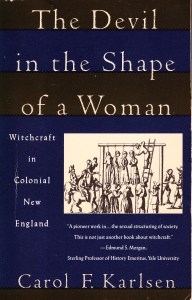
One of the more encouraging events of recent times took place on Tuesday. In elections across the country many public offices were won by women. After a year of official misogyny from the Comrade in Chief—it started long before the election, of course—I felt hope for the first time. You see, I’d been reading Carol F. Karlsen’s The Devil in the Shape of a Woman: Witchcraft in Colonial New England. I’ve been interested in witches as part of my general exploration of religious views of monstrosity, and in the Early Modern Period, witches were still lurking in the imagination of many. Karlsen’s book isn’t focused solely on Salem. There were other outbreaks of witchcraft accusations, and a general air of suspicion had hung over New England from its founding.

Why women? Karlsen’s question haunts much of human history. Why one gender, or gender construct, why one race, or racial construct, feels itself superior to others is an issue not easily resolved. It doesn’t come, necessarily, from being a “white” male, but it is a disease that primarily effects that demographic. It’s a myth of superiority. The Devil in the Shape of a Woman is not an easy book for a man to read. Centuries of bad behavior don’t exonerate those who, although their belief was sincere, found an outlet for their faith in the destruction of others. Karlsen demonstrates that quite often the background issues were those of inheritance—in a patriarchal society, land passed to male heirs. Women who owned property complicated a social picture that was already under stress. Consider: any family with two sons would halve (although the proportions were not equal) its land each generation. The only way to keep the wealthy wealthy was to snatch land wherever they could.

It wasn’t so simple as that, but the basic economics—which haven’t changed much—set colonial New England up for disaster. Birth control was considered evil. Men still had to be gratified, however, and population increased as land size remained the same. The system is untenable. Just a year ago the electoral college made love to an angry white man. A man who “owns” lots of “valuable” property. A man who demeans women and those of other “races.” When his own shady dealing come into the light he cries “witch hunt!” History is full of ironies. One of the greatest of them in the fact that women have been held back long after circumstances had advanced enough to allow equality in a stable society. There may still be witch hunts, but they flow in the direction they always have—toward those denied autonomy and civil rights. Maybe Tuesday was finally a sign of hope.


Guns and Ghosts

The irony of a nation that has gun laws made by those with body guards is especially cruel in the shadow of Sutherland Springs. Just a month after the worst mass shooting in United States history, another cohort of corpses receives only empty answers from DC. The solution to all the shooting deaths, 45 asserts, is more guns. This from the same White House that can find no credible alternative explanations for global warming, yet continues to break down any emissions barriers it can. The real noxious emissions are coming from the greedy mouths of the chicks in the feathered GOP nest. What is the word for what lies beyond insanity? We need it now.

Like many thinking people I’m very pleased with the results of the gubernatorial elections in New Jersey and Virginia. It seems, temporarily, as if reason has found its voice. The mistake at this point would be to relax and feel as if the job were done. We have raving lunacy at the national level, gun violence out of control, and politicians who just can’t live without NRA blood money. The story of Sarah Winchester’s ghosts may not be true, but it doesn’t have to be. We have a nation full of ghosts. Barely elected candidates claim a mandate to destroy the infrastructure that has allowed them to become rich. The wealthy, you’ll notice, are those who want to take all the marbles and go home. And they live in houses with guards to protect them from all the firearms they’re handing out like candy on Halloween.

Stop and think about this. The White House admits that climate change is human caused. The conclusions are quite dire for those who own property in New York City, let alone entire nations that will be underwater in a few years’ time. The response? Ignore the facts. Boast a bit more about how great we are. Give tax cuts to the wealthy and guns to the poor. Why doesn’t this equation add up? Pardon my jeremiad on what is the first hopeful morning a reasonable person has had in a long time. We have to start taking back local politics and let the national government know that it no longer speaks for the people that somewhat giddily gave it power just a year ago. Otherwise there are bound to be many more ghosts about. And one thing we know for certain, Washington doesn’t believe in ghosts.


Justice for All

One of the perks of working for a publisher is author talks. I’ve worked for three publishers now, and the last two have made great efforts to bring authors to their New York offices to present their work, in a kind of dry run, to those in the industry. When an author (whose book will eventually feature on this blog, so I don’t want to provide any spoilers just yet) was to speak on misogyny this week, I quickly signed up for a seat. Perhaps it’s a lack of imagination, but I could never understand how one human being could ever feel superior to another. As a child with no father around, my experience suggested that women were the strong ones. Yet when out in society I saw men always stepping in to take charge. What was wrong here?

I realize that I view life through male lenses. I’m also aware that gender isn’t nearly as definitive as we tend to think it is. Biology fits us with bits and pieces, and some of those constructed somewhat like me assume this gives them the right to dominate others. And they say we’re better than animals. Better at what, I ask? No, this isn’t about chauvinism—a man stepping in to support weaker women. This is about justice, plain and simple. We’re all born human. Humanity is nothing without those of both genders as well as those somewhere between. What should separate humankind from the vicissitudes of nature is the inherent commitment to fairness. Life is harsh and not all receive fair treatment. Do not listen to the narrative coming out of Washington, DC! The father of lies dwells there. And yes, I mean “father.”

We used to take pride in having climbed above the mere animals. We have constructed something that used to be known as democracy. Lawmakers, while fighting against women’s rights in word, nevertheless tacitly supported them at home. Now our government has declared open war on women. Men who have no idea what it is like to be viewed as and treated like an object every single day of their lives are making laws to punish those who do. I feel as though the sky is about to crack open and that blind principle we call justice is about to shout “Enough!” That’s not, however, the way that nature works. It is only when women are treated equally with men that we’ll ever be able to call ourselves civilized. Or even human. Until that day we’ll hunker down in our caves and await lawmakers who have any inkling at all of what fairness, what justice, even means.


News Pause

One of the benefits of “getting away from it all” is the blessed respite from news. Given the political situation these day I suppose that’s a rather risky proposition since the government is now based on presidential moods rather than any kind of policy or strategy. I worried as I got onto the plane home whether regulations might have changed when I was in the air and whether I’d be landing in the same country as the one from which I’d taken off. Maybe it was more than just time zones that we were changing. Being a child of the ‘60s I couldn’t help thinking about the Twilight Zone—getting onto a plane and then something happens. Quite a few episodes deal with that theme. Only now it’s real time. Real fear.

I have to wonder about the impact of constant news. Since November I’ve been obsessed with frequent updates—scanning headlines for any sign of hope that what began as a joke might have finally reached its punchline. Instead, the press has fallen into normalizing Trump, writing and reporting as if this is what happens in a democracy. It should be illegal to elect a dictator. It’s one of those logical conundrums, but it is a real one. Democracy shouldn’t be just those people who feel like they should getting out to vote. It should be a legal obligation. We know that if votes were counted straight up Trump could not have won the election. Since politicians like to play games we now live in the Twilight Zone of government. Every day Trump is allowed to remain in office the more credibility in government erodes. The knock-on effect will continue for years.

Since stepping off that plane I’ve been wondering what has changed over the past week. Has some basic fact of life been overturned by a presidential temper tantrum? Is what I’m doing now illegal? Has a horse been made a senator? Anything is possible. When I last paid attention it seemed we were well on our way to becoming the United States of Russia. I’m afraid to look at the headlines. The glow of getting away from it all hasn’t faded yet. It’s a hazy, dreamy reality that makes government seem like a bad dream. What would happen if they privatized air traffic control when I was in the air? The results are just to scary to contemplate. I think I need a vacation.


Prophets Paid

Photo credit: Cephas, Wikimedia Commons

Photo credit: Cephas, Wikimedia Commons

Prognostication used to be the remit of oversized rodents and individuals we’d now classify as mad. And news used to be stories about things that had already happened. Past tense things. I don’t read any daily newspapers—a personality flaw, I know—but I do read stories that are sent my way, even if it takes some time. One of the things I’ve noticed, particularly in this election year, is the amount of prediction that passes as news. Future tense reporting. And the future is very tense.

Always one to assume that others know more than I do, I consider the opinions of experts as more valid than my own. After all, they are paid for what they think. Nobody spends good money on amateur opinion, which is one of the cheapest resources available in the civilized world. So when I read the headlines about what to expect this fall I see that the prophets and anti-prophets are lined up along party lines and, if democracy holds up, we’ll find out which group is which, come November. This makes me wonder what life would’ve been like under biblical prophets. No, their job was not primarily foretelling—future prediction was a small percentage of their job description—but they occasionally made political predictions when the boss told them to. Some people think they were primarily concerned with a future political figure, even if Messiah isn’t exactly an elected position. Hoi polloi must have been in a state of high anxiety. Who’s right? We know that for every prophet, according to the laws of rhetoric, there must be an anti-prophet. If a message is coming from on high we don’t know from whom.

Long ago media moguls learned that anxiety sells papers. Or news broadcasts. Sales boom after disasters. Extra! Extra! Read all about it! I’ve seen it in movies and televisions shows, so I know it must be true. As if real life events don’t generate enough trauma, we speculate about a future that tends towards the bleak. What’s a polis to do? The dilemma hasn’t changed in the millennia since we’ve outgrown prophecy—there’s no way to know who’s right. It’s all speculation. As for me, I wonder what the local groundhog thinks. And while we’re at it, could we get a bit nicer weather for a while? I thought the prophecy was April showers bring May flowers, not the other way around. But then again, my opinion is a decidedly amateur one.