Foiled Again

Few things travel as well as curses. Or so it seems in a news report from Serbia. Archaeologists in Kostolac, according to The Guardian, have excavated skeletons nearly two millennia old. That’s not news, since people have been dying as long as there have been people. What makes the find extraordinary are the gold and silver metal foils that have been found at the gravesite. Inscribed in Aramaic with Greek letters, these tiny missives were rolled and placed in lead tubes to be buried with the dead. Although translations of the inscriptions aren’t given, the fact that they contain the names of demons would suggest these might be curses against anyone seeking to disturb the tombs. Such devices go all the way back to the Pharaohs, and perhaps earlier. Nobody likes to have their sleep disturbed.

Serbia, for those unfamiliar with geography, isn’t exactly next door to ancient Aram. The burials and inscriptions seem to fall into the Roman Period, however, a time of cultural diversity. When cultures come into contact—in the case of Rome and prior empires, through conquest—new ideas spread rapidly. And sometimes old ideas. The Romans, in general, didn’t like competing religions. Then again, their idea of religion was somewhat different than ours. Ancient belief systems were more or less run by the state. They served to support political ends—at least they were upfront about it. Your offerings and prayers were to be given in support of the king, or emperor, and beyond that nobody really cared. Unless, of course, you were making curses.

Curses, it was believed, really worked. Even today in cultures where belief in curses persists people tend to be physically susceptible to them. We don’t want others to wish us ill. Perhaps that’s the most surprising thing about politics today. Our society has taken a decided turn towards the more secular. Candidates for political office, even if they personally believe nothing, can still cast curses on those who are different. They can claim support of their “faith” to do so as well. Words, in ancient times, were performative. They meant something. Curses were taken seriously because if someone were serious enough to say it, they probably meant it. They could be written down and preserved beyond death. Today, however, words are a cheap commodity. You can use them to attain your personal ends and discard them once they’ve outlasted their usefulness. Perhaps we do have something to learn from the past after all.
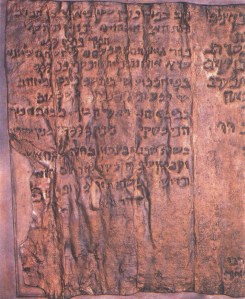
Copper scroll from Qumran, replica. Not a curse, just an illustration.

Copper scroll from Qumran, replica. Not a curse, just an illustration.


Ham Awry

Ham, in the movie Noah, is a conflicted figure. I felt a slight chill, I’ll have to admit, when the carnivore Tubal-Cain asked him his name, reminiscent as it is of pork. Of the sons of Noah he alone bears the impossibly stylish short hair his father seems to favor, and yet, he is one of four men alive and the only one without a mate. Japheth is young enough to wait for his twin nieces to grow up, and the ancestor of the Semites, Shem, has already begun his fruitful multiplication, just when humanity seemed at an evolutionary bottle-neck. Ham found a wife but couldn’t keep her. Noah leaves her to be trampled to death as he takes his son to the gentlemen’s club known as The Ark. The rain has already begun to fall.

In the Bible Ham gets short-shrift as well. Having seen Noah naked after he discovers alcoholism, Ham bears the brunt of his father’s wrath. Noah, perhaps still hungover, curses Ham’s son (not appearing in the movie), Canaan. From the biblical point of view, the reason is perfectly clear: when Israel arrived in the promised land, the Canaanites already lived there. Given that the promise was to Shem’s descendants, a genocide was ordered and probably the more liberal among the marauding Israelites felt a bit of guilt about that. No worries—like ethnic minorities in horror movies, the Canaanites were created to be killed. Ham, however, isn’t cursed for his voyeurism. Still, according to later interpretation, he is the ancestor of the Africans as well, and the “curse of Ham” was used for a biblically literate society as a justification of slavery. After all, Ham had had an eyeful, and it was only fitting, they reasoned, that his n-teenth-hundredth generation should suffer cruelly for it. How’s that for air-tight reasoning?

According to the movie, Ham decided to leave in voluntary exile. Perhaps he hoped that like Cain he might find an unlikely spouse in an unpopulated world. He had grown apart from the new Adam, welcoming Tubal-Cain aboard the ark, and keeping him hidden until Noah threatened to kill the future of all humankind. Strangely, it seems that Ham is the proximate cause of the salvation of all humanity, and he become a self-sacrificial scapegoat in the Icelandic scenery. He declares that his deceased chosen mate was good, and Noah had cursed her as well. In the Bible cursing is freely dispensed, and it is considered adequate to its task. Somehow that curse transmuted to a nobility in the film, for Ham is the most like Noah of all his children. And even today that self-same Bible is used to justify a genocide in a world where myth is taken for reality.

Noah doesn't like Ham

Noah doesn’t like Ham


NC-17

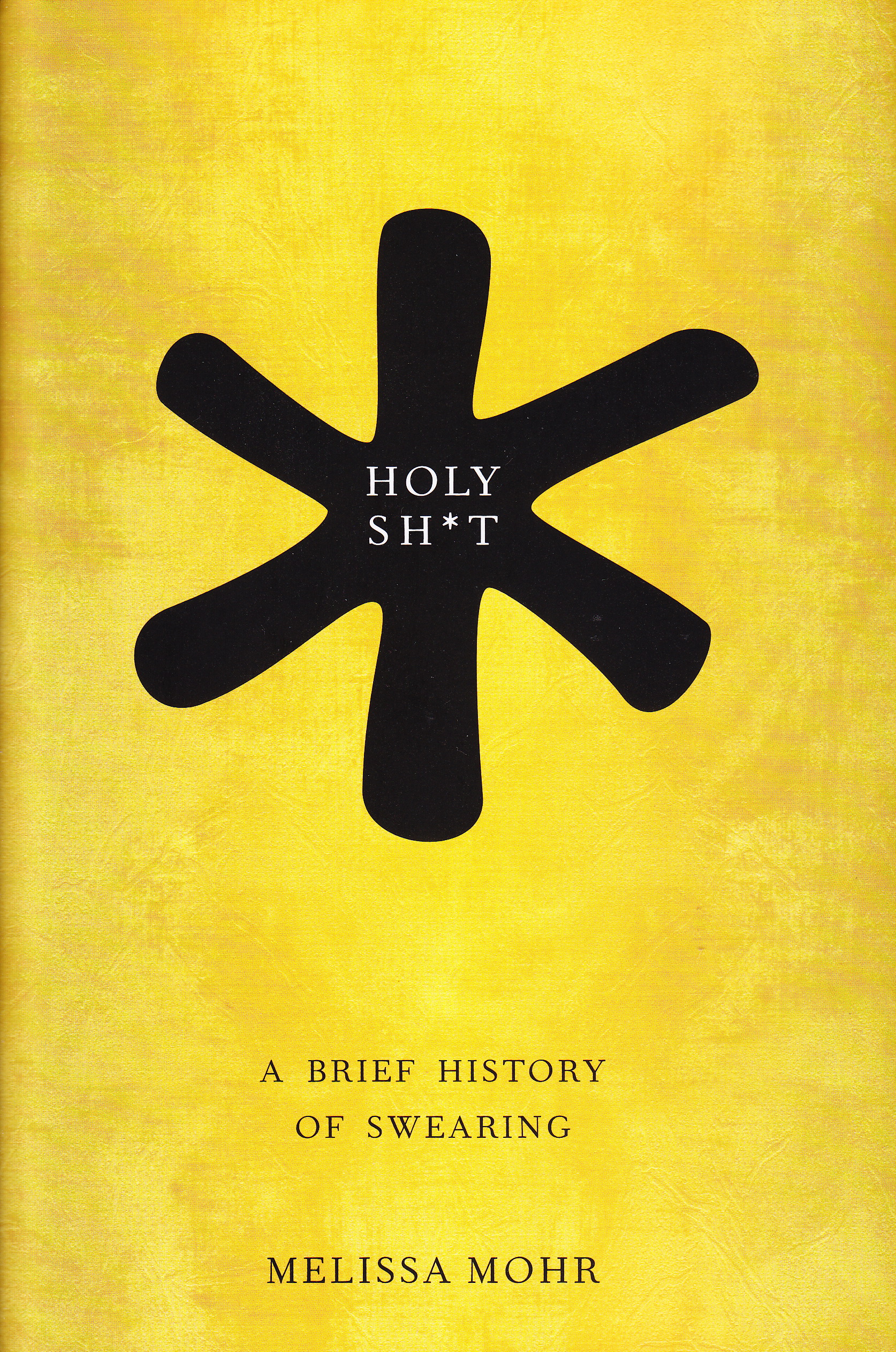
HolySh*tHoly Shit (in the philosophical mention sense, not the use sense), by Melissa Mohr, is a book I had intended to write. I’m glad Dr. Mohr beat me to it, however, since her treatment would be difficult to top. Few ideas are so arresting as the forbidden topics, and Mohr shows us that swearing occupies a compartment of the brain separate from regular speech, and it may even have therapeutic qualities. A Brief History of Swearing, to use the less offensive subtitle, is not an easy book to read in public. Since most of my reading time is spent in densely packed transit vehicles or waiting areas, I always wonder who might be reading over my shoulder. As a short guy that’s always an issue. Nevertheless, Mohr’s book is fun and informative, and I suspect I will read it again for all the information packed into it.

You see, Mohr uses both words of the title in a literal sense. Beginning with the Romans, but then stepping back to the Bible, clearly swearing has religious origins. While the Bible doesn’t prohibit coarse language in any direct sense, it does believe in oaths. Swearing oaths was serious business, and that seriousness led directly to the concept of swearing. Combine that with the idea of cursing (which the ancients also believed effective—ask Saint Peter) and you get the spectrum covered by the concept of “bad words.” (At least up until modern times.) Although I’ve studied religion my whole life, I was surprised how much I had to learn about the more earthy aspects of spoken sacred language.

As Mohr amply demonstrates, what counts as swearing changes with time. Giving the case of the Lindisfarne Gospels, she illustrates how a glossing priest causally dropped the equivalent of a medieval f-bomb right there on the pages of the holy Gospel. It wasn’t considered swearing at that historical moment in time (and besides, a fair amount of it goes on in the Bible). How far we’ve come. I recall one of my Nashotah House students telling me how he had to take a rather freely expressive classmate aside and tell him he was pretty sure that the f-word was an inappropriate adjective to use when referring to the Trinity. But now I see the wisdom of the ages at play. People use their most powerful words for what moves them most deeply. I doubt Mohr had quite that in mind, but if you read her delightful study you can find out what I may be full of after all.


I Swear it’s True

Spoon-fed the belief from youngest years that certain words are categorically bad, I find myself as an adult who daily plays with words wondering how this curious idea began. The taboo. The “badness” of select words can have nothing to do with the combination of sounds; one language’s swear word is another language’s polite invitation to dinner. It is the context of those sounds that constitute a swear, a cuss, a curse. Forbidden words. The sanctions against such words generally come from religious specialists who know the hidden power of human utterances. Even magic words trace their ancestry back to religious elocutions. In a report sure to be condemned by many religious groups, the journal NeuroReport has announced this week, according to the Los Angeles Times, that cussing makes you feel better.

In a controlled experiment involving ice water (shudder), participants who swore in response to the pain were found to have higher tolerance to discomfort compared to those who suffered in saintly silence. Those writing the report theorize that flight-or-fight response may be triggered by angry expostulation, giving cussing a survival advantage when used judiciously. I had previously read reports that suggested swear words, different for each language, were societally determined and were intended to freeze action (without ice water) in a similar way to a lion’s roar. Indeed, apart from those who habitually cuss, thus cheapening the effect, an inappropriate word is often enough to get the attention of a room full of people (not that I would know).

No matter what their psychological origins, taboo words exist in every culture. Whether they are intended to hurt or help is a matter of theoretical perspective. There is no question that these words possess the power to give pause. I am reminded of a former student who had gone on a missionary trip to a part of the world where Indo-European languages were not the norm. Introduced to a young Christian woman who had a name that sounded to English-speaking ears like his host (a bishop) was suggesting he commit an immoral act with himself, said student turned red with indignation. Months later, safely back in North America, he remained scandalized by the experience. In their context those sounds meant nothing inappropriate – so swearing is in the ears of the beholder. Before you decide to use this curative, however, be aware that the study reveals the best results in pain control apply to those who generally do not swear. Many of those I have worked with through the years would perhaps find a non-swear word far more helpful in stopping pain than their everyday vociferations.