Let It Be

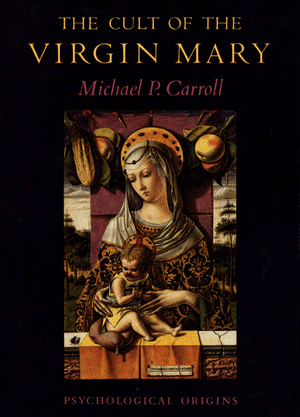
CultOfTheVirginMaryWhy do people pray to Mary? The question is a complex one and answers range from a desire to find some feminine compassion in an angry masculine god to the distinctly Freudian. Michael P. Carroll, in The Cult of the Virgin Mary: Psychological Origins, falls into the latter category. Yes, the book was written in the 1980s, but even then Oedipal complexes and penis envy were deeply suspect. Still, at various points along the way Carroll had me scratching my head and muttering “there may be something to this.” For a few pages, anyway. The problem begins much further back than Mary. To start with, we can’t all agree on what religion is. From there we move to the stage where ancient religions had as many goddesses as gods—even the divine don’t like to be lonely. The heads of most pantheons were male, which likely matched most earthly political systems. Powerful females still existed, at least in mythical realms. Monotheism effectively put an end to that, but before too terribly long, Mary emerged and eventually became almost a goddess.

Indeed, early on in his book Carroll discusses how Mary differs from the goddesses of antiquity, drawing parallels with only Cybele. Mary is the virgin mother completely dissociated from sexuality. Deeper study would reveal some mistakes in Carroll’s reasoning—there were virgin mother goddesses, such as Anat, who might in some ways fill in the gaps. Indeed, arguing for the uniqueness of Mary is kind of a goddesses-of-the-gaps theology. The more we learn the less unique any deity becomes. Still, looking to the psyche to explain Mary is a logical step. Tracing Marian devotion to the ineffective-father family, where a machoism hides a longing for the protective mother, Carroll offers us a Freudian feast of options here. Still, in the light of developments in psychology over the past quarter century, his premise is a bit dated.

We simply don’t know why Mary became such a strong devotional interest in a religion with a masculine Trinity. It would seem that women might be the motive force behind it. Given that half of Christendom was displaced, by default, from the male savior, why would Mary not emerge as the mother all people crave and whom, women know, often soften the harsh decrees of martial law? Delving into the apparitions of Mary from Our Lady of Guadalupe to Fatima and Medjugorje, Carroll finds illusions and hallucinations based on strong females behind each one. Rational inquiry into the deeply spiritual. This, however, remains the proximate cause only. What is really seen can’t be known, except to the seer. And it seems that seers tend to find, amid a religion with an omnipotent man at the top, that it is the mother who appears in times of need. Unless, of course, it is a matter of healthcare where, as government shows, father knows best.

Nun Such Luck

It hardly seems to be news anymore when the headlines read “Vatican orders crackdown on US nun association.” Religions are largely characterized as men telling women (and milquetoast men) what to do. Perhaps because of our evolutionary, simian respect for the alpha male, most followers will resist pointing out inequities in the system just to have a smoother ride. The all-male Vatican is reportedly worried about how nuns of the Leadership Conference of Women Religious might be distorting the masculine teachings of holy mother church. No matter how much science the Vatican supports, it just can’t get over the idea that when God is found out there he will have not only a human face, but a human penis as well. The Associated Press article states that the Congregation for the Doctrine of the Faith—that is the organization of the Inquisition, my dear readers—found grave errors of doctrine among the ladies. Sounds like time for an auto-da-fé, n’est-ce pas?

Somewhere on its long and weary trek, the control of fellow humans for the sake of God has slipped into the rut of control of fellow humans for the rush of power. The Catholic bishops are worried about abortion (and other healthcare options for women). The Bible says nothing about abortion, considering life to coincide with the first breath. The chosen people did not have a conception of how conception worked (you can’t see the sperm or ova without a microscope, no matter how divine they may be) and so life began and ended with breath. The only reason to push the origin of life to conception is so that men may control women’s sex lives. These decisions are made by sexless men who wear dresses behind inscrutable walls of power. When nuns start seeking fair treatment for women it quickly becomes heresy.

I don’t mean to single out the Roman Catholic Church here, since many religions proclaim male superiority—loudly or softly. Back in ancient times when goddess worship was taken as seriously as the cult of male gods, a few religions did exist that gave women a position equal to, or sometimes even above, men. The priests of Cybele, for instance, had to undergo ritual emasculation. Strangely, religions with celibate priesthoods today leave their men intact, perhaps as a loophole for sin. I wonder how much more women-friendly official theologies would be if only eunuchs were allowed to serve as pastors. It is, as Genesis famously states, sin that “is crouching at the door,” and therefore it is better to remain gendered and pray not to be led into temptation. Perhaps we have something to learn from history yet.


Patriarchalism or Party?

Father’s Day is a “holiday” I treat with great ambivalence. Having barely known my own father, I applaud those dads who devote enough time and energy to their kids to earn a day of recognition. On the other hand, in a society that continues to foster privileges for men in the market and labor worlds, I wonder if men need their own holiday. I suppose one must separate “father” from “men,” since the day is the celebration of an ideal rather than a gender.

“A good man is hard to find,” so the old saying goes. Maybe that’s why there was never a father’s day in the ancient world. Anyone reading the ancient myths, the way that many fathers behaved, well, it’s no wonder they weren’t celebrated! Cronos, in some traditions Cybele’s husband, actually ate his own children. Not much of a motivation for celebration there. Were the gods made in the image of the metaphorical fathers?

In the United States the first Father’s Day was observed in Fairmont, West Virginia in July 1908. It has been suggested that a mine disaster that had killed over 350 men nearby was the inspiration for the day. About two years later in Creston, Washington, Sonora Smatt Dodd celebrated her father who’d raised six kids mostly by himself. President Woodrow Wilson was famously celebrated by his own family, and President Calvin Coolidge proposed the holiday in 1924. An early supporter of Father’s Day was the politician William Jennings Bryan, famous for his stand on what he understood as family values. President Lyndon Johnson set the day as the third Sunday in June. Father’s Day only became official in 1972, under President Richard Nixon. Still, it seems to be a day established by men for men, smacking a little too much of the self-congratulatory.

Back before cell phones were invented, Father’s Day was the biggest day of the year for collect phone calls. Perhaps that phenomenon is the essence of the holiday. From those to whom more is given, more should be expected.


Holy May Days

The first few weeks of May are peppered with holidays, some religious, some secular. As my regular readers know, I’ve been working on a book about holidays for kids, so I showcase a few pieces on this blog, on occasion. Instead of providing several posts on May’s holidays, I’m combining the first three special days into a holiday compendium for early May.

May Day (May 1) is, in origin, a religious holiday. It is an ancient, pre-Christian Celtic holiday called Beltane, it celebrates fertility, and it is a day that workers throughout the world fight for fair treatment. Sometimes it is associated with Communism. So, where do we begin to unpack all that? To start with, May Day is a cross-quarter day (Groundhog Day and Halloween are two others). Cross-quarter days fall halfway between the solstices and equinoxes – the days that mark the change of seasons. Ancient Europeans believed that cross-quarter days allowed spirits of the dead and other supernatural beings into the human world, as can be seen in the Germanic Walpurgis Night (April 30-May 1). Although named after a saint (Walburga, d. Feb. 25, 779) Walpurgis Night has deep pre-Christian roots in northern Europe. It celebrates the coming of May, or summer, with huge bonfires lit at night. It Germany it was also called Witches’ Night (Hexennacht) because it was believed that witches gathered on Brocken mountain to await the coming of May. The Celtic May 1 is Beltane. For the Celts Beltane marked the start of summer and it was one of their two major holidays (the other comes around Halloween). Like the Germanic tribes, the Celts lit bonfires on Beltane. Druids would light two fires to purify those who would pass between them. In Ireland people would dress their windows and doors with May Boughs and would set up May Bushes. These were signs of the returning fertility of the earth. This tradition survives in parts of the United States in the form of the May Basket. May Baskets are filled with treats and are left at someone’s door. The tradition is to knock and run, but if you get caught, the gift recipient gets to kiss you! These days, however, an unexpected basket at the door is more likely to result in a call to the bomb squad, so let your sweetie know ahead of time if you plan to give a May Basket!

Today is Cinco de Mayo, and like most things Hispanic, it is misunderstood by many Angelos. Frequently Cinco de Mayo is represented as Mexico’s day of independence. What it actually commemorates, however, is a historic battle. Napoleon III’s French Army was in Mexico in 1862. These guys were in the state of Puebla where an outnumbered Mexican force under 33 year-old General Ignacio Zargoza actually beat them on May 5. In the States, Cinco de Mayo is becoming a day to showcase Mexican culture, kind of like St. Patrick’s Day is for Irish culture. The Battle of Puebla is not Mexico’s independence day – that falls on September 16 and often escapes notice in the United States.

And, of course, Sunday is Mother’s Day. People around the world celebrate their mothers at various times of the year, but many don’t realize that this holiday goes back to the ancient Near East. Cybele was an ancient goddess associated with all things motherly. Originally from the Levant, the Greeks and Romans believed her to have been from Turkey (Phrygia). She had a festival day at the vernal equinox. Although there is no direct connection with the date or form of our Mother’s Day, it is possible that this annual recognition of an exceptional mother gave people the idea for Mother’s Day. Whatever it ancient origins may have been, Mother’s Day as we know it started in the United States as a protest against the Civil War. Many women believed war to be wrong. During the Civil War Anna Jarvis organized Mothers’ Work Days (as if they didn’t already have enough to do!) to improve sanitation for both armies. Julia Ward Howe wrote the Mother’s Day Proclamation, which was a document calling for the end of the war. The idea was to unite women in protest and bring the conflict to a close. After the war ended Anna Jarvis’ daughter (who had the same name as her mother) campaigned for a memorial day for women. Because of her efforts, a Mother’s Day was celebrated in Grafton, West Virginia in 1908. After that various states began to observe Mother’s Day, and President Woodrow Wilson made it a national holiday in 1914, ironically the year the First World War began. It is celebrated on the second Sunday in May.

For whatever spirits, political ideals, or goddesses you admire, May is the appropriate time to celebrate.


A Sigh for Cybele

As we fall out of the holiday season into that distinctly chilly and sometimes cheerless February, Cybele comes to mind. Over the past several weeks I have added posts focused on the holidays associated with December and January. In the course of my research for a children’s book on American holidays (not published), I was astonished at how frequently Cybele appeared among the origins of current holiday practices. Having researched ancient Near Eastern mythology long enough to complete a doctorate in the field, and to write a book on an ancient goddess (Asherah), the lack of reference to Cybele in my sources was unexpected. I pushed this question mark to the back of my mind, but as I was reading H. P. Lovecraft’s story “The Rats in the Walls,” I found Cybele once again.

Cybele eventually became a major Roman goddess, although she was never among the Greek Olympians. Her importance shows in her connections with several Roman festivals and practices of antiquity, some of which have survived even to the present. Greco-Roman adherents to Cybele worship considered her to have been of Phrygian origin. Many scholars, however, see in her name and character echoes of a Semitic goddess named after Gebal, or the native name for Byblos in Phoenicia. If so, she is one further piece of the puzzle connecting the classical world with that of the fertile crescent.

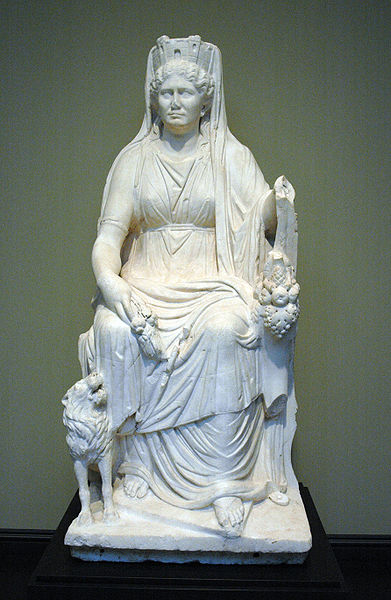
Wikipedia Commons Cybele

A standard title for Cybele was Magna Mater, or “great mother.” As such, she was frequently associated with the earth itself, widely considered to have been a primordial female deity in the ancient Near East. In many respects she resembles Asherah, although the two are never explicitly identified. In myths where she is associated with Atys (later Attis), she becomes the spouse of a “dying and rising god.” She is prominent in festivals around mid-March, at the time of the renewal of fertility in the Mediterranean basin. Matronly, stolid, and powerful, Cybele lurks in the background of religious sensibilities. Her association with spring offers something to look forward to as the overly long, yet short, month of February starts to become visible.