
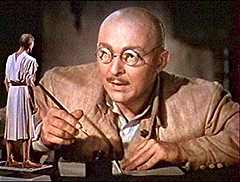
You can probably tell, if you read me regularly, that I’ve been going through an older movie kick. A lot of these are easier to find for free on streaming services, so that’s been the path of least resistance. So it was that I came to watch Doctor Cyclops. I’d completely forgotten that I’d watched it about fourteen years ago. In any case, a kind of precursor to The Incredible Shrinking Man, it’s the story of the deliberate shrinking of five people by a mad scientist with an endless supply of radium at hand. The movie made a splash because of the use of Technicolor in a horror film (with no blood, however). The story is a touch dull and the shrunken people (three scientists among them) spend most of their down time running around and saying very little. They do face an alligator, which is kind of fun, and the big hand that holds the pompous Dr. Bulfinch is distinctly unnerving. The movie received an Oscar nomination for visual effects.

There’s something distinctly enjoyable about these early sci-fi horror films that don’t explain much but nevertheless manage to employ some impressive cinematography. The use of oversized props and forced perspective make much of this possible, perhaps making up for the simplicity of the tale. Even by 1940 the “scientist goes mad and must be stopped” narrative was getting old. The Second World War was underway but nuclear power wasn’t yet harnessed either for bombs or energy. Interestingly, the source of the mad doctor’s radium is pitchblende, which one of the characters notes, is a source of uranium. Of course, many movies were to follow where radiation mutated life forms in various ways, including shrinking them.
Coincidentally—it was a rainy Sunday afternoon—I watched the Twilight Zone episode “The Little People” later in the day. Here was another story about the large oppressing the small. This one, however, has a stranded astronaut who discovers the little people thinking that he is their god because he has the power to harm them. The message here is much more profound, even if told with more brevity. No clear motive is given for Dr. Cyclops’ work beyond his interest in pure science. By the way, his real name isn’t “Cyclops.” That refers to his being a giant with one eye—the latter because one of his glasses lenses gets broken. Don’t worry, the shrunken people learn that the effect is temporary—their brush with radioactivity leaves no lasting harm. There is, however, a decided danger to desiring to return to a “simpler time,” as Mr. Serling steps in to remind us.
 Steve A. Wiggins